
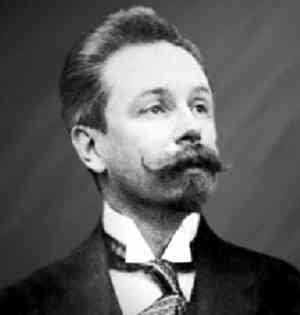
Alexander Scriabin
Source: Music With Ease
Alexander Scriabin is among composers dubbed an Impressionist Romantic. Yet what impressionistic manner that exists in Scriabin's composing is minor in importance compared to such as for which he became better known as his career progressed. An important note, however, before traveling too far: The Scriabin Association (scriabin-association.com) is (was) an essential authority for Scriabin. Unfortunately it was offline at the time I wrote this article. Being unable to use the Scriabin Association in research makes this page incomplete and subject to correction throughout. What few references are made to the Association are from the VF History years ago, and which links may or may not connect.
Scriabin's compositions are divided into three periods, the first romantic and Chopinesque to about 1902 or 1903. His middle period spans to 1907-10 during which Scriabin experimented with chromatic dissonance toward the nigh complete atonality of his last period. Born into one of the humbler aristocratic families in Moscow on 6 January 1872, Scriabin's father was in the military until the death of Scriabin's mother when he was one year old, then a diplomat to Turkey, leaving Scriabin home to be raised by family. As a youngster Scriabin built pianos, conducted with other children, and performed puppet operas and plays. He also studied piano under Nikolai Zverev as a child heading for a career of piano-intensive composition. At age ten he entered the Second Moscow Cadet Corps, later studying at the Moscow Conservatory. Scriabin's Op 1 was 'Waltz' in F minor in 1886, in which is heard the delicacy of Chopin, his hero as a youth.
'Waltz' Op 1 in F minor Alexander Scriabin
Comp 1886 Pub in Moscow by Jurgenson 1893
Piano: Valery Kastelsky 1978
Scriabin graduated from the conservatory a notable pianist in 1892, then composed 'Piano Sonata No.1' in F minor the next year:
'Piano Sonata No.1' ('Sonatine') Op 6 in F minor Alexander Scriabin
Comp 1893 Pub in Leipzig by M.P. Belaieff 1895
Piano: Tsotne Tsotskhalashvili
Scriabin began performing in St. Petersburg in 1894. The only concerto he wrote was 'Piano Concerto' in F sharp minor Op 20 written in 1896, orchestrated in May of 1887 toward premiere in Odessa on 23 October 1897.
'Piano Concerto' Op 20 in F-sharp minor Alexander Scriabin
Comp 1893 Premiere 23 Oct 1897 in Odessa Pub in Leipzig by M.P. Belaieff 1895
Piano: Daniil Trifonov
Berliner Philharmoniker / Andris Nelsons
Berlin Philharmonic Hall 22 June 2019
Elijah Ho Hyperion IMSLP Kathryn Louderback Georg Predota Wikipedia
In the meantime Scriabin married pianist, Vera Ivanovna Isakovich, in August of 1897 with whom he then honeymooned in the Crimea prior to Vienna, then Paris. Back in Russia in 1898, Scriabin began to teach at the Moscow Conservatory that year. His 'Symphony No.1' in E major was premiered in Moscow in March 1901 by the RMS Orchestra with Vasily Safonov conducting. 'Symphony No.1' included a Finale that was a paean to art with a text by himself.
'Symphony No.1' Op 26 in E major Alexander Scriabin
Comp 1899-1900 Premiere 29 March 1901 in Moscow Pub in Leipzig by M.P. Belaieff 1900
Libretto: Scriabin
Moscow Conservatory Chamber Choir w the Russian National Orchestra / Mikhail Pletnev
Mezzo-soprano: Svetlana Shilova Tenor: Mikhail Gubsky
Elijah Ho Hyperion IMSLP Kathryn Louderback Georg Predota Wikipedia
Scriabin was at the height of his Romantic period when he wrote 'Symphony No.2' in C minor Op 29, that closing his first period. It saw performance on 12 January 1902 in St. Petersburg by the RMS Orchestra conducted by Anatoly Lyadov.
'Symphony No.2' Op 29 in C minor Alexander Scriabin
Comp 1901 Premiere 12 Jan 1902 in St. Petersburg Pub in Leipzig by M.P. Belaieff 1903
Symphonie Canadiana / Yondani Butt 1982
Scriabin's middle or second period in which he moves away from traditional form commences with 'Sonata No.4' in F sharp major Op 30 composed in 1903. In 1904 he moved to Switzerland where he composed 'Symphony No.3' ('The Divine Poem') in C minor Op 43 toward its premiere in Paris on 29 May 1905.
'Sonata No.4' Op 30 in F-sharp major Alexander Scriabin
Comp 1903 Pub in Leipzig by M.P. Belaieff 1904
Piano: Mikhail Pletnev
Fugue For Thought IMSLP Blair Johnston SF Symphony Wikipedia
'Symphony No.3' ('The Divine Poem') Op 43 in C minor Alexander Scriabin
Comp 1902-1904 Premiere 29 May 1905 in Paris Pub in Leipzig by M.P. Belaieff 1905
Radio Filharmonisch Orkest / Stanislav Kochanovsky
1 April 2022 at the TivoliVredenburg in Utrecht, Netherlands
BBC Music Magazine IMSLP Wikipedia
Scriabin is known to have developed an interest in the Theosophy of Helena Blavatsky by April of 1905, occult mysticism to become a major element in future works to the end of his career. Blavatsky had founded the Theosophical Society with Henry Olcott in New York City in 1875. Scriabin then toured to locations in Switzerland, Italy, France and Belgium before leaving to the United States in 1906, arriving to Hoboken, New Jersey, in December. Returning to Paris in 1907, he was back in Lausanne, Switzerland, the same year to write 'Sonata No.5' Op 53 toward the end of his second period, which counterpoint Agustín-Aquino & Mazzola have analyzed in relation to Scriabin's "mystic" or "Prometheus" chord while Soomi Song has examined the work's expressionistic elements [see also expressionism in music / Wikipedia]. 'Sonata No.5' was eventually published in 1910.
'Sonata No.5' Op 53 Alexander Scriabin
Comp 1907 Premiere 18 Nov 1908 Pub 1908 (?)
Piano: Mikhail Pletnev
Vich Boonrod Derrick's Blog Robert Greenberg IMSLP Blair Johnston Timothy Judd
Piano Street Score Score Score Marie H. Sirois Wikipedia
Scriabin's wife was pregnant as he wrote 'Sonata No.5', to give birth to a son named Julian in February 1908, all to reside in Brussels before returning to Russia permanently in 1909. In the meantime Scriabin had recorded a strong selection of his own compositions to fourteen piano rolls for Ludwig Hupfeld (Triphonola) in Leipzig in January of 1908, including movements from 'Piano Sonata No.2' Op 19 and 'Piano Sonata No.3' in F# minor Op 23, the latter on Hupfeld 54037 and 54038.
'Sonata No.3' Op 23 Alexander Scriabin
1 of 14 piano rolls recorded for Hupfeld in 1907
Scriabin's 'Symphony No.4' ('Poem of Ecstasy') Op 54 had premiered at Carnegie Hall in New York on 10 December 1908 with Modest Altschuler conducting for the Russian Symphony Society of New York. Scriabin had begun writing his fourth symphony back in 1905, now completing it near the beginning of his third period in which he employs his mystic chord toward the dissonant harmony and tonal ambiguity that would find full expression in his next symphony, 'Prometheus', thus also called the "Prometheus" chord.
'Symphony No.4' ('The Poem of Ecstasy') Op 54 in C minor Alexander Scriabin
Comp 1905-1908 Premiere 10 Dec 1908 at Carnegie Hall in NYC Pub 1908
Frankfurt Radio Symphony / Alain Altinoglu 17 Oct 2022
Marin Alsop Calvin Dotsey Andrew Huth IMSLP Blair Johnston Georg Predota Wikipedia
In February 1910 Scriabin was back to making piano rolls, now a total of nine for Welte-Mignon & Sohne [Wikipedia] in Moscow]. Piano rolls by Scriabin also saw issue by license from Hupfeld or Welte-Mignon on the De Luxe, Ampico and Duo-Art labels. Making piano rolls was a lot of tinkering about compared to 'Prometheus: The Poem of Fire' Op 60, his ultimate complete symphonic work for which he is probably best-known. That premiered in Moscow on 2 March 1911 with conducting by Serge Koussevitzky. 'Prometheus' was a whole burgeoning of several of the conceptual and musical elements important to Scriabin's development up to that time, one of which was the employment of his mystic chord to become known as the Prometheus chord with this work. Igor Bèlza referred to it as a "pleroma" chord, translated to the vicinity of "divinely full" or "fully divine" ("complete" or "totality" of divine powers). Another development was Scriabin's color wheel corresponding to the circle of fifths, derived in the opposite direction of synesthesia. That is, rather than seeing sound in colors as a clinical synaesthete, he mapped colors to tones in the broader sense that some may use "synesthesia" or "synesthetic" to mean a correlation between two or more senses like vision and sound that isn't necessarily neurological or involuntary. Scriabin's fascination with light saw the arrival of 'Prometheus' with a clavier à lumières, that is, a keyboard with colored keys corresponding to the circle of fifths wrapped up with his mystic chord. As Scriabin imagined 'Prometheus' as a symphony of both sound and light, it was performed with colored lighting for the first time at Carnegie Hall on 21 March 1915 with Marguerite Volavy on piano, more recently in 2010 with the assistance of lighting designer, Justin Townsend, and music theorist, Anna Gawboy with Toshiyuki Shimada conducting the Yale Symphony Orchestra.
Nine piano rolls recorded by Alexander Scriabin for Welte-Mignon & Sohne in 1910
'Symphony No.5' ('Prometheus' aka 'The Poem of Fire') Op 60 Alexander Scriabin
Comp 1910 (?) Premiere 2 March 1911 in Mocow Pub 1911
Yale Symphony Orchestra / Toshiyuki Shimada
Royal S. Brown LA Phil IMSLP Lighting Wikipedia
Scriabin's mystic chord is used in his 'Three Etudes' of 1912 as well. The mystic chord is also employed in Scriabin's last assigned Opus, 'Five Preludes' Op 74 composed in 1914.
'Three Etudes' Op 65 Alexander Scriabin
Comp 1912 Premiere 2 March 1911 in Mocow Pub summer 1912
Piano: Alexey Chernov
Arthur Rubinstein Piano Master Competition in Tel Aviv May 2011
Lana Forman John Keillor IMSLP Kuo-Ying Lee Piano World
'Five Preludes' Op 74 Alexander Scriabin
Comp 1914 Pub 1915
Piano: Emil Gilels
Chia-Lun Chang IMSLP Blair Johnston Simon Nicholls Wikipedia
While in London in 1914 Scriabin developed a sore on his upper lip resulting in septicemia, killing him the next year in Moscow on 27 April 1915. He had left his 'Prefatory Action' begun in 1903 unfinished in 72 pages of 53 sketches, which Alexander Nemtin spent 26 years, beginning in 1970, working into a performable version. Portioned into three parts titled 'Universe', 'Mankind' and 'Transfiguration', 'Universe' saw its first recording in 1973 with conducting by Kiril Kondrashin. 'Mankind' was finished in 1976, but 'Transfiguration' required of Nemtin another twenty years. 'Prefatory Action' was Scriabin's cantata "Prelude" to a greater speculative work called 'Mysterium'. Some use 'Prefatory Action' ('Preparation for the Final Mystery') and 'Mysterium' interchangeably, but Scriabin envisioned his 'Mysterium', not yet composed, to arrive with an apocalypse that would occur upon its performance at the base of the Himalayas in India, ushering in a new and improved humankind. The first actual performance of 'Prefatory Action' (not 'Mysterium' proper) at the foot of the Himalayas arrived at the Thikse Monastery in Tibet in 2015, 100 years after Scriabin's death. All in all, aside from such as German Beethoven, French Chopin and Hungarian Liszt, Scriabin is one more major composer via whom Russia would come to largely own the Romantic to Modern eras of classical music.
'Prefatory Action' ('Preparation for the Final Mystery') Alexander Scriabin
So-called "prelude" to 'Mysterium' yet to be composed
Comp begun 1903 Incomplete upon death in 1915
Finished by Alexander Nemtin in 3 parts:
'Universe' 1973 'Mankind' 1976 'Transfiguration' 1996
Hungarian Radio Choir / Belgian National Orchestra / Stanislav Kochanovsky
Piano: Alexander Ghindin Soprano: Nadezhda Gulitskaya
16 March 2018 in Brussels
See 'Mysterium' below
Sources & References for Alexander Scriabin:
Classical Net
Zoran Minderovic (All Music)
Simon Nicholls (Scriabin Association)
VF History (notes)
Audio of Scriabin: Corpora:
UbuWeb (piano by Daniel Kunin)
Audio of Scriabin: Individual: Chronological:
Waltz (Op 1 in F minor / 1886 / piano by Valentina Lisitsa)
Waltz (Op 1 in F minor/ 1886 / piano by Xiayin Wang)
Piano Sonata No.1 (Op 6 in F minor / 1893 / piano by Vladimir Ashkenazy)
Piano Sonata No.1 (Op 6 in F minor / 1893 / piano by Igor Zhukov)
Piano Concerto (Op 20 in F-sharp minor/ 1896 / piano by Daniil Trifonov / 2019)
Piano Sonata No.4 (Op 30 in F-sharp major / 1903 / piano by Jong Hai Park)
Piano Sonata No.4 (Op 30 in F-sharp major / 1903 / piano by Svetlana Smolina)
Eight Etudes (Op 42 / 1903 / piano by Vladimir Sofronitsky)
Symphony No.3 (Op 43 in C minor / 1905 / Philadelphia Orchestra w Riccardo Muti / 2015)
Three Etudes (Op 65 / 1912 / piano by Artem Abashev)
Three Etudes (Op 65 / 1912 / piano by John Campbell / 2009)
Helena Blavatsky (1831-91 / founder of the Theosophical Society:
Blavatsky Archives New World Encyclopedia Theosophy Wiki Wikipedia
Clavier à Lumières (keyboard of lights): Interlude Interlude Jim the Obscure Wikipedia
Compositions:
Classic Cat (by Opus)
IMSLP (alphabetical)
IMSLP (by Opus / WoO)
IMSLP (sonatas)
IMSLP (symphonies)
Klassika (by date / genre / Opus / title)
Rate Your Music (by genre)
Scriabin Association (by genre)
Wikipedia English (by date / genre / Opus / title)
Wikipedia English (by genre)
Wikipedia Español (by genre)
Wikipedia Français (by genre)
Wikipedia Français (sonatas)
Documentaries:
Alexander Scriabin: Towards the Light / Calculation and Ecstasy (directed by Oliver Becker / 1996):
CineFan Letterboxd MovieCat Nevix
Scriabin In the Himalayas (directed by Jarek Kotomski / 2022 of concert in 2015):
Iconography: Scriabin Association Wikimedia Commons
Lyrics / Texts: Emily Ezust (LiederNet)
Mysterium (imaginary work to which Prefatory Action is described as its prelude):
Mystic Chord / Pleroma Chord / Prometheus Chord: Tler Matthew Secor (alt) Anson Yeung
Recordings of Scriabin: Catalogs (see also Audio above):
45 Worlds Arkiv Discogs Music Brainz Scriabin Association
Recordings of Scriabin: Piano Rolls: Core (alt) Henle Pianola Reproducing Piano Roll Foundation
Recordings of Scriabin: Select:
The Complete Piano Sonatas (Marc-André Hamelin at piano / Hyperion / 1996)
The Composer As Pianist: His Recordings For M. Welte & Soehne: Moscow 1910 (Caswell Collection / Volume 5 / 2007)
Scores / Sheet Music:
Abe Books (vendor / Amazon subsidiary)
Musicalics (vendor)
Notenlager (vendor Europe)
Synesthesia (the experience of one sense as another):
Theosophical Societies:
Adyar (India)
Adyar (India / Wikipedia)
Pasadena (California)
Pasadena (California / Wikipedia)
Theosophy: Britannica New Advent Theosophy Wiki Wikipedia
Further Reading:
Eckart Altenmüller (Alexander Scriabin: his chronic right-hand pain and its impact on his piano compositions / 2015)
James M. Baker (Scriabin's Implicit Tonality / Dover / 2015) (alt)
Faubion Bowers (Scriabin Again and Again)
Maria Carlson (Fashionable Occultism: The World of Russian Composer Aleksandr Scriabin / Journal of the International Institute / Vol 7 No.3 / 2000)
Emily Chialin Chiang (Rubato and Climax Projection in Two Piano Sonatas by Scriabin / University of Toronto / 2013)
Juan Manuel Cisneros (Scriabin's Great Orchestral Works / 2000)
Documents / Facsimiles / Manuscripts
Anna Gawboy (“Oneness through the sharpening of contradictions”: Theosophical Polarity in Scriabin’s Late Harmonic Practice / Journal of Musicological Research / Vol 36 / 2017)
Arthur Eaglefield Hull (A Survey of the Piano Works of Scriabin / The Musical Quarterly / 1916)
IMDb (usage of Scriabin in film)
Vasilis Kallis (Principles of Pitch Organization in Scriabin’s Early Post-tonal Period: The Piano Miniatures / Society for Music Theory / Vol 14 No.3 / 2008)
Jesse Muñoz Jr. (A Shared Heritage: Cross-cultural Influence Between Polish and Russian Violin Repertoire / University of Maryland / 2021)
The Mystic Chord (Pleroma Chord / Prometheus Chord)
Geoffrey Norris (Alexander Scriabin: the innovation and audacity of the Russian composer / Gramophone / 2023)
Jeremy C. Nowak (Development of middle-period style in the preludes of Alexander Scriabin / 2015)
Papers (numerous by various)
Piano Rolls:
Lincoln Ballard / Matthew Bengtson (The Alexander Scriabin Companion / Rowman & Littlefield / 2017)
Anatole Leikin (The Performing Style of Alexander Scriabin / Taylor & Francis / 2016)
Tom Service (Scriabin: the agonies and the ecstasies / 2014)
Christopher Scheer (Painting Music: Enchanted Modernities / Utah Public Radio / 2014)
Yevgeny Sudbin (Scriabin: mystic, devil worshipper, erotic composer / BBC Music Magazine / 2025)
René Wadlow (Alexander Scriabin: Music of Ecstasy and Light / 2016)
Stephen Wigler (Scriabin Liner Notes)
Ursula Rehn Wolfman (Scriabin’s Color Symbolism in Music / 2016)
Bibliography:
James Baker (The Music of Alexander Scriabin / Yale University Press / 1986) (review)
Lincoln Ballard (Alexander Scriabin's Centenary Revival in Soviet Era Russia)
Lincoln Ballard (Defining Moments: Vicissitudes in Alexander Scriabin's Twentieth-Century Reception / 2010)
Lincoln Ballard (The Lost Golden Age of Scriabin's Early Posthumous Reception)
Faubion Bowers (Scriabin: A Biography / 1996)
Brad Damare (Music and Literature in Silver Age Russia: Mikhail Kuzmin and Alexander Scriabin / 2008)
Anatole Leikin (The Performing Style of Alexander Scriabin / Taylor & Francis / 2016) (review)
Georgian Peacher (Skryabin Mysterium / Xlibris Corporation LLC / 2004)
Peter Sabbagh (The Development of Harmony in Scriabin's Works / Universal Publishers / 2003)
Other Profiles:
Bobb Edwards (Find a Grave)
Encyclopædia Britannica (1922)
Wikipedia: Español Français Русская
Classical Main Menu Modern Recording
|
|