
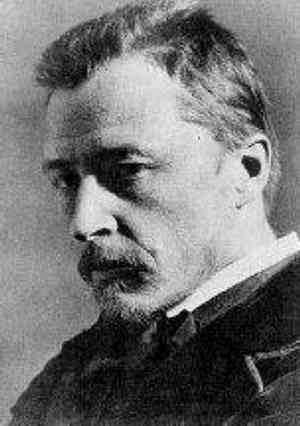
Hugo Wolf
Source: Wikipedia
Hugo Wolf was born on 13 March 1860 in Windischgrätz, Austria (now Slovenj Gradec, Slovenia). He began playing piano and violin at age four. Schooled locally until age 10, he left home for the Gymnasium at Graz in 1870, the Gymnasium at St. Paul in 1872 and at Marburg in 1874. His Op 1 is an unfinished sonata written circa 1875 while attending the latter Gymnasium, existing in fragments and so ignored that most catalogues don't bother to list it. His Op 2 was completed about the same time and yet exists, 'Variations' in C for piano. Wolf entered the Vienna Conservatory in 1875 where he met Wagner with whom he shared a strong distaste for Brahms. He wrote 'Traurige Wege' in January 1877 to text by Nikolaus Lenau.
'Variations' Op 2 Hugo Wolf 1875
Piano: Emese Virág
'Traurige Wege' ('Sad Pathways') Hugo Wolf
Completed Jan 1877 No.3 of 'Lieder aus der Jugendzeit' ('Songs From Youth') C 1878
Text by Nikolaus Lenau
Piano: Dido Keuning Tenor: Nico van der Meel
IMSLP Text Text Text Roger Vignoles
Wolf was expelled from the Conservatory in early 1877 for outspoken criticism. Upon getting the boot, he taught in Vienna and discovered benefactors permitting him more time to compose. Ernest Newman has Wolf writing 'Morgentau' ('Morning Dew') in June of 1877, that to go toward 'Sechs Lieder fur eine Frauenstimme' not published until 1888. In 1880 Wolf began work on the twenty songs of Joseph von Eichendorff in his 'Eichendorff-Lieder' (W 2) eventually published in 1889. Richard Stokes at Hyperion has Wolf composing 'Erwartung' No.18 and 'Die Nacht' No.19 as early as 1880, albeit IMSLP has all twenty songs written from 1886 to 1888. Classical Archives and Hyperion include several Eichendorf songs not belonging to Wolf's 'Eichendorff-Lieder'. One is 'Nachruf' ('In Memorium') composed in 1880.
'Morgentau' ('Morning Dew') Hugo Wolf
Completed June 1877
No.1 of 'Sechs Lieder fur eine Frauenstimme' ('Six Songs for a Female Voice') W 6/1
Text by Reinhold (?)
Piano: Gerald Moore Soprano: Elisabeth Schwarkopf
IMSLP John Palmer Text Text Text Text
'Nachruf' ('In Memorium') Hugo Wolf 1880
Text by Joseph von Eichendorff
Piano: Ammiel Bushakevitz Mezzo-soprano: Anna Lucia Richter
Wigmore Hall in London Oct 2021
Upon Wagner's death in 1883 Wolf found another composer to champion in Franz Liszt, meanwhile finding Anton Rubinstein utterly unpleasant. Wolf's censorious nature wouldn't serve him well when, after a brief term as second kapellmeister in Salzburg in 1882, he returned to Vienna to publish his first weekly review in the 'Wiener Salonblatt' in 1883. Wolf's gig with the 'Salonblatt' came to an end in 1887, his negative treatment of Brahms particularly unpopular. In the meantime Wolf's symphonic poem, 'Penthesilea', was finished and ready for premiere in 1885 by the Vienna Philharmonic to whom Wolf submitted it, though it was neither performed nor published in his lifetime. In Kleist's erotic yet violent version of the contest between Achilles and Penthesilea during the Trojan War, the Amazonian queen slays Achilles rather than the other way around.
'Penthesilea' (Amazon queen) W 16 in F minor Symphonic poem by Hugo Wolf
Comp 1883-85
NDR Symphony Orchestra / Winfried Zillig 1955
Adrian Corleonis Steve Dowden IMSLP Wikipedia English Wikipedia Français
Wolf early ceased attempting to assign opus numbers to his works. His Op 14 of 1876 was his last, an unfinished piano sonata in G minor. Beginning to write songbooks in 1886 would necessitate another system in which songbooks are assigned "W" numbers which refer to the 'Kritische Gesamtausgabe' ('Critical Complete Edition') by the International Hugo Wolf Society of Vienna, that project of 1956 to 1991 headed by Hans Jancik, from 1991 to 1998 by Leopold Spitzer [Wikipedia]. 'The Complete Edition' was published by the Musikwissenschaftlicher Verlag Wien (MVW) in 1998. Wolf's W 1 is assigned to the 53 pieces of 'Morike-Lieder' of Eduard Mörike that he composed in 1888-89. Wolf's W 2 that is 'Eichendorff-Lieder' of twenty pieces (above) would seem chronologically inconsistent, being earlier composed from 1886-1888 [IMSLP]. But it was published in 1889, probably following ''Morike-Lieder' also first published in 1889.
'Morike-Lieder' W 1 Hugo Wolf Pub 1889
Heft 4 No.51: 'Bei einer Trauung' ('At a Wedding')
Heft 4 No.49: 'Zur Warnung' ('Word of Warning')
Heft 4 No.53: 'Abschied' ('Farewell')
Baritone: Dietrich Fischer-Dieskau Piano: Hartmut Höll
Wolf's 'Goethe-Lieder' (W 3) of 51 songs by Johann Goethe was much composed alongside 'Morike-Lieder' about the same time toward publishing in 1889. Favored among Wolf's songs by Goethe are his four 'Mignon' with 'Mignon I-III' assigned to Nos. 5-7 and 'Mignon: Kennst du das Land?' assigned to No.9.
'Goethe-Lieder' W 3 Hugo Wolf
Comp C 1875 Pub 1889 Vienna by C. Lacom
No.5 'Mignon I': 'Heiß mich nicht reden' ('Do not bid me speak')
No.6 'Mignon II': 'Nur wer die Sehnsucht kennt' ('Only those who know longing')
No.7 'Mignon III': 'So laßt mich scheinen' ('So let me appearl')
No. 9 'Mignon': 'Kennst du das Land?' ('Do You Know the Land?')
Shawn Jaeger Score Text Text Text
Contralto: Helen Watts Piano: Geoffrey Parsons
In 1891 Wolf published his 'Spanisches Liederbuch' (W 4), a collection of 44 songs in two volumes written from October 1889 to April 1890 to 'Spanisches Liederbuch' by Paul Heyse and Emanuel Geibel published in 1852. 'Spanisches Liederbuch' is a collection of Spanish and Portuguese folk songs and poems by either known or anonymous authors. The initial ten of 'Spanisches Liederbuch' are geistliche lieder (sacred songs). The remaining 34 are weltliche lieder (secular songs). Wolf published this collection in 1891. The six songs recorded by Jessye Norman below are secular lieder.
'Spanisches Liederbuch' W 4 Hugo Wolf
Oct 1889-April 1890 to texts by Emanuel Geibel and Paul Heyse
'Weltliche Lieder' ('Secular Songs'):
No.36: 'Bedeckt mich mit Blumen' ('Cover me with flowers')
Geibel after María Doceo
No.33: 'Tief im Herzen trag' ich Pein' ('Deep in my heart I bear pain')
Geibel after Luiz Vaz de Camõens
No.26: 'Bitt' ihn, o Mutter' ('Pray for him, O Mother')
Heyse after Anonymous
No.12: 'In dem Schatten meiner Locken' ('In the shadow of my curls')
Heyse after Anonymous
No.31: 'Alle gingen, Herz, zur Ruh' ('All went, heart, to rest')
Geibel after Anonymous
No.44: 'Geh' Geliebter, geh jetzt!' ('Go, beloved, go now!')
Geibel after Anonymous
Soprano: Jessye Norman Piano: James Levine April 1990 in New York
Michael Stanley Durham Jr. IMSLP John Palmer Wikipedia
'Geistliche Lieder' ('Secular Songs') Nos.1-10: Texts Texts
'Weltliche Lieder' ('Secular Songs') Nos.11-44: Texts Texts
Wolf's 'Italienisches Liederbuch' (W 5) was written between September 1890 and December 1891 toward publishing in 1893, that a collection of 46 lieder documented by Heyse from Italian folk songs.
'Italienisches Liederbuch' W 5 Hugo Wolf
Nos.1-22 comp Sep1890-Dec 1891 Pub 1892
Nos.23-46 comp March 1896-Aug 1896 Pub 1896
Soprano: Pamela Coburn w pianist Helmut Deutsch
Baritone: Hermann Prey w pianist Thomas Leander
IMSLP Graham Johnson Texts Texts Wikipedia
Of the two operas that Wolf wrote he completed only the comedy, 'Der Corregidor', with libretto by Rosa Mayreder, that premiering at the Nationaltheater Mannheim on 7 June 1896. A corregidor is a provincial magistrate who represents Spanish royalty at a local level. In this story the corregidor is one Don Eugenio de Zuniga who has designs on Frasquita, wife of Lucas, the local miller. Wolf left his other opera, 'Manuel Venegas', unfinished in 1897, the same year he wrote his 'Michelangelo-Lieder' consisting of three songs written by Walter Heinrich Robert-Tornow after the painter, Michelangelo Buonarroti.
'Der Corregidor Suite' W 12 Comic opera by Hugo Wolf
Comp 1895 Premiere 7 June 1896 at the Nationaltheater in Mannheim Pub 1896 / 1904
Libretto: Rosa Mayreder (nee Obermayer)
L'Orchestre de la Suisse Romande / Horst Stein
'Michelangelo-Lieder' W 6/7 Hugo Wolf Comp 1897
Texts: Walter Heinrich Robert-Tornow after Michelangelo Buonarroti
No.1: ' Wohl denk ich oft an mein vergangnes Leben' ('I often think of my past life')
No.2: 'Alles endet, was entstehet' ('All must end that has beginning')
No.3: 'Fühlt meine Seele das ersehnte Licht' ('Does my soul feel the longed-for light')
Baritone: Dietrich Fischer-Dieskau Piano: Gerald Moore Berlin 1959
The songs of 'Michelangelo-Lieder' were Wolf's final compositions before being placed in a mental home in 1897. Released four months later in January of 1898, he attempted to drown himself the next October. At his own request he was that month committed to an asylum in Vienna where he died on 22 February 1903 of syphilis three weeks shy of his 43rd birthday.
Sources & References for Hugo Wolf:
Roger Dettmer (All Music)
Ernest Newman (Hugo Wolf / Methuen & Company / 1907) (alt)
Philadelphia Chamber Music Society
Programme (37th season of the Boston Symphony Orchestra / Harvard University / 1918)
Jure Rozman (The formation of a style: selected early works by Hugo Wolf / Louisiana State University / 2007)
VF History (notes)
Audio of Hugo Wolf: Corpora:
Classical Archives Europeana Hyperion Liber Liber Naxos Presto YouTube
Audio of Hugo Wolf: Individual:
Sechs Lieder fur eine Frauenstimme (Six Songs for a Female Voice / comp 1877-82 / piano: Sholto Kynoch / soprano: Lydia Teuscher)
Authorship / Correspondence: Letters to Melanie Kochert (University of Wisconsin Press / 1964)
Chronology: Hugo Wolf Museum
Collections: Austrian National Library
Compositions:
Classic Cat (by W)
Hugo Wolf Museum (by W)
IMSLP (alphabetical)
IMSLP (by date)
Klassika (by date / genre / Opus / title)
Barry Cooper (by Opus / Child Composers and Their Works / Bloomsbury Publishing / 2009)
Iconography: Wikimedia Commons
Lyrics / Texts: Emily Ezust (LiederNet) Oxford Lieder
Eichendorff-Lieder (W 2 / 1880-88 / pub 1889)
Recordings of Wolf: Catalogs (see also Audio above):
DAHR (1912-1949)
Recordings of Wolf: Select:
Aus Dem Italienischen Liederbuch (baritone: Dietrich Fischer / piano: Hertha Klust / Deutsche Grammophon Gesellschaft / 1951)
Italienisches Liederbuch (soprano: Diana Damrau / tenor: Jonas Kaufmann / piano: Helmut Deutsch / 2019)
Piano Music of Hugo Wolf (John Kersey / RDR CD89 / 2011)
Scores / Sheet Music:
Abe Books (vendor / Amazon subsidiary)
Musicalics (vendor)
Musikwissenschaftliche Verlag (Hugo Wolf Gesamtausgabe / vendor)
Notenlager (vendor / Europe)
Further Reading:
Ernst Decsey (Hugo Wolf / Schuster & Loeffler / 1903): Google Books HathiTrust
IMDb (usage of Wolf in film)
John C. Pierce (Wölferl's Own Howl: Musical Characterization in the Rollengedichte of Hugo Wolf / University of Connecticut / 2013)
Romain Rolland / Mary Blaiklock (Musicians of To-Day / Henry Holt and Company / 1915)
Edward Sand (The Development of the Song Literature of Hugo Wolf / Central Washington University / 1964)
Susan Youens (The Lieder of Hugo Wolf / Hampsong Foundation)
Bibliography:
Julien Bogousslavsky (Neurological Disorders in Famous Artists / Part 3 of 4 / Karger / 2010)
Amanda Glauert (Hugo Wolf and the Wagnerian Inheritance / Cambridge University Press / 2006)
Jon Paxman (Classical Music 1600-2000: A Chronology / Omnibus Press / 2014)
Heather Platt (Hugo Wolf and the Reception of Brahms's Lieder / Brahms Studies Vol 2 / 1998)
Frank Clifford Rose (Neurology of Music / Imperial College Press / 2010)
Eric Sams (The Songs of Hugo Wolf / Faber & Faber / 2011)
Joe Staines (The Rough Guide to Classical Music / Rough Guides Limited / 2010)
Authority Search: Libris Personensuche
Other Profiles:
Bobb Edwards (Find a Grave)
Britannica (1911)
Enciclopedia Italiana (1937)
Georg Predota (Interlude)
Wikipedia:
Classical Main Menu Modern Recording
|
|