
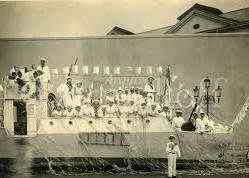
Carnival Float 1920
Source: Brazil Carnival
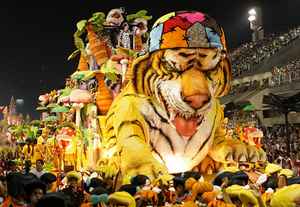
Carnival Float 2010
Photo: Reuters
Source: Eirinika
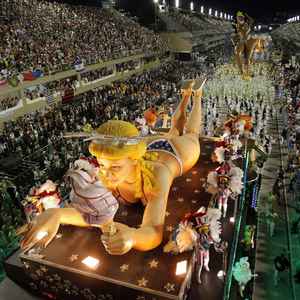
Carnival Float 2013
Photo: EPA / Antonio Lacerda
Source: Culture Town
Among the more significant events in the music of Brazil is the annual Carnival celebrated for four days and nights in early February. Its major element, the samba, was brought to Brazil from Africa via the slave trade. Some or other version of Carnival is celebrated throughout the world, such as in Germany, Venice and the Mardis Gras (Fat Tuesday) in New Orleans. Marlene Hufferd traces the roots of Carnival to to same Roman holiday at the roots of Christmas, Saturnalia, which Roman historian, Titus Livius (Livy), has beginning sometime in the 5th century BC. Saturn was the god of agriculture. Saturnailia became a weeklong festivity in 133-31 BC. Its connection to Carnival is via the Catholic practice of Lent [BBC / Britannica] officially recognized and placed into formal practice by the First Council of Nicaea in 325 AD, two years after Constantine pronounced Christianity to be the official religion of the Roman Empire, ten years after he had legalized it.
Enter "carne vale" which is "farewell to the meat" in Latin [MMOS
/ Kevin Roche]. Taken across the Atlantic by the Portuguese, the first known reference to Carnival in Brazil is traced to Rio de Janeiro (native residents known as Cariocas) as early as 1723 when costume and masquerade consisted of the poor donning the clothing of the higher class (royalty) while the latter exchanged their apparel for rags. Such developed into an event called the Entrudo, which was three days in which one might go outside and get hit with wax balls about the size of a lime or orange filled with water, perfume, urine or flour, the latter if you were black. It was a manner of practical joking or marking whom one liked, or whom one didn't, which caused enough fighting to eventually get the celebration outlawed.The first known Carnival masquerade ball was held by the aristocracy in 1840 where the price of attendance precluded trading garments with riffraff. It is said that circa 1848 that a shoemaker named Jose Nogueira de Azevedo began marching the streets on Carnival Monday in Portugal with a drum, tambourine and whistle, inviting who would to join him, including slaves (slavery abolished in Portugal in 1861, in Brazil in 1888). That account originates with José Vieira Fazenda in a publication of 1904. Legend (murky, various and disputable) has this introducing the traditional folk parade called Zé Pereira [Wikipedia] to make its way to Rio with Azevedo. Howsoever true or not, the aristocracy followed suit with another exclusive event in the parade of the Grand Societies (Grandes Sociedades) in 1855 during which some 80 costumed and masked participants promenaded the streets with the Emperor of Portugal in attendance.
Until the much later introduction of samba the music of Carnival consisted of such as was popular among the Carioca elite ranging from tangos, marches, mazurkas, polkas and waltzes to the fado and the maxixe. The first title written specifically for Carnival was a march (marcha) composed in 1899 by Chiquinha Gonzaga: 'O Abre Alas' ('Out of the Way'). Come the major spectacle that is the Carnival float in 1907 upon the invention of the automobile.
Sambas likely got recorded during the first decade of the 20th century in Rio, but remain unidentified. Geisa Fernandes has 'At Bahia' recorded in 1913, 'The Viola Is Hurt' in 1914, neither real popular. The first successful samba recording is considered to be 'Pelo Telefone' in 1916 on Odeon 121313, composed by Donga (Ernesto Maria dos Santos) and recorded by Banda Odeon. That was quickly followed in 1917 with a version by Bahiano (Manuel Pedro dos Santos).
'Pelo Telephone' Banda Odeon on Odeon 131313 1916
Composition: Donga (Ernesto Maria dos Santos)
'Pelo Telephone' Bahiano on Odeon 131322 1917
Composition: Donga (Ernesto Maria dos Santos)
Various Carnival Sambas 1919-20
The samba group, Portela, was formed in 1923. It would later become a prominent samba school. Samba schools are as elementary to Carnival as samba, as Carnival is a competition between them, Portela winning the most with 21 victories at the time of this writing. It was 1926 when the first samba school originated, Deixa Falar located near Praca Onze. Cartola founded his school, Mangueira, in 1928, the year of the initial samba school showdown at the home of Zé Espinguela where his school, Conjunto Oswaldo Cruz, whooped the other two schools in existence at the time, Deixa Falar and Mangueira. Those schools weren't at that time a part of Carnival or other street parades in other regions.
There were five samba schools in 1929, to multiply to 19 by 1932 when a journalist named Mario Filho organized the first Samba School Parade. The following year the Mayor of Rio made the beginning of Carnival official by handing a giant key to the city of silver and gold to King Momo, the Fat King, corresponding to the King of Misrule in Saternalia.
Carnival Rio 1939
Carnival Rio 1942
Carnival has since developed into a huge hours-long event requiring its own Sambadrome as of 1984 designed by architect, Oscar Niemeyer. There are currently about 200 samba schools from various towns in the region of Rio de Janeiro which populate the Carnival Parade usually held in February, the warmest month in Brazil. Large schools have wings within themselves and can parade more than 3000 performers, the top fourteen of which construct their floats in a huge warehouse called Cidade do Samba (Samba City). Though schools are typically from shantytowns, Carnival seating at the Sambadrome isn't for the poor, ranging from $55 to $3000 per ticket. The majority of five million Carnival revelers in 2012, however, weren't seated at the Sambadrome, half a million of which were foreigners. Find below some of the Carnivals documented in the last quarter century.
Carnival Rio 1999
Carnival Rio 2003
Carnival Rio 2004
Carnival Rio 2010
Carnival Rio 2015
Carnival São Paulo 2018
Carnival Rio 2020
Carnival Rio 2021
Carnival Rio 2022
Carnival Rio 2023
Carnival Rio 2024
Sources & References for Carnival Brazil:
Wagner de Almeida (Why 100 Years of Samba? / 2016)
VF History (notes)
Wikipedia (Brazil)
Wikipedia (Rio de Janeiro)
Carnival Costumes:
Sarah Brown (Culture Trip) David Sim (Newsweek / 2019)
Carnival History:
(Culture Trip)Carnival Present Day:
Ipanema Belajar KimiaDocumentaries:
National Geographic (2007)
The Sambadrome Marquês de Sapucaí (1984):
Arch Daily Rio Sambadrome Wikipedia
Samba Schools: Encyclopedia Wikipedia
Samba Schools History:
Carnival Bookers Carnival Bookers Rio Carnival
Samba Schools Present Day: Rio Carnival
Saturnalia (replaced by Carnival and Christmas):
Further Reading:
Vitor Padilha Mattos (Carnival and its founding myth / Universite do Minho / 2023)
Vitor Padilha Mattos (From Minho pilgrimages to Brazilian carnival: the trajectory of Zé Pereira in Rio de Janeiro (1850 – 1910) / Universite do Minho / 2023):
Bibliography:
Devin Denomme / Christopher Muscato (Carnival in Brazil | History, Traditions & Facts)
Umberto Eco / V. V. Ivanov / Monica Rector (Carnival! / Mouton Publishers / 2011)
Marlene Hufferd (Carnaval in Brazil, samba schools and African culture / Iowa State University / 2007)
Other Accounts of Carnival Brazil: