
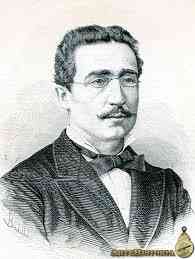
Ruperto Chapí
Source: Arte Historia
Born in Villena, Spain, on 27 March 1851 just like Vincent d'Indy, Ruperto Chapí began playing piccolo and composing at age nine. Like his most significant Spanish contemporary, Tomás Bretón, Chapí had composed largely operas (7 of them), numerous zarzuelas [Wikipedia] and orchestral works including symphonies. EcuRed has him writing the fantasy, 'A Day In the Woods', at age twelve (1863). He wrote his first zarzuela, 'La estrella del bosque', at age fifteen (1866), the same year that he began conducting in Alicante. Chapí began studies the next year at the Madrid Conservatory at age sixteen. A second zarzuela, 'Doble engaño', followed in 1868. Come the scherzo, 'Combate de Don Quijote', in 1869 before 'Abel y Cain' in 1871, the year prior to winning a scholarship to the Paris Conservatoire in 1872. Chapí's initial opera, 'Las Naves de Cortés' ('The Ships of Cortez'), premiered at the Teatro Real in Madrid on 19 April 1874 [score to Prelude].
'Combate de Don Quijote contra las ovejas' E major Scherzo by Ruperto Chapí
'Don Quijote's Fight Against the Sheep'
1869
Orquesta Sinfonica de RTVE Adrian Leaper
Chapí's long-lost second opera, 'La Muerte de Garcilaso', wasn't commercially performed but won him a scholarship from the Royal Spanish Academy of Fine Arts. Upon returning to Madrid to commence a highly successful professional career Chapí premiered his fourth opera, 'Roger de Flor', on 23 January 1878 at the Teatro Real in Madrid, that composed while in Rome with libretto by Mariano Capdepón Maseres. Roger de Flor (b c 1267) is a mercenary who lead the powerful Catalan Company into the service of the Byzantine Empire against the threat of the Ottoman Turk. He was assassinated in Turkey on 30 April 1305.
'Escenas de capa y espada' Symphonic poem by Ruperto Chapí
'Cloak and Dagger Scenes'
1876
OS de Radio Televisión Española Adrian Leaper
'La Muerte de Garcilaso' Second opera by Ruperto Chapí
'The Death of Garcilaso'
1876
Libretto by Antonio Arnao
Stage direction: Carlos Durán Conducting: Tulio Gagliardo Varas
Garcilaso de la Vega: Rafael Lledó
İzmir State Opera and Ballet 2020
Garcilaso de la Vega Foundation Informacion El Mundo Nuestra Zarzuela
'Symphony' D minor Ruperto Chapí
1877
Orquestra del Gran Teatre del Liceu Guerassim Voronkov
Prelude to 'Roger de Flor' Fourth opera by Ruperto Chapí
Premiere 23 Jan 1878 at the Teatro Real in Madrid
Orquestra del Gran Teatre del Liceu Guerassim Voronkov
Serenata from 'La Corte de Granada' aka 'Fantasía Morisca' Ruperto Chapí
Originally for military band 1879
Orquesta de la Comunidad de Madrid José Ramón Encinar
'En la playa' ('On the Beach') from '6 Melodias' No.2 of 6 D minor Ruperto Chapí
C 1879
Libretto: Miguel Ramos Carrión
Mezzo soprano: Laure de Marcellus Piano: Alberto Urroz
Chapí premiered his fifth opera, 'La Serenata' [IMSLP] with libretto by José Estremera, on 5 November 1881 at the Teatro Apolo in Madrid. The failure of that turned him away from opera, not to approach that form again for another score of years (c 1902). In the meantime he produced numerous zarzuelas such as 'El rey que rabió' ('The King Who Raged') at the Teatro de la Zarzuela in Madrid on 20 April 1891 with libretto by Miguel Ramos Carrión and Vital Aza. This comedy concerns the love affair of Rosa and her king complicated by one Jeremias who also loves Rosa although she doesn't return it.
Nocturne from Act II of 'El rey que rabió' ('The King Who Raged')
Comic Opera by Ruperto Chapí
Premiere 20 April 1891 at the Teatro de la Zarzuela in Madrid
Libretto: Miguel Ramos Carrión / Vital Aza
Camerata del Prado Tomas Garrido
Beckmesser IMSLP Wikipedia Zarzuela Net
Come Chapí's one-act zarzuela, 'El tambor de granaderos' ('The Drum of the Grenadiers') in 1894. This tale set in Spain concerns the love between Gaspar who faces death as a Bourbon loyalist and a wealthy Luz who faces life as a nun.
Preludio to 'El tambor de granaderos' ('The Grenadier Drum') Zarzuela by Ruperto Chapí
1894
Libretto: Emilio Sánchez Pastor
Voices for Peace Concert at the Monumental Theater in Madrid 21 Jan 2001
Fuente de Cantos Music Band Hollywood Bowl LA Phil Wikipedia
Chapí conducted 'Las Bravías' ('The Pigeons') at the Teatro Apolo on 12 December 1896 with libretto by Carlos Fernández Shaw and José López Silva borrowed from Shakespeare's 'The Taming of the Shrew' (1591-94). Seven rapidly written zarzuelas later 'La Revoltosa' arrived to the Apolo on 25 November 1897 with libretto again by Shaw and Silva. That became the subject of a silent film called 'The Troublemaker' directed by Florián Rey in 1924. Set in Chapí's Madrid, 'The Rebel' concerns the love between one Felipe and Mari Pepa.
'La Revoltosa' ('The Rebel') Zarzuela by Ruperto Chapí
Premiere 25 Nov 1897 at the Teatro Apolo in Madrid
Libretto: José López Silva / Carlos Fernández Shaw
Teatro Calderon in Madrid Jose Irastorza
IMSLP Wikipedia English Wikipedia Spanish Zarzuela Net
It had been 21 years since Chapí premiered his last opera in 1881 ('La Serenata' above) when his next, 'Circe', arrived to Madrid with libretto by Carrión (above) on 7 May of 1902. Among the eight zarzuelas given a date of 1902 at French Wikipedia, 'El Puñao de Rosas' ('A Bunch of Roses') premiered at the Teatro Apolo with libretto by Carlos Arniches on 30 October 1902.
'El Puñao de Rosas' ('A Bunch of Roses') Zarzuela by Ruperto Chapí
Premiere 30 Oct 1902 at the Teatro Apolo in Madrid
Libretto: Carlos Arniches
Rosario: Ana María Iriarte
Coro Cantores de Madrid / José Perera
Orquesta de Cámara de Madrid / Ataulfo Argenta
IMSLP Alejandro Mejías Moya Wikipedia English Wikipedia Spanish
'El Puñao de Rosas' ('A Bunch of Roses') Zarzuela by Ruperto Chapí
Premiere 30 Oct 1902 at the Teatro Apolo in Madrid
Libretto: Carlos Arniches
Rosario: Carmen Sinovas
Coro Cantores de Madrid / José Perera
Orquesta Filarmonica de España / Rafael Frühbeck de Burgos
IMSLP Alejandro Mejías Moya Wikipedia English Wikipedia Spanish
'El Puñao de Rosas' ('A Bunch of Roses') Zarzuela by Ruperto Chapí
Premiere 30 Oct 1902 at the Teatro Apolo in Madrid
Libretto: Carlos Arniches
Rosario: Dolores Pérez
Oquesta de Cámara de Madrid / Enrique Navarro
IMSLP Alejandro Mejías Moya Wikipedia English Wikipedia Spanish
Though the greater portion of Chapí's music was for theatre, he composed instrumentals as well, such as 'String Quartet No.1' in G in 1903. He followed that the next year with his four-movement 'String Quartet No.2' in F.
'String Quartet No.1' G major Ruperto Chapí
1903
For 2 violins / viola / cello
Arriaga Quartet:
Violin: Rodrigo Bauza / Adrien Jurkovic
Viola: Miguel Ángel Lucas
Cello: Damien Ventula
Allegro moderato of 'String Quartet No.2' Movement 1 of 4 F major Ruperto Chapí
1904
For 2 violins / viola / cello
Cuarteto Latinoamericano
Chapí premiered his last opera, 'Margarita la Tornera', at the Teatro Real on 24 February 1909, that with another libretto by Shaw, now based on a poem by José Zorrilla. It seems that Margarita who is a nun has been uncharacteristically seduced by an immoral Don Juan Alarcon. She is forgiven by a living statue of the Virgin Mary, but Don Juan is not, to be struck by lightning.
'Margarita la Tornera' Opera by Ruperto Chapí
Premiere 24 Feb 1909 at the Teatro Real in Madrid
Libretto: Carlos Fernández Shaw based on a poem by José Zorrilla
Coro de la Orquesta Sinfónica de Madrid
Orquesta Sinfónica de Madrid / Luis Antonio García Navarro
Opera Today Wikipedia Zarzuela Net
EcuRed lists a final zarzuela titled 'The Magic of Life' with a posthumous date of 1910, albeit Chapí died in Madrid on 25 March 1909, one month after the premiere of 'Margarita la Tornera'.
Sources & References for Ruperto Chapí:
Robert Cummings (All Music)
VF History (notes)
Audio of Chapí:
Classical Archives Europeana MuziekWeb
Naxos El Poder de La Palabra Presto
Compositions: Corpora: Chronological:
EcuRed (Spanish) Wikipedia French Wikipedia Spanish
Documents / Manuscripts: Gallica
Iconography: Wikimedia Commons
Libretti:
Circe / opera 1902 / Miguel Ramos Carrión: Google Books Internet Archive (scroll)
Las Naves de Cortés / first opera 1874 / Antonio Arnao: Filosofia
El Puñao de Rosas / zarzuela 1902 / Carlos Arniches Barrera / Ramón Asensio Más: Internet Archive (scroll)
Roger de Flor / opera 1878 / Mariano Capdepón Maseres: Internet Archive (scroll)
El Tambor de Granaderos / zarzuela 1894 / Emilio Sánchez Pastor: A Toda Zarzuela
Recordings of Chapí: Catalogs:
DAHR (shellac 1901-51) Discogs
Music Brainz Rate Your MusicRecordings of Chapí: Select:
Complete String Quartets (Brodsky Quartet / 2000)
Margarita la Tornera (Orquesta y Coro Sinfónica de Madrid / García Navarro / Elisabete Matos as Margarita/ 1999)
String Quartets 1 & 2 / Cuarteto Latinoamericano / 2014):
Sono LuminusScores / Sheet Music: Abe Books (vendor) Europeana IMSLP MusOpen
Further Reading: IMDb (usage of Chapí in film)
Bibliography: Christopher Webber (The Zarzuela Companion / Scarecrow Press / 2002)
Other Profiles:
Spanish:
Wikipedia International: Catalan French German Russian
Classical Main Menu Modern Recording
|
|