
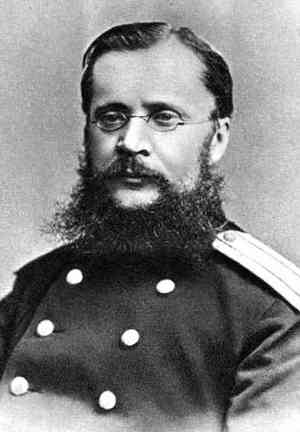
César Cui
Source: Fond a Grave
Born on 18 January 1835 in present-day Lithuania, César Cui composed operas, choral works and pieces for keyboard or voice along with works for chamber and orchestra. He had a French soldier in the Napoleonic army for a father, who had remained in Russia upon Napoleon's defeat in 1812. Cui began his own career in the military at age 16 upon entering the Chief Engineering School in Saint Petersburg. After further studies at what is presently the Military Engineering-Technical University, Cui entered the service as an instructor in fortifications in 1857. He would eventually attain the rank of general in 1906. But in 1856 he had met Mily Balakirev and begun composing. He had experimented with composition since a teenager, but now it became an intent and mature pursuit. Balakirev was beginning to shape what became known as The Five, a group of composers to which Cui belonged which interest was nationalistic Russian individuality in composition versus the conservatory-bred music of western Europe. Classical music had seen it's medieval apex in France, its early Renaissance in the Low Countries to full bloom in Italy, the Germanic in general at the wheel during the Baroque and Classical, and now Russia wanted to hog the Romantic minus Mozart.
Cui's first publicly performed composition was 'Scherzo 1' Op 1, a piano 4 hands composed in 1857 and published in 1859. He had begun his opera, 'Prisoner of the Caucasus' in 1857 though that wouldn't be finished until 1883 (below). Come Cui's incomplete 'Neuhausen Castle' in 1859 though 'The Mandarin's Son' privately premiered on 22 February that year in St. Petersburg. In this tale a Chinese innkeeper's daughter is attracted to the innkeeper's servant which doesn't please the innkeeper. Then the mandarin (imperial Chinese civil servant) arrives to discover that the innkeeper's servant is his lost son. All things Oriental are, of course, thematically romantic.
'Scherzo No.1' Op 1 F major Piano 4 hands by César Cui
Composed 1857 Published 1859
Dedicated to Malvina Bamberg whom Cui married in 1858
Piano: Leonid Schick / Tatjana Schick
Overture to 'The Mandarin's Son' Opera by César Cui
1st private performance: 22 Feb 1859 at the apartment of Cui's in-laws in St. Petersburg
Cui's wife as the innkeeper's daughter Mussorgsky as the mandarin
IMSLP dates this private performance on 6 March of 1859
(Russia switched from old style Julian calendar to the new style Gregorian in 1918)
1st public performance: Julian 7 Dec 1878 in St. Petersburg IMSLP: Gregorian 19 Dec 1878
Libretto: Viktor Krylov (1838–1906)
Radio-Sinfonieorchester Stuttgart des Südwestrundfunk (Southwest German Radio)
Conducting: Alfons Rischner
Cui wrote his first of nigh 800 articles in music criticism in 1864. It appeared in the 'Vedomosti' in Saint Petersburg, Russia's first newspaper established 1702-03. Cui also wrote some ten texts during his life concerning military fortifications. His next of seventeen operas (fourteen finished) was 'William Ratcliff' staged on 26 February 1869 at the Mariinsky Theatre in Saint Petersburg. The Mariinsky Theatre (pronounced Mary-inski) was only nine years old at the time, having held its grand opening on 2 April of 1860 with a performance of Mikhail Glinka's 'A Life for the Tsar'. 'William Ratcliff' concerns one Scottish Mary MacGregor who is promised to Earl Douglas although she really loves William Ratcliff whom she knew as a child. Ratcliff challenges Douglas to a duel during which he is wounded. He later loses his mind and murders both Mary and her father before killing himself, suicide also a frequent theme in romantic opera. Come 'Mlada' in 1872 which was a collaboration of acts divided between Cui, Alexander Borodin, Modest Mussorgsky and Rimsky-Korsakov that was never finished nor staged, nor to be confused with Rimsky-Korsakov's 'Mlada' of 1892. 'Angelo' arrived to the Mariinsky on 1 February 1876 with libretto by Viktor Burenin after Victor Hugo's 1835 play of the same name. Living in Padua in 1549, Angelo becomes involved in the tragic story of two women who love the same man named Rudolfo. At least one must die or it's not a romantic opera. Below, Rudolfo sings a sad love song to one of those women, Catarina, at her balcony.
'Rudolfo's Song' from Act II of 'Angelo' Opera by César Cui
Premiere 13 Feb 1876 at the Mariinsky Theatre in St. Petersburg
Libretto: Viktor Burenin after Victor Hugo's eponymous play of 1835
Tenor: Leonid Sobinov
It was 16 February of 1883 when Cui's 'Prisoner of the Caucasus' finally saw production at the Mariinsky, Cui having begun the first and third acts back in 1857. 'Prisoner' concerns a Russian captured by the Muslim leader, Kazenbek, with whom Kazenbek's daughter, Fatima, falls in love. All the worse, she is bound in marriage to one Abubeker. She helps her Russian love escape, then kills herself. It was also 1883 when Cui and Rimsky-Korsakov resigned from the Mariinsky Theatre selection committee due to its rejection of Mussorgsky's 'Khovanshchina'. On the other hand, 'Prisoner' was the first opera composed by a member of the Mighty Handful (The Five) to be performed in Western Europe when it was staged in Liege in 1866.
'Prisoner's Arioso' from Act I of 'Prisoner of the Caucasus' Opera by César Cui
Premiere 4 Feb 1883 at the Mariinsky Theatre in St. Petersburg
Libretto: Viktor Krylov after Alexander Pushkin's eponymous poem of 1822
Tenor: Leonid Sobinov
Works by Cui other than operas include 'Kaleidoscope' Op 50, a set of 24 pieces for violin and piano composed in 1893 toward publishing in 1894.
'Kaleidoscope' César Cui
1893 toward print 1894
Piano: Aaron Shorr Violin: Peter Sheppard
Cui's opera, 'Le Flibustier' ('The Pirate') premiered in Paris on 22 February 1894 with libretto by Jean Richepin. 'Le Flibustier' concerns the competition for the love of Janik between the pirate, Jacquemin, and the former pirate, Pierre.
Prelude to 'Le Flibustie' Opera by César Cui
Premiere 22 Feb 1894 at the Opéra-Comique in Paris
Slovak Radio Symphony Orchestra / Robert Stankovsky
From 1896 to 1904 Cui directed the Russian Musical Society, Russia's first public music school founded back in 1859. During that period he staged the operas 'The Saracen' in 1899 [IMSLP], 'Feast in Time of Plague' in 1901 and 'Mademoiselle Fifi' in 1903 [IMSLP]. He completed his '25 Preludes' Op 64 in 1904:
'Feast in Time of Plague' Opera by César Cui
Premiere 24 Nov 1901 at the New Theatre in Moscow
Libretto: Aleksandr Pushkin
Performance above:
Director: Toni Scharle Musical direrctor: Lucia Švecová
Oxford Opera Society / New Road Baptist Church in Oxford 9 May 2021
No.9 of '25 Preludes' Op 64 César Cui 1904
Piano: Margaret Fingerhut
No.10 of '25 Preludes' Op 64 César Cui 1904
Piano: Margaret Fingerhut
No.18 of '25 Preludes' Op 64 César Cui 1904
Piano: Miguel Ángel Barca Sancho
Cui staged four more operas after 'Mademoiselle Fifi' of 1904 : 'The Snow Bogatyr' for children in 1905 [IMSLP], 'Mateo Falcone' in 1907 [IMSLP], 'The Captain's Daughter' in 1911 [IMSLP] and 'Little Red Riding Hood' for children on an unknown date [Wikipedia]. His next to last opera was written for children and performed in 1913: 'Ivan the Fool' with libretto by Nadezhda Nikolaevna Dolomanova [IMSLP]. Ivan the Fool is a Russian folklore character whom the author(s) at Wikipedia relate to the modern blonde joke, such as: "If a brunette and a blonde fall off a skyscraper at the same time, which splatters first? . . . The brunette, since the blonde has to stop to ask for directions." Ivan, however, isn't so much the fool as that he but appears like one for his simple manner. As well, in 'Ivan the Fool' this peasant with a magical horse comes up with the Tsarevna's missing kerchief, thus to marry her. Come Cui's choral work, 'Песнь Пресвятыя Богородицы' written 'Pesn' Presvyatïya Bogoroditsï' ('Song of the Most Holy Theotokos' or 'Song of the Most Holy Mother of God') Op 93 of 1914. This Eastern Orthodox Magnificat is variously titled 'Magnificat Beata Virgine' or 'Velichit dusha moya Gospoda' ('My Soul Magnifies the Lord').
'Pesn' Presvyatïya Bogoroditsï' 'Song of the Most Holy Theotokos' Op 93 César Cui 1914
('Песнь Пресвятыя Богородицы')
Soprano: Maria Guimaraes
The Capella Duriensis at the Igreja do Marquês in Porto, Portugal 2013
'Puss in Boots' was Cui's final opera, a fairy tale for children staged in Rome in 1915 as 'Il gatto con gli stivali' [IMSLP / Wikipedia]. He began composing by dictation in 1916, becoming blind. His last assigned opus arrived that year, 'Petite Sonatine' Op 106 for keyboard. Cui died on 13 March 1918 in Petrograd nine months before the end of World War I.
Sources & References for César Cui:
Uncle Dave Lewis (All Music) VF History (notes) Wikipedia English
Audio of Cui: Classical Archives Internet Archive Naxos Presto
Authorship: Gallica
(digital copies) Wikipedia EnglishCompositions: Corpora:
IMSLP (by date / genre / opus)
IMSLP (operas)
Klassika (by date / genre / opus)
Lyel Neff (by opus)
Lyel Neff (operas)
Lyel Neff (operas)
Wikipedia English (by date / genre / opus)
Wikipedia English
The Five (The Mighty Handful: Balakirev / Cui / Mussorgsky / Rimsky-Korsakov / Borodin / 1856-70):
Austin M. Doub (Cedarville University / 2019)
Ella Uren (Northern Michigan University / 2020)
The Magnificat (Magnificant):
Dr. Stephen De Young Orthocath Orthodox Wiki Wikipedia
Mariinsky Theatre (St. Petersburg / grand opening 1860):
Mariinsky Theatre Saint-Petersburg Wikipedia English
Recordings of Cui: Catalogs:
45 Worlds Arkiv DAHR (shellac) Discogs Music Brainz RYM
Recordings of Cui: Select:
Cesar CUI: 25 Preludes, Op. 64 (piano by Jeffrey Biegel / 1992):
Scores / Sheet Music:
IMSLP Musicalics (vendor)Further Reading:
Lyle K. Neff (Story, Style, and Structure in the Operas of César Cui / 2002 / Indiana University)
Raymond T. Ryder (Russian Elements in Selected Piano Compositions by César Cui / 2001 / University of Arizona)
Other Profiles:
Bobb Edwards (Find a Grave)
George Predota (Interlude)
Classical Main Menu Modern Recording
|
|