
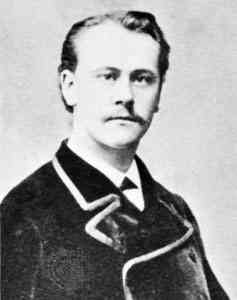
Henri Duparc
Source: Britannica
Born on 21 January 1848 in Paris, among Henri Duparc's first works were 'Six rêveries pour Piano' in 1863-65, printed but not published. As a severe judge of his own works, Duparc would destroy most of what he wrote, leaving behind fewer than forty compositions. He was a law student when he received instruction in piano and composition from César Franck. His Op 1 was a work of five pieces for piano called 'Feuilles volantes' ('Loose Leaves') which he dedicated to Franck circa 1869. His first surviving song collection, 'Cinq Melodies' Op 2, was composed in 1868, published circa 1869, the year a trip to Munich made a Wagner fan of him, though the two aren't alike. 'Cinq Melodies' included 'Soupir' as No.1 of five and 'Chanson Triste' ('Sad Song') in E flat major as No.4.
'Feuilles volantes' ('Loose Leaves') Op 1 Piano piece by Henri Duparc
Published c 1869
Piano: Esther
'Soupir' ('Sigh') Op 2 No.1 D minor Song by Henri Duparc
Composed c 1869
Libretto: Sully Prudhomme
Piano: Marc Durand Baritone: Bruno Laplante
'Chanson triste' ('Sad Song') Op 2 No.4 E-flat major Song by Henri Duparc
Composed 1868
Libretto: Henri Cazalis as Jean Lahor
Piano: Getacine Pegorim Mezzo-soprano: Esther Verheye
Helen Abbott IMSLP Indiana University Press Score Text Text Text
'L'invitation au voyage' C minor Song by Henri Duparc
Composed c 1870
Libretto: Charles Baudelaire
Piano: Paula Bär-Giese Soprano: Paula Bär-Giese
'La Vague et la Cloche' ('The Wave and the Bell') C minor Song by Henri Duparc
Composed c 1871
Libretto: François Coppée
Piano: Maria Fuller Baritone: Philippe Sly
In 1871 Duparc assisted in the founding of the Société Nationale de Musique in Paris with Romain Bussine and Camille Saint-Saëns. He composed his symphonic poem, 'Lenore', in 1873 toward publishing in 1874, that set to the ballad by Gottfried August Bürger.
'Lenore' C minor Symphonic poem by Henri Duparc
Premiere 5 May 1875 at the Société Nationale de Musique in Paris
Orchestre du Capitole de Toulouse Michel Plasson
In 1874 Duparc premiered his orchestral 'Poeme Nocturne' at the Société Nationale de Musique on 11 April, then later destroyed two of its three movements, leaving only its first, 'Aux Etoiles'. He later revised 'Aux Etoiles' for piano 4 hands in 1910, and for both orchestra and keyboard in 1911.
'Aux Etoiles' ('To the Stars') Nocturne by Henri Duparc
Composed 1874 Revised 1911
Orchestre du Capitole de Toulouse Michel Plasson
'Aux Etoiles' ('To the Stars') Nocturne by Henri Duparc
Composed 1874 Revised 1911
Piano: Phillip Sear
Duparc wrote 'Phidylé' in A flat major in 1882. He later revised 'Phidylé' for orchestra in 1891-92:
'Phidyle' A-flat major Song by Henri Duparc
Composed 1882 Revised for orchestra 1891-92
Libretto: Leconte de Lisle
Piano: William Vann Baritone: Njabulo Madlala
IMSLP Score Text Marianne Williams Tobias Wikipedia
'La Vie Antérieure' ('The Past Life') E-flat major Song by Henri Duparc
Composed 1884
Libretto: Charles Baudelaire
Piano: Jacqueline Bonneau Baritone: Gérard Souzay
IMSLP Text Georg Predota Wikipedia
Excepting seven later orchestral revisions of his melodies, Duparc abruptly quit composing altogether in 1885, perhaps for psychological reasons combined with neurasthenia. He hung out with his family and painted until eventually becoming blind toward the end of his life. Transcribing organ works by J.S. Bach in 1903 and César Franck in 1908 probably didn't help.
In 1912 Duparc published 'Souvenirs de la Société Nationale' in the December 1912 issue of 'Revue de la Société Internationale de Musique' [Princeton]. In December of 1922 he published 'César Franck pendant le Siège de Paris' ('César Franck During the Siege of Paris') in the 'Revue Musicale'. Duparc spent most of the latter years of his life in La Tour-de-Peilz, Switzerland, before dying in Mont-de-Marsan, France, on 12 February 1933.
Sources & References for Henri Duparc:
Robert Cummings (All Music)
Aryeh Oron (Bach Cantatas)
VF History (notes)
Audio of Henri Duparc:
Compositions: Corpora: Chronological:
Discussion: Talk Classical
Iconography: Wikimedia Commons
Lyrics: Lieder Net
Recordings of Duparc Catalogs:
DAHR (shellac 1913-49)
Recordings of Duparc: Select:
The Songs of Henri Duparc (Roger Vignoles at piano w mezzo-soprano Sarah Walker & baritone Sir Thomas Allen / 1989)
Scores / Sheet Music:
Abe Books (vendor) IMSLP Internet Archive
Musicalics (vendor) MusOpen Presto (vendor)
Further Reading:
(Spanish)IMDb (usage of Duparc in film)
Thomas MacGreevy (on the songs of Duparc / 1947)
Joseph Thirouin (Walk through the work of Henri Duparc / 2018)
Bibliography:
The Songs of Henri Duparc (Sydney Northcote / Read Books / 2011)
Authority Search: BNF Data
Other Profiles:
Musicologie (French)
Classical Main Menu Modern Recording
|
|