
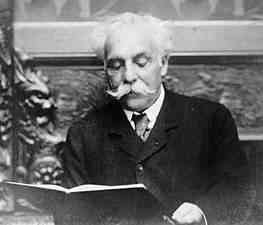
Gabriel Fauré
Source: Wikipedia
Born in Pamiers in southern France on 12 May 1845, Gabriel Fauré would write melodies that were the French response to the German lied. Though Fauré played organ for the Church continually during his career he composed nothing for that instrument, preferring piano. Fauré had a school master for a father who took him to Paris to study at the School of Classical and Religious Music (École Niedermeyer) upon receiving a scholarship at age nine. He there distinguished himself at organ, harmony, piano and composition until graduating at age twenty. The next year he assumed a position as organist at the Church of Saint-Sauveur in Rennes, Brittany, during which period he composed his Opus 1, 'Two Songs': 'Le papillon et la fleur' and 'Mai' from texts by Victor Hugo, the former first performed on 13 August of 1868.
'Mai' from 'Two Songs' Op 1 No.2 Song by Gabriel Fauré
Composed 1862? Premiere22 March 1873
Libretto: Victor Hugo
Piano: Joseph Middleton Soprano: Carolyn Sampson
Fauré was resigned from his job at the Church of Saint-Sauveur in 1870 upon showing up one Sunday to perform at Mass in evening clothes after having attended an overnight ball. His like of cigarettes was another mismatch with the Church. Georges Bizet and Rimsky-Korsakov were other composers who took up the stick about the time that cigarettes began to replace snuff. Since we're there, the first commercial cigarette operation in the United States was started in 1865, hand rolled in North Carolina. Cigarette manufacture became mechanized in 1881 upon the founding of the American Tobacco Company, releasing the world's first cigarette brand, 'Duke of Durham', packaged with baseball cards.
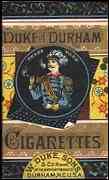
First Cigarette Brand 1892
Source: Jim's Burnt Offerings
Not long after leaving Saint-Sauveur in Rennes Fauré's career was further interrupted by the Franco-Prussian War of 1870-71. This conflict helped determine a relative decline in French power as Germany arose. These histories have seen not a few composers associated with the military such as Fauré's contemporary, Massenet, and warriors going back to Guillaume IX born in 1071 and Frederick II born in 1712. Fauré himself saw too much action upon volunteering in 1870 that made a no-nonsense soldier of him that couldn't but have had an enormous effect on him. Upon Prussia's victory and the subsequent Commune, Fauré fled to Switzerland where he taught at the École Niedermeyer, which school had also relocated from Paris. Able to return to Paris the next year, Fauré became choirmaster at the Église Saint-Sulpice. In 1874 he began working under Saint-Saëns at the Église de la Madeleine, eventually to take his place as organist. Fauré's 'Sonata No.1' in A major Op 13 saw performance on 27 January 1877. Also in 1877 Fauré wrote his version of 'Libera Me' which he later used in his 'Requiem' composed from 1887 to 1893. Fauré had first met Saint-Saëns as a teenager at the École Niedermeyer where Saint-Saëns had taught. Now, having worked together, Saint-Saëns took Fauré to Paris to meet Franz Liszt.
'Sonata No.1' Op 13 Gabriel Fauré
Premiere 27 Jan 1877
Violin: Stephen Waarts Piano: Gabriele Carcano
Juan March Foundation in Madrid 21 Oct 2018
IMSLP LA Phil Joseph Stevenson Wikipedia English Wikipedia French
'Libera Me' ('Free Me') Op 48 No.6 D minor Gabriel Fauré
1877 for baritone and organ Revised 1892-93 for choir and orchestra
Baritone: David Bizic
Choeur Accentus / Ensemble Orchestral de Paris / Laurence Equilbey
Festival de Saint-Denis Basilique Cathédrale 10 June 2010
In I878 Gabriel and André Messager, who had been his first student in Switzerland, went on a tour of Wagner operas in Germany. Though not alike as composers, Fauré was a Wagner fan. In 1883 he married, but the eighties were a stretch for him. While working at the Église de la Madeleine he earned no royalties selling songs for about 60 francs a piece ($12, worth about $240 today). It was at the Madelaine that Fauré premiered his 'Requiem' on 16 January 1888. Fauré's father had died in 1885, his mother following in 1887 after he had already begun this requiem. Fauré wrote the work for itself, however, not for anyone in particular. Matters financial improved upon a trip to Venice in 1890, then an appointment at the Paris Conservatoire as an inspector of provincial conservatoires, then as professor of composition in 1896. His students at the Madeleine had been amateurs, but now Fauré was teaching serious musicians such as Maurice Ravel.
'Requiem' Op 48 D minor Gabriel Fauré
Composed 1887-93 Premier 16 Jan 1888
1. Introït et Kyrie
2. Offertoire
3. Sanctus
4. Pie Jesu
5. Agnus Dei
6. Libera Me
7. In Paradisum
Voces8 w the English Chamber Orchestra conducted by Barnaby Smith
Choeur Accentus / Ensemble Orchestral de Paris / Laurence Equilbey
Orchestration: Taylor Scott Davis
Cadogan Hall in London 2021
Classictic Adrian Corleonis IMSLP IMSLP Wikipedia
'Cinq Mélodies' Op 58 Gabriel Fauré
1891 Libretti by Paul Verlaine
1. Mandoline
2. En Sourdine ('Softly')
3. Green
4. À Clymène
5. C'est l'extase ('It's Ecstacy')
Piano: Graham Johnson Soprano: Felicity Lott
'Dolly Suite' Op 56 Gabriel Fauré
Composed for piano 4 hands in 1892-94 Orchestrated by Henri Rabaud in 1905
1. Berceuse
2. Mi-a-ou
3. Jardin de Dolly
4. Kitty Valse
5. Tendresse
6. Pas espagnole
Orchestre National de France Cristian Măcelaru
Fauré performed the first of his cycle of ten songs, 'La chanson d'Ève' Op 95, on 18 March of 1898 at Bechstein Hall (Wigmore Hall) in London. Begun in June of 1896 with 'Crépuscule', the remainder were written toward publishing in January of 1910.
'La chanson d'Ève' ('Eve's Song') Op 95 Gabriel Fauré
Premiere of 'Crépuscule' 18 March 1898 The remainder composed 1906-10
Libretti: Charles van Lerberghe
1. Paradis
2. Prima verba ('First verb')
3. Roses ardentes ('Fiery roses')
4. Comme Dieu rayonne ('As God shines)
5. L'aube blanche ('The white dawn')
6. Eau vivante ('Living water')
7. Veilles-tu, ma senteur de soleil? ('Are you awake, my scent of sunshine?')
8. Dans un parfum de roses blanches ('In a scent of white roses')
9. Crépuscule ('Dusk')
10. O mort, poussière d'étoile ('O death, stardust')
Piano: Tristan Raës Tenor: Cyrille Dubois
Adrian Corleonis IMSLP Wikipedia
Fauré's lyric tragedy, 'Prométhée' Op 82, premiered at the Arènes de Béziers on 27 August 1900 with libretto by the symbolist poets Jean Lorrain and André-Ferdinand Hérold:
'Le Cortège de Pandore' from 'Prométhée' Op 82 Lyric tragedy by Gabriel Fauré
'Pandora's Procession' from 'Prometheus'
Premiere 27 Aug 1900 at Arènes de Béziers conducted by Fauré
Libretto: Jean Lorrain / André-Ferdinand Hérold
Gabriel Fauré Choir w the National Orchestra of the Monte-Carlo Opera
Conducted by Roger Norrington Soprano: Danielle Galland
Fauré had premiered his incidental music to Maeterlinck's symbolist 'Pelléas and Mélisande' at the Prince of Wales Theatre in London on 21 June 1898. Originally written for piano that May, it was orchestrated much in part by Charles Koechlin. Reworked as a 'Suite' in three parts, that was performed on 3 February 1901. A fourth part titled 'Sicilienne' as No.3 was added in 1903 (Potter) or 1905 (Bard), though not performed until 1912.
'Pelléas and Mélisande' Op 82 Suite by Gabriel Fauré
Originally incidental music premiering in London on 21 June 1898
Premiere of 'Suite' without 'Sicilienne' ('No.3') on 3 Feb 1901
'Sicilienne' composed c 1904
Premiere of 'Suite' with 'Sicilienne' ('No.3') in 1912
1. Prélude
2. La fileuse ('The Spinner')
3. Sicilienne
4. Mort de Mélisande ('Death of Mélisande')
Frankfurt Radio Symphony François Leleux 12 May 2017
Bard College Roger Dettmer Hollywood Bowl
IMSLP Timothy Judd Caroline Potter Wikipedia
'Pelléas and Mélisande' Op 82 Suite by Gabriel Fauré
Originally incidental music premiering in London on 21 June 1898
Premiere of 'Suite' without 'Sicilienne' ('No.3') on 3 Feb 1901
'Sicilienne' composed c 1904
Premiere of 'Suite' with 'Sicilienne' ('No.3') in 1912
1. Prélude
2. La fileuse ('The Spinner')
3. Sicilienne
4. Mort de Mélisande ('Death of Mélisande')
Orchestre Philharmonique de Radio France Mikko Franck 5 Oct 2018
Bard College Roger Dettmer Hollywood Bowl
IMSLP Timothy Judd Caroline Potter Wikipedia
From 1903 to 1921 Fauré wrote criticism for the newspaper, 'Le Figaro', the first national daily newspaper in France founded in 1826 [archives since 1854; presently]. In 1905 he succeeded Théodore Dubois as director of the Paris Conservatoire, the same year that he may have made his first piano rolls for Aeolian Metrostyle [Nectoux]. Nectoux estimates those to be 'Barcarolle No.3' in G flat Op 42 (65841), 'Pavane' in F sharp minor Op 50 (65303) and possibly 'Valse-Caprice' Op 62 No.4 (66531). No audio of those rolls is found but Fauré had published 'Barcarolle No.3' back in 1885 [Hyperion / IMSLP]. Originally wrtten for piano, Fauré had premiered the orchestral version of 'Pavane' [IMSLP] on 25 November 1888, three days before the choral version. 'Valse-Caprice No.4' in A flat Op 62 was published in 1894.
'Pavane' Op 50 Gabriel Fauré
Premiere 28 April 1888 in Paris w Fauré conducting
Libretto (choral version): Robert de Montesquiou
Radio Philharmonic Orchestra Peter Dijkstra in Utrecht, Netherlands 8 Nov 2019
Fauré was elected to the Institut de France in 1909. He then produced at least five piano rolls for Welte-mignon in 1912 or 1913 [Johnson / Pianola Institute]. One of those was No.3 in E-flat major from '3 Nocturnes' Op 33. Fauré devoted himself to eighteen nocturnes in all, writing his last as Op 119 in 1921. Another of Fauré's recordings was his second piano roll version of 'Pavane' on Welte 2772 [Listener's Club].
No.3 of '3 Nocturnes' Op 33 A-flat major Gabriel Fauré
1875 Revised 1881 / 1883
Piano: Michael Brown Fishtail, Montana 16 Sep 2017
Robert Cummings IMSLP Wikipedia
'Pavane' Op 50 Gabriel Fauré
Premiere 28 April 1888 in Paris w Fauré conducting
Libretto (choral version): Robert de Montesquiou
1913 for Welte Mignon Welte 2772
Fauré's sole opera, 'Pénélope', premiered at the Salle Garnier in Monte Carlo on 4 March 1913 with libretto by René Fauchois. Penelope is the wife of Ulysses, King of Ithaca, for whose return she has been faithfully waiting ten years. In the meantime she is besieged by suitors. In the process she claims she will marry whoever can draw Ulysses' bow. Of course, no one can. Which is too bad because Ulysses who has slipped into his palace as a beggar now takes his bow and shoots all of Penelope's suitors. Shepherds glad in Ulysses' return also help to slay Penelope's suitors before she and Ulysses are finally happily reunited.
'Pénélope' Op 50 Opera by Gabriel Fauré
Premiere 4 March 1913 at the Salle Garnier in Monte Carlo
Libretto: René Fauchois Certain sections orchestrated by Fernand Pécoud
Musical direction: Patrick Davin Mise en Scene: Olivier Py
Costumes: Pierre-Andre Weitz Lighting: Bertrand Kily
Pénélope: Anna Caterina Antonacci (soprano)
Ulysses: Marc Laho (tenor)
Opera National du Rhin in France 2015
Philharmonia Northwest John Rockwell Wikipedia
Fauré lived in France throughout World War I (7/28/1914-11/11/1918) with considerably less trouble than the action he'd seen during the Franco-Prussian War four to five decades earlier. Retiring from the Conservatoire in 1920, Fauré completed his final composition, 'String Quartet in E minor' Op 121, in September 1924. Dying less than two months later of pneumonia on 4 November of 1924 in Paris, this his only string quartet was performed and published posthumously in 1925.
'String Quartet' Op 121 E minor Final composition by Gabriel Fauré
Posthumous premiere 12 June 1925 at the Salle du Conservatoire
Ebène Quartet
Violin: Pierre Colombet / Gabriel La Magadure
Viola: Marie Chilemme Cello: Raphaël Merlin
Wissembourg Festival in France 27 Aug 2018
'String Quartet' Op 121 E minor Final composition by Gabriel Fauré
Posthumous premiere 12 June 1925 at the Salle du Conservatoire
Castalian String Quartet
Violin: Sini Simonen / Daniel Roberts
Viola: Charlotte Bonneton Cello: Christopher Graves
Wigmore Hall in London 30 Dec 2018
Sources & References for Gabriel Fauré:
Aryeh Oron (Bach Cantatas)
Rovi Staff (All Music)
VF History (notes)
Audio of Fauré: Corpora:
10 of Gabriel Fauré's Compositions in Honor of His Birthday (steemit)
Kunsterfuge (MIDI file downloads)
Music and Musings by Gabriel Fauré (Chamber Music Society 2019)
UCSB (cylinders 1910)
Audio of Fauré: Isolé:
Sonata No.1 (Op 13 / 1877 / by various)
String Quartet (Op 121 / E minor / 1924 / by various)
Compositions: Corpora:
Classic Cat (by opus)
Klassika (by date / genre / opus / title)
IMSLP (for chamber)
IMSLP (by date / force / opus / title)
IMSLP (for piano)
RYM (by genre)
Wikipedia English (for chamber)
Wikipedia English (choral: religious and secular)
Wikipedia English (by genre)
Wikipedia English (operas)
Wikipedia English (by opus)
Wikipedia English (orchestral)
Wikipedia English (for piano)
Wikipedia English (for piano and voice)
Wikipedia English (template)
Wikipedia French (by genre)
Documents / Manuscripts: Gallica
Franco-Prussian War (1870-71):
Iconography: Wikimedia Commons
Lyrics: LiederNet
Recordings of Fauré Catalogs:
45 Cat DAHR (shellac 1903-1950) Discogs Music Brainz
Scores / Sheet Music:
Abe Books (vendor)
Musicalics (vendor)
Further Reading:
IMDb (usage of Fauré in film)
Wikipedia (the piano music of Fauré)
Bibliography:
Graham Johnson (Gabriel Fauré: The Songs and Their Poets / Ashgate / 2009)
Jean-Michel Nectoux (Gabriel Fauré: A Musical Life / Cambridge U Press / 2004)
Charles Osborne (The Concert Song Companion: A Guide to the Classical Repertoire / Springer US / 2012)
Edward R. Phillips (Gabriel Fauré: A Guide to Research / Taylor & Francis / 2011)
Authority Search: BMLO BNF Data
Other Profiles:
Wikipedia International: Estonian French Norwegian Russian
Classical Main Menu Modern Recording
|
|