
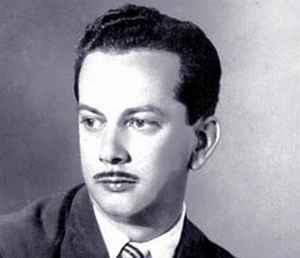
Garoto
Source: Zonacurva
Garoto (aka The Kid) was a guitarist born Anibal Augusto Sardinha on 28 June 1915 in Sao Paulo, Brazil. He was eleven when his violinist brother gave him a banjo, that the first of a variety of strings that he would learn to play. He trained in classical guitar and piano as well. His brother also christened him with "Molech de Banjo" for a stage name, but he settled for "Garoto" (Boy).
Garoto made first recordings in 1929 with his mentor, the singer, Paraguassu, not thought to have been released. The next year he began working in radio and recorded 'Bichinho-de-queijo' with 'Driblando'.
Among Garoto's compositions in the thirties were 'Sore' and 'Moreninha' in 1936, and 'Sobre o Mar' and 'Quinze de Julho' two years later. Accordion player, Arnaldo Meirelles, recorded two of his compositions in June of 1938, 'Suspirando' and 'Saudadas', for release on Victor 34441.
'Moreninha' Garoto (guitar)
1936 Columbia 8223-B
Composition: Garoto
Not until 1938 did Garoto move from Sao Paulo to Rio de Janeiro, the greater musical hub some 270 miles up the coast. He there formed a duet, Cordas Quentes (Hot Strings), to record with Laurindo Almeida. 'Dá-me tuas mãos' and 'Música, maestro, por favor' went down as duets on 12 September 1939 toward release on Victor 34516.
In 1939 Garoto headed for Uruguay, then joined Carmen Miranda in the United States. He worked with Miranda for eight months, including an engagement at the White House for President Roosevelt, then returned to Rio de Janeiro where, preceding bossa nova, he became master of the choro (pronounced "sho-ro") and chorinho (little choro).
The waltz had arrived to Rio de Janeiro in 1808 with Queen Maria I of Portugal, she in flight of the Napoleonic threat along with about 10,000 servants and citizens to make a new Lisbon of Rio [Wikipedia]. Royalty would return to Lisbon in 1820 before the polka found its way to Rio in 1845. In the meantime slaves in Brazil had long since developed Lundu rhythm. The maxixe (dance) developed about 1868 as a combination of Lundu with European music. The tango, South America's version of the waltz, was developing in Argentina and Uruguay about the same time. In 1870 the flautist, Joaquim Callado (1848-80) [Wikipedia
], recognized as the father of choro, formed his group, O Choro do Callado. The first female member of that group would be pianist, Chiquinha Gonzaga (1847-1935). Gonzaga is regarded as Brazil's first popular musician. MPB Day (Música Popular Brasileira) is celebrated on October 17, her birthday. Another prominent name in early choro is that of pianist, Ernesto Nazareth (1867-1934).After forty years of choro developing into the dominant genre that it became, during which slavery ended in Brazil in 1888, the group, Choro Carioca (meaning Choro of Rio de Janeiro), began recording choro for Favorite Records (Casa Faulhaber) in 1911. Those nine titles were followed in 1913 with six more, or so it would appear, on Phoenix Records. In the meantime the major label, Odeon, had established itself in Rio in 1912. Columbia followed in 1929. Initial members of the Choro Carioca are cited as Irineu de Almeida (oficleide), Octávio Vianna (aka China at guitar and vocals) and Léo Vianna (guitar). Adolescent flautist, Pixinguinha, is believed to have joined the group in 1911 in time to appear on its recordings. Almeida and China wrote some of their titles with Pixinguinha contributing 'Carne assada' and 'Não tem nome' in 1913. Choro (cry or lament) is considered the father of samba and grandfather of bossa nova. It became the tropical metropolitan sound in Brazil until jazz came along to fuse with samba, creating bossa nova. Personnel on recordings by the Choro Carioca below are possibly as mentioned above. Not pursuing their exact recording dates or matrix numbers, they descend by Favorite issue number.
'Nhonhô em Sarilho' Choro Carioca
Recorded 1911 Favorite R 1-450002
Composition: Guilherme Cantalice
'Dainea' Choro Carioca
Recorded 1911 Favorite R 1-450005
Composition: Irineu de Almeida
'São João debaixo d`agua' Choro Carioca
'São João under water'
Recorded 1911 Favorite R 1-450006
Composition: Irineu de Almeida
'Salve (A Princesa de Cristal)' Choro Carioca
Recorded 9 May 1911 Favorite R 1-450011
Composition: Irineu de Almeida
'Albertina' Choro Carioca
Recorded 1911 Favorite R 1-450030
Composition: Irineu de Almeida
'Morcego' Choro Carioca
Recorded May 1911 Favorite R 1-450087
Composition: Irineu de Almeida
From 1942 to 1944 Garoto and Carolina Cordoso Menezes partnered on numerous titles. DAHR lists twelve of those issued on six shellacs. Also released was the EP, 'Carolina e Garoto', in 1944. I suspect if Garoto and Menezes didn't record rather more together, but I've found not the proof.
'Tico-Tico no Fubá'
Garoto (guitar) w Carolina Cordoso Menezes (piano)
12 Jan 1943 in Rio Matrix S-052694 Victor 80-0061 (Brazil)
Composition: Zequinha de Abreu 1917
At this point in this article session data like dates is rare to find, so we progress alphabetically regardless of chronology. My aim is recording dates but some may be release dates. All titles below were arranged or composed by Garoto except as indicated.
'Choro Triste #1' 'Sad Choro #1' Garoto (guitar)
21 Nov 1950 Matrix 8871 Odeon 13119-B
'Choro Triste #2' 'Sad Choro #2' Garoto (guitar) 1950
'Debussyana' Garoto (guitar) 1950
'Esperança' 'Hope' Garoto (guitar) 1950
'Improviso' Garoto (guitar) 1950
'Inspiração' Garoto (guitar) 1950
'Jorge do Fusa' Garoto (guitar) 1950
'Lamentos do Morro' Garoto (guitar) 1950
'Meditação' Garoto (guitar) 1950
'Nosso Choro' 'Our Cry' Garoto (guitar) 1950
'Um Rosto de Mulher' 'A Woman's Face' Garoto (guitar) 1950
'Vivo Sonhando' 'I Live Dreaming' Garoto (guitar) 1950
'Voltarei' 'I Will Return' Garoto (guitar) 1950
'Abismo de Rosas' 'Abyss of Roses' Garoto (guitar)
Recorded April 1951 Composition: Canhoto (Americo Jacomino)
'Meu Coração' 'My Heart' Garoto (guitar)
Recorded April 1951
In 1951 Garoto formed the Trio Surdina with Fafa Lemos and accordion player, Chiquinho do Acordeom (or Acordeon). That ensemble released four albums on Musicdisc before dissolving in 1954: 'Trio Surdina', 'Trio Surdina & Leo Peracchi: Ary Barroso', 'Trio Surdina Interpreta Noel Rosa e Dorival Caymmi' and 'Trio Surdina'.
'Duas Contas' 'Two Accounts' Garoto (guitar) w the Trio Surdina
See the original 1953 album on Musidisc M-007
'O Relógio Da Vovó' 'Grandma's Clock' Garoto (guitar) w the Trio Surdina
See the original 1953 album on Musidisc M-007
Composition: Trio Surdina
Having spent the last fifteen years of his life in Rio, Garoto died on 3 May 1955 just as bossa nova was being developed.
Sources & References for Garoto:
Henrique Gomide (Reading Garoto / 2014)
Alvaro Neder (All Music)
VF History (notes)
Associates Musical:
Chiquinho do Acordeom or Acordeon (accordion / 1928-93):
Trio Surdina (formed 1951 by Garoto / Lemos / Acordeom):
Choro Music Blogspot Jorge Mello
Choro:
Choro Music (balanco)
Henrique Eisenmann (YouTube)
Choro and Samba:
Bruce Gilman (Origins of Samba - From Choro to Samba / 1996)
Nandakumar Nayar (Choro or Samba? Which is king? / 2023)
Compositions (as Sardinha): Music Brainz Second Hand Songs
Contemporaries:
Pixinguinha (choro composer / flautist / member of Choro Carioca / 1897-1973):
Choro Music (chronology [disputed])
Documentaries:
Garoto - Vivo Sonhando directed by Rafael Veríssimo in 2021
Recordings by Garoto: Catalogs:
Recordings by Garoto: Compilations:
Viva Garoto (Projeto Memória Brasileira 107.225 / 1992):
Recordings by Garoto: Sessions: DAHR (1938-46)
Recordings by the Trio Surdina: Catalogs:
Recordings by the Trio Surdina: Select:
Trio Surdina (Musidisc M-007 / 1953)
Further Reading:
Choro Music Blogspot (Guitar Works Of Garoto / 2009)
Henrique Eisenmann (A Brief History of Brazilian Music / video / 2020)
Ines Korver (150 Years of Choro – Where Are We Now? / Musicologist Vol 4 No.4 / June 2020)
NPR (Choro Ensemble: Brazil Before Bossa / audio / 2008)
Luiz Zanin Oricchio (Garoto, the inventor of paths and ideal father of the Brazilian guitar dynasty / 2016)
Authority Search: BNF Data VIAF
Other Profiles: Choro Music Blogspot Gennady Zalkowitsch