
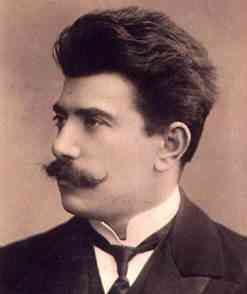
Reinhold Glière
Source: On Music Dictionary
Born on 11 January 1874 in Kiev, Russia (now Ukraine), Reinhold Moritzevich Glière (Рейнгольд Морицевич Глиэ́р; "Gleer") composed for chamber, orchestra and stage in addition to a lot of piano pieces like preludes. One reason he is not so famous as other Russian composers is that, though he studied in Berlin from 1905 to 1908, he otherwise left Western Europe, much less America, off his itinerary, working in the more musically remote areas of Russia such as Azerbaijan, Siberia and Uzbekistan. Among his pupils, however, were names like Khachaturian, Prokofiev and Myaskovsky.
Glière had a father who was a professional builder of wind instruments. His initial formal training was in violin in Kiev in 1891. He entered the Moscow Conservatory, founded 1866 by Nikolai Rubinstein and Prince Nikolai Troubetzkoy, in 1894. Dating early compositions and publications by Gliere is hazardous so I approximate from several sources with which IMSLP may differ: His Opus 1 arrived circa 1898 or later per 'String Sextet No.1' in C minor. It won the Glinka Prize [established 1884 by publisher, Mitrofan Belyayev [Wikipedia] and was later published w a dedication to one of his teachers, Sergei Taneyev. Two later string sextets eventually followed per Opus 7 and Opus 11.
Gliere was yet a student at the Conservatory when he composed his sufficient though lukewarm 'Symphony No.1' in E flat Op 8 in 1899-1900. Having graduated from the Conservatory in 1900 with his first one-act opera, 'Earth and Heaven', written, Gliere began teaching at the Gnesin School of Music [Wikipedia] the next year.
'Symphony No.1' Op 8 in E-flat major Reinhold Glière
Comp 1899-1900 Premiere 21 Dec 1902 in Moscow Pub 1905
Slovak Philharmonic Orchestra / Stephen Gunzenhauser
Hector Bellman Tom Godell IMSLP Joerg Schnadt
'2 Morceaux pour Contrebasse et Piano' Op 9 was probably composed in 1902 and published in 1905. 'Symphony No.2' in C minor Op 25 saw its first performance in Berlin on 23 January 1908 with Serge Koussevitzky conducting.
'Deux Morceaux pour Contrebasse et Piano Op 9 Reinhold Glière 1902 IMSLP
'Deux Pièces pour Contrebasse et Piano' Op 32 Reinhold Glière 1908 IMSLP
Comp 1899-1900 Premiere 21 Dec 1902 in Moscow Pub 1905
Double bass: Nabil Shehata Piano: Karim Shehata
'Symphony No.2' Op 25 Reinhold Glière
Comp 1907-08 Premiere 23 Jan 1908 in Berlin
BBC Philharmonic / Sir Edward Downes
Robert Cummings IMSLP Joerg Schnadt
'Vingt Cinq Preludes' ('25 Preludes') Op 30 Reinhold Glière Comp 1906-08
Piano: Anthony Goldstone
Gliere's symphonic poem in F minor, 'Sirens' Op 33, premiered in Moscow on 23 January of 1909 with Emil Cooper conducting the orchestra of the Russian Musical Society. Gliere's 'Symphony No.3' ('Ilia Mourometz') Op 42 saw premiere in Moscow on 23 March of 1912 with Emil Cooper conducting the RMS again. 'Symphony No.3' concerns the adventures of bogatyr (knight-errant), Ilia Mourometz.
'The Sirens' Op 33 in F minor Symphonic poem by Reinhold Glière
Comp 1908 Premiere 17 Jan 1909 in Moscow Pub in Leipzig 1912 by M.P. Belaieff
Dedicated to his wife, Marie Renquist
Moscow Radio and Television Symphony Orchestra / Vladimir Esipov
'Symphony No.3' ('Ilya Muromets') Op 42 Reinhold Glière
Comp 1909-11 Premiere 23 March 1912 in Moscow Pub in Moscow 1912 by P. Jurgenson
BBC Philharmonic / Edward Downes
Alan Beggerow Geoffrey Bushell IMSLP
Denis Savelyev Joerg Schnadt Wikipedia
Glière became the first director of the Kiev Conservatory [Wikipedia] in 1914, raised in status from a school that year to become a Soviet institution. He left the Kiev Conservatory in 1920 to begin teaching at the Moscow Conservatory where he remained until WW II. Being of the nationalist classical school associated with the Belyayev circle, Gliere would weather the Soviet Union [1922-91: Britannica / Wikipedia] well, the regime assuming that tradition. His ballet with a Russian Revolutionary theme, 'The Red Poppy', premiered on 14 June 1927 at the Bolshoi Theatre in Moscow. 'The Red Poppy' takes place in 1920s China. In this tale the flower is a symbol of love, given by the dancer, Taï-Choa, to the captain of a Soviet ship for his kindness to coolies laboring at the harbor. Her fiancé, one Li-Chan-Fou, becomes jealous of the Soviet captain and wants Taï-Choa to kill him. She instead sacrifices herself for the captain during a riot in which she is killed. Before she dies she gives another red poppy to a Chinese girl. [See Anderson / IMSLP / Predota / Schnadt / Wikipedia.] The best-known of the dances in 'The Red Poppy' is probably 'Russian Sailors' Dance' ('Танец русского моряка') No.18 at the end of Act I. 'The Sailor's Dance' is from a Russian naval folk song titled 'Yablochko' ('Яблочко' 'Little Apple') of unidentified origin [Wikipedia]. Gliere also pulled a couple of suites from 'The Red Poppy', No.1 Op 70a and No.2 Op 70b [Schnadt]. The expanded version of 'The Red Poppy' was retitled 'The Red Flower' for its posthumous premiere on 24 November 1957 at the Bolshoi.
'Dance of the Soviet Sailors' Reinhold Glière
From Act I of the ballet 'The Red Poppy' Op 70 composed 1926-27
Comp 1909-11 Premiere 23 March 1912 in Moscow Pub in Moscow 1912 by P. Jurgenson
St. Petersburg State Symphony Orchestra / André Anichanov
'Suite No.1' of 'The Red Poppy' Op 70a Reinhold Glière 1927
St. Petersburg State Symphony Orchestra / André Anichanov
Gliere had already accepted three Glinka Prizes when he won the first of three Orders of Lenin [Wikipedia] in 1945, followed twice more in 1950 and 1955. His first of three Stalin Prizes arrived in 1946 for 'Concerto' for coloratura soprano and orchestra in F minor Op 82. Gliere's second Stalin Prize in 1948 was for another composition of 1943, his 'String Quartet No.4' in F minor Op 83.
'Concerto for Coloratura Soprano and Orchestra' Op 82 in F minor Reinhold Glière
Comp 1943 Pub 1944
Berlin Philharmonic / Sergiu Celibidache
Coloratura soprano: Erna Berger
IMSLP Georg Predota Joerg Schnadt
'Concerto for Coloratura Soprano and Orchestra' Op 82 in F minor Reinhold Glière
Comp 1943 Pub 1944
Croatian Army Wind Band / Miro Saje
Trumpet: Mary Elizabeth Bowden
Velika Gorica Brass Festival 2015
IMSLP Georg Predota Joerg Schnadt
'String Quartet No.4' Op 83 in F minor Reinhold Glière
Comp 1943 Premiere 30 Oct 1943 in Moscow by the Beethoven Quartet Pub 1946
Dedicated to the Beethoven Quartet
The Beethoven Quartet:
Violin: Dmitri Tsyganov Violin: Vasily Shirinsky
Viola: Vadim Borisovsky Cello: Sergei Shirinsky
Gliere's third Stalin Prize arrived in 1950 for his ballet, 'The Bronze Horseman' Op 89 first performed on 14 March 1949. This ballet concerns the flood of St. Petersburg in November 1824. The libretto was supplied by Petr Abolimov. [See IMSLP / Wikipedia.] Gliere pulled four more works from 'The Bronze Horseman' as Opp 89a through 89d, the first of which is 'Suite No.1'. 89b is 'Suite No.2' of which is 'Waltz' is the third of five movements. 89c is 'Dance on the Square' for piano four hands. 89d is a set of four piano solos.
'The Bronze Horseman Suite No.1' Op 89a Reinhold Glière Comp 1949
BBC Philharmonic / Edward Downes
'Waltz' From 'The Bronze Horseman Suite No.2' Op 89b No.3 Reinhold Glière Comp 1949
Piano: Cyprien Katsaris
Another nice example of one of Gliere's works for piano is 'Two Pieces for Piano' Op 99 composed in 1955 of which 'Melodie' ('Мелодия') in B♭ major is No.2.
'2 Pieces for Piano' Op 99 Reinhold Glière Comp 1955 Pub 1956
1. 'Impromptu for Left Hand' in E major
2. 'Melodie' in B-flat major
Piano: Ponta Yamazato Dec 2022
Gliere died in Moscow on 23 June 1956, leaving his 'Violin Concert' Op 100 unfinished with that task left to his student, Boris Lyatoshinsky. This work premiered posthumously in Moscow on 20 September 1959 by the Großes Sinfonieorchester des Allunionsradios conducted by A.K. Jansons with violin by B.E. Goldstein.
'Violin Concert' Op 100 in G minor Reinhold Glière
Incomplete at time of death Finished by Boris Lyatoshinsky
Premiere 20 Sep 1959 in Moscow:
Großes Sinfonieorchester des Allunionsradios / A.K. Jansons
Violin: B.E. Goldstein
Performance above:
Kostroma Gubernsky Symphony Orchestra / Pavel Gershtein
Violin: Andrei Baranov
Sources & References for Reinhold Glière:
Michael Morrison (All Music)
VF History (notes)
Audio of Glière: Corpora:
Classical Archives Geoffrey Bushell Hyperion Internet Archive Muziekweb Naxos Presto
Audio of Glière: Individual: Chronological:
The Sirens (symphonic poem / Op 33 / comp 1908 / Slovak Philharmonic Orchestra / Stephen Gunzenhauser)
Symphony No.3 (Ilya Muromets / Op 42 / comp 1909-11 / WDR Sinfonieorchester Köln / Neeme Järvi)
Concerto for Coloratura Soprano and Orchestra (Op 82 / comp 1943 / Radio Sinfonieorchester Stuttgart / Kurt Eichhorn / soprano: Edita Gruberová)
Belyayev Circle (1885-1908 / society promoting a nationalistic Russian identity in music):
Wikipedia English Wikipedia Español
Compositions:
Geoffrey Bushell (by genre) (alt)
IMSLP (alphabetical)
IMSLP (by Opus / date [WoO])
Klassika (by date / genre / Opus / title)
MusicWeb International (by date)
Rate Your Music (by genre)
Onno van Rijen (by date)
Joerg Schnadt (by date / Op)
Joerg Schnadt (lieder)
Wind Repertory Project (works for winds)
Wikipedia Dutch (by genre)
Wikipedia English (by genre)
Wikipedia Español (by genre)
Wikipedia German (by genre)
Wikipedia Italian (by genre)
ウィキペディア日本語版 (by genre)
Википедия Русская (by genre)
Documentaries: Composer Glière (Salnikov & Groom-Grzhimailo / Central Television of the USSR / 1968)
Iconography: Glière House-Museum Wikimedia Commons
Lyrics / Texts: Emily Ezust (LiederNet)
Moscow Conservatory (since 1866):
Moscow State Conservatory Moscow State Conservatory Russia In Global Perspective Wikipedia
Recordings of Glière: Catalogs (see also Audio above):
Recordings of Glière: Select:
The Bronze Horseman (ballet suite / St. Petersburg State Symphony Orchestra w André Anichanov / Naxos 8.223675 / 1995)
The Gliere Orchestral Collection (BBC Philharmonic Orchestra / Chandos / 5 CDs / 2011)
The Red Poppy (ballet / St. Petersburg State Symphony Orchestra w André Anichanov / Naxos 8.553496-97 / 1995)
Symphony No.3 (San Diego Symphony w Yoav Talmi / Pro-Arte Digital / 1991)
Scores / Sheet Music:
Abe Books (vendor / Amazon subsidiary)
Musicalics (vendor)
Notenlager (vendor Europe)
Further Reading: Coloratura Soprano IMDb (usage of Glière in film)
Bibliography:
Gerald Christopher (Music in Transition: the Life and Works of Reinhold Glière / University of Canterbury / 2017)
Authority Search: BNF Data
Other Profiles:
Bobb Edwards (Find a Grave)
Encyclopedia of Modern Ukraine
Classical Main Menu Modern Recording
|
|