
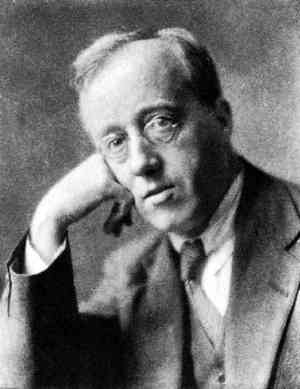
Gustav Holst
Photo: Herbert Lambert
Source: Wikipedia
Born on 21 September 1874 in Cheltenham, Gloucestershire, Gustav Theodore Holst was a Romantic composer peculiar to those on the Continent only by being English. England is the oddball of classical music, like something in the air there, pun intended. Spain is not so thick with composers in music history due much to early occupation by not so musical Moors getting it a late start. Though Spain was later a force in the development of the piano, it led in classical guitar whilst competing with Flamenco. It was also, though less than Russia, a more difficult distance to travel from hubs in France, Germany and Italy. Though no great distance across the Channel, England was less thick with classical composers due to factors like a culture set apart by high literacy and a greater proclivity for song than orchestrations or operas. Nor was London far from Paris, easily importing what it less produced than literature and folk songs. Transitioning from romantic to modern was for Holst also something of a transition to English, gradually pulling away from Continental influences, even as Russia aggressively pursued a nationalistic identity whilst at once remaining abreast with Western Europe, acquiring a leading role during the Romantic. Holst himself composed largely for stage, such as ballets and operas, as well as piano, choral music and, of course, songs. His instrumental works include concertantes (featuring solos) as well as works for chamber and orchestra like incidental music. "H" numbering in Holst is per 'A thematic catalogue of Gustav Holst's music' written by Imogen Holst, daughter of his second marriage in 1901 [see Faber 1974].
Holst had a father who was organist and choirmaster at All Saints' Church. He played violin and trombone as a child but preferred piano. Even so, he wrote no works for solo piano, though many a hymn or song. Wikipedia has him composing 'A Christmas Carol' for chorus and orchestra as early as 1890 with numerous choral works following. Attending Merton College at Oxford University in 1891, his first public performance as a pianist may have arrived in November when he and his father played Brahms' 'Hungarian Dances' at a concert in Cheltenham. Holst wrote his first symphony the next year.
Gustov's first employment as a musician was as organist and choirmaster at the Wyck Rissington parish in Gloucestershire, but he was soon packing for London in 1893 to study at the Royal College of Music. Holst's Opus 1 was assigned to his 1895 opera, 'The Revoke'. He began publishing his works while at RCM, but in 1898 he had to take work as an organist in London churches and a trombonist in London theatres. He yet distinguished himself in that capacity and was soon touring with the Royal Scottish National Orchestra [Wikipedia].
Along with Indian Sanskrit literature like the Vedas, British author, Thomas Hardy, wrote some of Holst's favorite literature. Texts from both the 'Rigveda' and Hardy saw inclusion in 'Six Songs' Op 15 of 1902-03. 'Invocation to the Dawn' Op 15 No.1 may have been Holst's first setting with text translated from Sanskrit by himself. Settings to Hardy were Nos. 3-5 to include 'The Sergeant's Song', 'In the Wood' and 'Between Us Now'. Holst himself considered them to be "early horrors" along with all else that he had composed before 1904.
'Six Songs' composed 1902-03 Op 15 No.3 Gustav Holst
'The Sergeant's Song'
Baritone: Stephen Foulkes Piano: Colin Hunt
'Six Songs' composed 1902-03 Op 15 No.5 Gustav Holst
'Between Us Now'
Baritone: Stephen Foulkes Piano: Colin Hunt
In 1903 Holst left the life of an orchestra musician to concentrate on composing, the American poet, Walt Whitman, meanwhile another of his favorite authors. His 'The Mystic Trumpeter' Op 18 of 1904 is a setting to Whitman's eponymous poem found in 'From Noon to Starry Night' from 'Leaves of Grass'. Holst's revised version arrived in 1912.
'The Mystic Trumpeter' Op 18 H 71 Gustav Holst
Comp 1904 Revised 1912
Royal Scottish National Orchestra / David Lloyd-Jones
Soprano: Claire Rutter
18 Feb 2001 at City Hall in Glasgow, Scotland
Beginning to teach in 1905, Holst became musical director of the St. Paul's Girls' School [Wikipedia] in 1905, a position he would keep until his death. In 1907 he became musical director at Morley College [Wikipedia] where he remained until 1924. Holst wrote his own libretto for his chamber opera, 'Savitri' Op 25, in 1909, that premiering on 5 December 1916 at Wellington Hall of St. John's Wood in London. Savitri is the wife of the woodman, Satyavan, whom Death threatens. But Death is Maya, that is, unreal.
'Savitri' Op 25 H 96 Chamber opera by Gustav Holst
Comp 1908-09 Premiere 5 Dec 1912 in London Pub 1923
Libretto: Holst
English Chamber Orchestra / Imogen Holst
As the romantic readily shifts toward the exotic, Holst conducted his 'Beni Mora' Oriental Suite in E minor Op 29 No.1 on 1 May 1912, inspired by a trip to Algeria in 1908. Its last of three movements is widely cited in its resemblance to much later Minimalist composing in its repetition of a four-bar theme.
'Beni Mora' Op 29 No.1 H 107 E minor Oriental suite by Gustav Holst
Comp 1909-10 Premiere 1 May 1912 at Queen's Hall in London w Holst conducting Pub 1921
Royal Scottish National Orchestra / David Lloyd-Jones
Holst was rejected from military service during World War I, during which time another setting to Whitman arrived in a 'Dirge for Two Veterans' H 121 in 1914:
'Dirge for Two Veterans' H 121 E minor Lamentation by Gustav Holst
Comp 1914 Pub 1914 in London
Joyful Company of Singers w the City of London Sinfonia / Richard Hickox
In 1918 Holst worked in Greece as a musical organizer for the YMCA. His return to the UK saw to the public premiere of the work that would make him internationally famous, 'The Planets' Op 32, at Queen's Hall in London on 29 September 1918. Composed in 1914-16, though 'Mars' ('Bringer of War') No.1 and 'Jupiter' ('Bringer of Jollity') No.4 may receive the most performing overall, Holst's own favorite movement of the seven was 'Saturn' ('Bringer of Old Age') No.5. Neither Earth nor Pluto are included in Holst's depiction of the planets.
'Saturn' ('Bringer of Old Age') Op 32 No.5 H 125 Adagio Gustav Holst
From the suite for large orchestra 'The Planets'
Comp 1914-16 Premiere 29 Sep 1918 at Queen's Hall in London
Pub 1921 Dedicated to Imogen Holst (daughter)
BBC Symphony Orchestra / Susanna Mälkki
BBC Proms at Royal Albert Hall in London 27 July 2015
Meredith Gailey IMSLP Honey Meconi The Planets Kenric Taylor Wikipedia
Now a huge celebrity, Holst premiered 'The Hymn of Jesus' at Queen's Hall on 25 March 1920 with libretto translated by himself from the Gnostic text, 'Acts of John'.
'The Hymn of Jesus' Op 37 H 140 C major Sacred hymn by Gustav Holst
Comp 1917 Premiere 25 March 1920 at Queen's Hall in London w Holst conducting Pub 1919
Text from the apocryphal 'Acts of John' as translated by Holst
BBC Symphony Orchestra / Adrian Boult
Gnostic Society Library Raymond Head IMSLP Patheos Wikipedia
On 27 October 1922 Holst recorded the first of numerous tracks for Columbia conducting the London Symphony Orchestra [Wikipedia], that being 'Jupiter' released on Columbia L 1459 in Feb of 1923. His first recordings of 'The Planets' were the noisy acoustic made 1922-1925. The arrival of electronic recording in 1925 meant the rerecording of 'The Planets' in 1926 toward issue that December.
'The Planets' Op 32 H 125 Acoustic recordings by Gustav Holst
Recorded 1922/1923 at Petty France Studios in London
Holst wrote the libretto to his opera, 'The Perfect Fool' H 150 Op 39, that premiered at the Covent Garden Theatre in London on 14 May 1923, though after 'The Planets' his career entered into its decline. In this unpopular comic opera the Fool is a peasant farmer for whom a singular "No" is eventually his entire portion of the libretto. This Fool ends up a Prince with zero effort despite others who vie for the hand of the Princess, but have not the required love potion which has come into the possession of the Fool's mother. Considerably more popular than the opera is its introductory ballet music formed into a suite.
'The Perfect Fool Ballet Suite' Op 39 H 150 Comic opera in one act by Gustav Holst
Comp 1918-1922 Premiere 14 May 1923
1. 'Invocation'
2. 'Dance of Spirits of Earth'
3. 'Dance of Spirits of Water'
4. 'Dance of Spirits of Fire'
Enigma Brass Ensemble Arrangement:
George Colrick IMSLP Wikipedia
In 1927 Holst composed his homage to Hardy (above) titled 'Egdon Heath'. Egdon Heath is a fictional location in the writings of Hardy. That confronted poor reception as well, though Holst himself regarded it to be his best composition.
'Egdon Heath' Op 47 H 172 Adagio Tone poem by Gustav Holst
Comp 1927 Pub 1928
Dedicated to the New York Symphony Orchestra until Hardy's acceptance in Aug 1927
London Philharmonic Orchestra / Adrian Boult
Holst lectured at Harvard in 1932 until illness forced him back to England. His last Opus was assigned to 'Six Choruses' H 186 Op 53 of 1931-32. That took the place of his original Op 53 that was 'On the Battle Which Was Fought at Fontenoy', then was left WoO until cataloged as H 186a. Among Hoslt's last works was the 'Brook Green Suite' H 172 Op 47 of 1933. Brook Green is where Holst married his wife, Isobel, in 1901. This suite was composed while in the hospital for an ulcer the year prior to his death, written for St. Paul's Girls' School in Brook Green, and kept simple for unaccomplished musicians.
'Brook Green Suite' H 190 C major Gustav Holst
Comp 1933 Pub 1934
1. Prelude
2. Air
3. Dance
New York Classical Players / Dongmin Kim
Korean Central Presbyterian Church in Centreville VA 1 April 2014
Holst's final composition was 'Lyric Movement' H 191 in 1933, a work for viola and orchestra dedicated to the violist, Lionel Tertis. Holst died soon after on 24 May 1934 of heart failure.
'Lyric Movement' H 191 D minor Gustav Holst
Comp 1933 Premiere 18 March 1934 in London w Adrian Boult conducting
Dedicated to violist Lionel Tertis
English Sinfonia / Howard Griffiths Viola: Andriy Viytovych
Lewis Foreman IMSLP Joseph Stevenson
Sources & References for Gustav Holst:
Bruce Eder (All Music)
VF History (notes)
Aryeh Oron (Bach Cantatas)
Acts of John (Gnostic / 2nd century AD):
Got Questions Internet Sacred Text Archive Tyler Journeaux NASSCAL New Advent
Scribd Western Kentucky University WikipediaAudio of Holst: Corpora: Classical Archives Hyperion MuziekWeb Naxos Presto
Audio of Holst: Individual: Chronological:
The Mystic Trumpeter (Op 18 / H 71 / comp 1904/12 / London Symphony Orchestra / David Atherton / soprano: Sheila Armstrong)
The Mystic Trumpeter (Op 18 / H 71 / comp 1904/12 / BBC Concert Orchestra / Martin Yates / soprano: Ilona Domnich)
The Mystic Trumpeter (Op 18 / H 71 / comp 1904/12 / BBC Symphony Orchestra / Andrew Davis / soprano: Susan Gritton)
Savitri (chamber opera / Op 25 / H 96 / comp 1909 / musical direction: Stephen Dubberly / 2017)
Savitri (chamber opera / Op 25 / H 96 / comp 1909 / musical direction: Aviv Ron / 2012)
Dirge for Two Veterans (H 121 / comp 1914 / US Army Chorus / John C. Clanton)
Saturn (from The Planets Op 32 No.5 / H 125 / comp 1914-16 / BBC Philharmonic Orchestra / Charles Mackerras)
Saturn (from The Planets Op 32 No.5 / H 125 / comp 1914-16 / Orchestra Wellington / Marc Taddei)
Chronology: Holst Museum
Collections: Britten Pears Arts Archive
Compositions:
Classic Cat (by Opus)
IMSLP (alphabetical)
IMSLP (by date / genre / H / Opus / title)
Klassika (by date / genre / H / Opus / title)
Pytheas (by date)
Pytheas (by genre)
Rate Your Music (by genre / date)
Kenric Taylor (Gustov Holst Info / by genre)
Wikipedia Deutsch (by genre)
Wikipedia English (by date / genre / H / Opus / title)
ウィキペディア日本語版 (by genre)
Wind Repertory Project (works for winds)
Thomas Hardy (1840-1928 / British fiction author):
Iconography: Wikimedia Commons
Lyrics / Texts: Emily Ezust (LiederNet)
Minimalist Music: Classic fM
Ohio State University Megan Reich Kiran Sande WikipediaRecordings of Holst: Catalogs (see also Audio above):
Kenric Taylor (Gustov Holst Info)
Recordings by Holst:
Gustov Holst: The Collected Recorded Works (conducting by Holst / Explore Multimedia / 3 CDs)
Holst: The Planets (London Symphony Orchestra / Gustov Holst / Pristine / compact discs)
Recordings by Holst: Sessionographies (The Planets Op 32 H 25 / 1922-1925 acoustic / 1926 electronic):
Recordings of Holst: Select:
Holst (City of London Sinfonia w Richard Hickox / Chandos)
Holst: Orchestral Works Volume 3 (BBC Symphony C & O / Sir Andrew Davis / soprano: Susan Gritton / Chandos)
Holst: The Planets | The Mystic Trumpeter (Royal Scottish National C & O / David Lloyd-Jones / soprano: Claire Rutter / Naxos 8.555776 2002) About Reviews
Scores / Sheet Music:
Abe Books (vendor / Amazon subsidiary)
CPDL (choral works)
Hal Leonard (vendor)
Musicalics (vendor)
Notenlager (vendor Europe)
The Planets Op 32:
Galaxy Music Notes (vendor)
Walt Whitman (American poet / 1819-1892 / see Leaves of Grass [1855]):
Encyclopedia The MarginalianNew World Encyclopedia Poets Walt Whitman Archive Wikipedia
Further Reading:
Classic fM (Holst: 15 facts about the great composer)
Norman Gilliland (Gustav Holst & Thomas Hardy / 2018)
Holst Museum (Unveiling Gustav Holst’s Musical Zodiac)
IMDb (usage of Holst in film)
Tony Palmer (The Inner Orbit of Gustav Holst / 2011)
Bibliography:
Imogen Holst (Gustav Holst: A Biography / Faber & Faber / 2012)
Mary Christison Huismann (Gustav Holst: A Research and Information Guide / Routledge / 2011)
Michael Short (Gustav Holst 1874-1934: A Centenary Documentation / White Lion Publishers / 1974)
Michael Short (Gustav Holst: The Man and His Music / Oxford University Press / 1990)
Kenric Taylor (Gustov Holst Info)
Authority Search: BNF Data Deutsche Nationalbibliothek
Other Profiles:
Bobb Edwards (Find a Grave)
Wikipedia: Dutch Español Portuguese
Classical Main Menu Modern Recording
|
|