
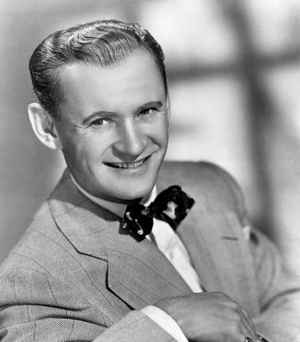
Sammy Kaye
Photo: James Kriegsmann
Source: Wikiwand
Born on 13 March 1910 in Lakewood, Ohio, Sammy Kaye (no relation to Danny Kaye) was a bandleader and vocalist who also played clarinet and saxophone though never performed solo. Known for "sweet" dance music that had originated and become popular in America's hotels, though Kaye indulged in a touch of swing (calling his band Swing and Sway) he is treated as an exclusively popular musician by Tom Lord who doesn't list him in his jazzography at all. That's because Kaye is an early representative of the "easy listening" subgenre of popular music. Kaye recorded often and, despite that people tend to avoid so-called "elevator" music, you can scroll him at YouTube to gain a notion of infinity.
Sammy's parents were immigrants from Czechoslovakia. Graduating from high school in 1928 [Discogs], he attended Ohio State University where he started his own band called the Ohioans as well as a trio called Sammie's Red Hot Peppers in which he played banjo. Indeed, he even opened his own venue at which to perform called the College Inn. Graduating in 1932 with a degree in civil engineering, Kaye then began his professional career at Bill Green’s Casino in Pittsburgh. Come 1935 his band was performing at the Statler Hotel in Cleveland. DAHR traces Kaye's earliest recordings to 14 April 1937 toward such as 'It Looks Like Rain In Cherry Blossom Lane' and 'Why Do You Pass Me By' for issue on Vocalion. The following year in 1938 Kaye booked his orchestra at the Commodore Hotel where Tommy Dorsey had been playing.
'It Looks Like Rain In Cherry Blossom Lane'
Swing and Sway with Sammy Kaye backing Tommy Ryan
Kaye's first-known recording
14 April 1937 in NYC Matrix 20970 Vocalion 3531
Music: Joe Burke Lyrics: Edgar Leslie
'Swing and Sway'
Swing and Sway with Sammy Kaye backing the Three Barons
19 July 1937 in NYC Matrix 21411 Vocalion 3669
Composition: Sammy Kaye
'Love Walked In'
Swing and Sway with Sammy Kaye backing Tommy Ryan
1938 Vocalion 4017
Composition: Gershwin Brothers
Kaye was the first to record the classic, 'Blueberry Hill', in 1940. The
next year his band released his
highest-selling title overall called 'Daddy' [Music VF
/
TsorT]. From
1937 to 1950 five of Kaye's releases rang Billboard's bell at #1:
Daddy June 1941
I'm a Big Girl Now March 1945
Chickery Chick Oct 1945
The Old Lamplighter Nov 1946
Harbor Lights Sep 1950
'Blueberry Hill'
Swing and Sway with Sammy Kaye backing Tommy Ryan
31 May 1940 in NYC Matrix 051050 Vocalion 4017
Composition: Al Lewis / Vincent Rose / Larry Stock
'Daddy'
Swing and Sway with Sammy Kaye backing the Kaye Choir
31 March 1941 in NYC Matrix 063320 Victor 27391
Trumpet: Frank Blake / Jerry Carr / Dale Cornell / Lloyd Gillion
Trombone: Oscar Reach
Sax: Maury Cross / George Brandon / Don Wallmark / Charles Wilson
Guitar: Tommy Ryan Bass: Howard Workman Drums: Ernest Rudisell
Composition: Bobby Troup Jr.
'The Old Lamplighter'
Swing and Sway with Sammy Kaye backing Billy Williams
1946 Victor 20-1963
Music: Nat Simon Lyrics: Charles Tobias
'Serenade of the Bells'
Swing and Sway with Sammy Kaye backing Don Cornell w the Kaydets
11 July 1947 in NYC D7VB-1259 Victor 20-2372
Composition: Kay Twomey / Al Goodhart / Al Urbano
'It Isn't Fair'
Swing and Sway with Sammy Kaye backing Don Cornell
9 Nov 1949 in NYC Matrix D9VB-2490 Victor 20-3609
Composition: Sylvester Sprigato / Frank Warshauer / Richard Himber
Kaye hosted the 'Sammy Kaye Show' on television from 1950 to 1959. That was known for some years as 'So You Want to Lead a Band' during which he gave away batons to audience members who answered his challenge to step on stage and conduct his band as well as can. Though that added to an evening's fun, Kaye's organization was rhythmically conservative and there was no extemporaneous fooling around. Though he ran a tight ship of competent musicians he drew sharp criticism from critics and other musicians for being everyday and unoriginal. Per above, Kaye examples the "easy listening" subgenre of popular music by which one could set a metronome. It's nigh as returning to the old largely Irish beat of the first couple decades of popular recording before the development of jazz.
'I Love You Because'
Swing and Sway with Sammy Kaye backing the Kaydets
1951 Columbia 39270
Composition: Leon Payne
'Melody of Love'
Swing and Sway with Sammy Kaye backing the Kaydets Recitation: Kaye
1954 Columbia 40417
Composition: Tom Glazer / Hans Engelmann
'Sammy Kaye Plays Strauss Waltzes For Dancing' Sammy Kaye
1959 Album on Columbia CL 1236
'Sexy Strings and Subtle Saxes' Sammy Kaye and His Orchestra
1962 Album on Decca DL 74215
'Come Dance to the Hits with Sammy Kaye and His Orchestra'
Sammy Kaye and His Orchestra
1964 Album on Decca DL 74502
'The Hucklebuck' Sammy Kaye and His Orchestra Television
28 Nov 1965 'The Ed Sullivan Show'
Music: Andy Gibson 1949 Lyrics: Roy Alfred
'The Glory of Love' Sammy Kaye and His Orchestra
1967 Album on Decca DL 4970
Sammy died in Manhattan on 2 June 1987 [obit] to be posthumously inducted into the Big Band Hall of Fame in 1992.
Sources & References for Sammy Kaye:
Christopher Popa (Big Band Library)
VF History (notes)
Ron Wynn (All Music)
Associates Musical:
Don Cornell (vocals / 1919-2007):
DAHR (1942-1958)
Tommy Ryan (guitar / vocals / 1921-2007):
DAHR (with Swing and Sway with Sammy Kaye 1937-1942)
Audio of Kaye: Internet Archive YouTube
Collections: Ohio University
Compositions: Music Brainz Music VF Second Hand Songs
Kaye in Film / Television: IMDb
Sammy Kaye Show (fifties - dates vary per source): IMDb Nostalgia Central
So You Want to Lead a Band (fifties - dates vary per source): IMDb Wikipedia
Recordings: Catalogs: 45 Worlds Discogs RYM Wikipedia
Recordings: Sessionographies: DAHR (1937-50)
Further Reading:
The "Easy Listening" or "Elevator" Subgenre of Popular Music:
RYM Talk Classical (discussion) Wikipedia Wikipedia
Other Profiles: From the Vaults Travalanche