
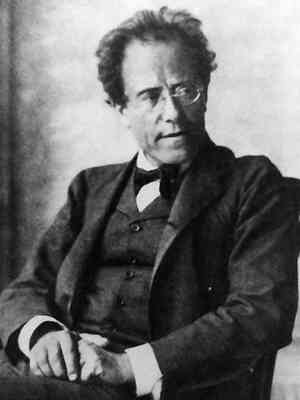
Gustav Mahler
Source: Wikipedia
Born on 7 July 1860 in Kalischt, Bohemia (now Kaliště, Czech Republic), Gustav Mahler arrives at the culmination of the Romantic period. Though romantic to the finish there are modernistic touches to his work. His oeuvre is largely vocal and orchestral, especially symphonies. He also composed for chamber and stage, some of those joining other scores that are lost. Mahler was principally a conductor, making for a plentiful though not especially prolific legacy of works. More appreciated during his time for the concerts he gave than his composing per se, recognition of the latter has been largely posthumous, notably excepting banishment by the Nazi regime for being Jewish. Mahler had a distiller and tavern keeper for a father. His grandmother had a piano that he began to play at age four. In 1875 he began studying piano, then composition, at the Vienna Conservatory. Mahler attended the University of Vienna for a year before becoming a piano teacher. On 10 July of 1876 he performed on piano his only surviving work for chamber at the Conservatory, the first movement of an otherwise abandoned quartet, which section alone has come down as 'Piano Quartet' in A minor. GMW numbers in Mahler are per 'Gustav Mahler Werke' finished by Federico Celestini and Christian Utz in 2022. (Mahler didn't use Opus numbers due that they could get easily confused between publishers, as experienced by previous composers.)
'Piano Quartet' GMW F52 in A major Gustav Mahler
Composed 1876
Premiere 10 July 1876 at the Vienna Conservatory Pub 1973
Violin: Ivan Penchev Piano: Darina Vassileva
Viola: Tatyana Todorova Cello: Stoyan Bozhkov
Alex Burns Camosun College Steven Coburn IMSLP
Mahler Foundation Massey University Sidney Prim Wikipedia
Mahler began the text of his cantata, 'Das Klagende Lied' ('Song of Lamentation'), during his last year at the Conservatory in 1878, music following the next year toward completion on 1 November 1880. It wasn't performed, however, until Mahler conducted it on 17 February 1901 in Vienna, having been twice revised in 1893 and 1899.
'Das Klagende Lied' ('Song of Lamentation') GMW GMW 1a-c Gustav Mahler
'Waldmärchen' ('Forest Fairy Tales') GMW 1a
'Der Spielmann' ('The Minstrel') GMW 1b
'Hochzeitsstück' ('Wedding Play') GMW 1c
Composed 1878-80 Revised 1892-93 / 1898-99
Premiere 17 Feb 1901 in Vienna Conservatory Pub 1901
Libretto by Mahler
San Francisco Symphony and Chorus / Michael Tilson Thomas
Soprano: Marina Shaguch Mezzo soprano: Michelle DeYoung
Tenor: Thomas Moser Baritone: Sergei Leiferkus
Roy Brewer IMSLP Edward R. Reilly Text Wikipedia
Mahler had taken his first conducting position in 1880 in a little town called Bad Hall, then at a theatre in Laibach (presently, Ljubljana, Slovenia) the next year. After a couple more small theatres in towns off route Mahler finally landed work conducting at the Liepzig Opera in 1886. He became director at the Hungarian State Opera House in Budapest in October of 1888. He there conducted his 'Symphony No.1' ('Titan') in D major on 20 November 1889 to small success.
'Symphony No.1' ('Titan') GMW 11 in D major Gustav Mahler
Composed 1884-88
Premiere 20 Nov 1889 in Budapest Pub 1899
National Orchestra of France / Neeme Järvi
Radio France Auditorium in Paris 24 Jan 2019
Classic fM Bettie Jo Basinger Steven Coburn CPH GustovMahler
Tom Huizenga IMSLP Henry-Louis de La Grange Mahler Foundation Wikipedia
In 1891 Mahler exchanged Hungary for Germany, conducting at the Hamburg State Opera in 1891, becoming Director in 1894. In the meantime he wrote titles for 'Des Knaben Wunderhorn' ('The Boy's Magic Horn'), a set of fifteen songs of which 'Das himmlische Leben' ('The Heavenly Life') is No.13. The libretti of 'Des Knaben Wunderhorn' are taken from 'Des Knaben Wunderhorn' of 1806/1808, a collection of traditional German folk songs. See discussion of individual songs.
'Das himmlische Leben' ('The Heavenly Life') GMW 24-K in F major Gustav Mahler
'From 'Des Knaben Wunderhorn' ('The Boy's Magic Horn') GMW 21-29 / 32-36 / 38
Composed 1892-96 Revised 1899-1901
Premiere 27 Oct 1893 in Hamburg Pub 1899
Libretto from 'Des Knaben Wunderhorn' of 1806 / 1808 (traditional German folk songs)
Baritone: Thomas Hampson Piano: Wolfram Rieger
Theatre Musical de Paris 2002
IMSLP Mahler Foundation Das Orchester Text Text Text Wikipedia
Mahler then visited London with the Hamburg Singers in the summer of 1892. In the summer of 1893 he built a composing hut at Steinbach am Attersee in Austria where he completed his second and third symphonies. Mahler conducted the premiere of his 'Symphony No.2' ('Resurrection Symphony') in Hamburg on 13 December 1895, which didn't make him a rock star of the symphony though it came to better reception than his first in 1889. Mahler's autograph of his second symphony is estimated by Sotheby's auction house to be worth above four million dollars [Deutschlandfunk].
'Symphony No.2' ('Resurrection') GMW 30 Gustav Mahler
Composed 1888-94 Revised 1903
Premiere 13 Dec 1895 in Berlin
Pub 1896 (piano arrangement of 2nd movement) / 1897 (entire)
Libretto: Friedrich Gottlieb Klopstock
Royal Concertgebouw Orchestra / Mariss Jansons
Netherlands Radio Choir / Celso Antunes
Soprano: Ricarda Merbeth Mezzo soprano: Bernarda Fink
CPH GustovMahler Peter Gutmann IMSLP Henry-Louis de La Grange Wikipedia
'Lieder eines fahrenden Gesellen' ('Songs of a Wayfarer') is a song cycle consisting of four pieces first performed on 16 March 1896. His 'Symphony No.3' in D minor is Mahler's longest symphony of at least ninety minutes. It saw performance of only its second movement on 9 November 1896 in Berlin, again on 9 March 1897 with Movements 3 and 6. The whole didn't see premiere until 9 June 1902, conducted by Mahler.
'Lieder eines fahrenden Gesellen' ('Songs of a Wayfarer') GMW 10
Four songs by Gustav Mahler
'Wenn mein Schatz Hochzeit macht' ('When My Sweetheart Gets Married')
'Ging heut' morgen übers Feld' ('Walked Across the Field This Morning')
'Ich hab' ein glühend Messer' ('I Have a Glowing Knife')
'Die zwei blauen Augen von meinem Schatz' ('My Sweetheart's Two Blue Eyes')
Composed 1883-85 Premiere 16 March 1896
Librettos by Mahler from 'Des Knaben Wunderhorn' of 1806 / 1808 (traditional German folk songs)
Wiener Philharmoniker / Leonard Bernstein
IMSLP Steven Ledbetter Text Text Wikipedia
'Symphony No.3' GMW 31 Gustav Mahler
Composed 1896 Premiere 9 June 1902 in Krefeld, Germany
Librettos by Mahler from 'Des Knaben Wunderhorn' of 1806 / 1808 (traditional German folk songs)
Wiener Philharmoniker / Leonard Bernstein
Bettie Jo Basinger Steven Coburn Tony Duggan
GustovMahler IMSLP Timothy Judd
Henry-Louis de La Grange Mariinsky Theatre Wikipedia
In 1897 Mahler converted from Judaism to Roman Catholicism to become director at the Vienna Court Opera [Vienna Hofoper (Mahler's repertory 1897-1907)], bypassing that theater's ban against that position being filled by a Jew. Now in a highly suitable position, he conducted 'Symphony No.4' in G major in Munich on 25 November 1901.The fourth movement of that is set around the song, 'Das himmlische Leben' ('The Heavenly Life'), written for voice in 1892 which we've visited above. Mahler later wrote 'Kindertotenlieder' in the summer of 1901, eventually completing it in 1904. This is another song cycle, a set of five with texts by Friedrich Rückert. 'Kindertotenlieder' premiered on 29 January 1905.
'Symphony No.4' GMW 37 Gustav Mahler
Composed 1900-1901 Premiere 25 Nov 1901 in Munich
Libretto: folk song from 'Des Knaben Wunderhorn'
Lucerne Festival Orchestra / Claudio Abbado Aug 2009
Mezzo soprano: Magdalena Kožená
Bettie Jo Basinger GustovMahler Houston Symphony IMSLP
Henry-Louis de La Grange Steven Ledbetter Hugh Macdonald Wikipedia
'Kindertotenlieder' ('Songs on the Death of Children') GMW 45
Five songs by Gustav Mahler
'Nun will die Sonn' so hell aufgeh'n' ('Now the Sun Is About to Rise So Brightly')
'Nun seh' ich wohl, warum so dunkle Flammen' ('Now I See Full Well Why Such Dark Flames')
'Wenn dein Mütterlein' ('When Your Dear Mother')
'Oft denk' ich, sie sind nur ausgegangen' ('I Often Think They’ve Just Gone Out')
'In diesem Wetter' ('In This Weather')
Composed 1901-04 Premiere 29 Jan 1905 in Vienna Pub 1905
Librettos by Friedrich Rückert
Wiener Philharmoniker / Leonard Bernstein
Baritone: Thomas Hampson
Mitch Friedfeld IMSLP John Mangum Georg Predota Text Wikipedia
Mahler began the 20th century with another composing hut built in 1900 on Lake Wörthersee at Maiernigg in Carinthia, Austria, where he would write his fifth through seventh symphonies [Mahler Foundation / Wikipedia]. But he would marry Alma Mahler [compositions] first on 9 March 1902. Alma wouldn't die until December 1964, 53 years after Gustav, and long enough to witness the British Invasion of the United States by the Beatles and Rolling Stones the same year. Alma's, however, was a rarified classical world in which such as Mercy beat and R&B didn't much register. There were other things that didn't quite register with Alma, that being her accounts of life with Gustav which made research confusing for Mahler scholars for a time due to inaccuracies.
Composing his 'Symphony No.5' in 1901 and 1902 largely at Maiernigg, Mahler conducted the Gurzenich Concert Orchestra's performance of it in Cologne on 18 Oct 1904. He completed 'Symphony No.6' ('Tragic') toward its first performance at the Saalbau Essen in Germany on 27 May 1906. Mahler finished the dated score of 'Symphony No. 7' ('Lied der Nacht') in E minor on 15 August 1905, its orchestration the next year, though he wouldn't conduct it until 19 September 1908 in Prague with the Czech Philharmonic Orchestra.
'Symphony No.5' GMW 44 in C-sharp minor Gustav Mahler
Composed 1902-05 Revised 1904-11
Premiere 18 Oct 1904 in Cologne Pub 1904
Lucerne Festival Orchestra / Claudio Abbado 2004
Classic fM GustovMahler Everything2 IMSLP
Henry-Louis de La Grange Steven Ledbetter Lumen Learning Wikipedia
'Symphony No.6' GMW 46 Gustav Mahler
Composed 1903-04
Premiere 26 May 1906 in Essen Pub 1906
Frankfurt Radio Symphony / Andrés Orozco-Estrada 19 Oct 2018
Marin Alsop John Armstrong Steven Coburn Tom Duggan
GustovMahler IMSLP Henry-Louis de La Grange Mahler Foundation
David Matthews Posthorn Recordings Tom Service Wikipedia
'Symphony No.7' GMW 47 Gustav Mahler
Composed 1904-06
Premiere 19 Sep 1908 in Prague Pub 1909
Wiener Philharmoniker / Leonard Bernstein 1974
Bettie Jo Basinger Classic fM Andrew Clements GustovMahler
Steven Johnson IMSLP Henry-Louis de La Grange Wikipedia
Though Mahler had no interest in the poor fidelity of early cylinder or flat disc recording, he made more truly sounding piano rolls of four of his works. Three of them had gone down for Welte-mignon on 9 November 1905: 'Ich ging mit Lust', 'Ging heut morgens ubers Feld' and 'Das Himmlische Leben'. A version from the 1st movement of his 5th symphony was produced on the same date per Bert van der Waal van Dijk at the Mahler Foundation.
Recordings (4) by Gustav Mahler
9 November 1905 for Welt-mignon in Leipzig, Germany
'Ich ging mit Lust durch einen grünen Wald' ('I Walked with Delight Through a Green Forest')
'Ging heut morgen überr's Feld' ('Went Across the Field This Morning')
'Das himmlische Leben' ('The Heavenly Life')
'Trauermarsch' ('Funeral March')
Gustov Mahler (Europe) Gustov Mahler (Europe)
Timothy Judd Mahler Foundation
Mahler began writing 'Symphony No.8' ('Symphony of a Thousand') in E-flat in June of 1906 though he didn't conduct it until 12 September 1910 in Munich with the Munich Philharmonic. That was the last symphony of his that he would perform.
'Symphony No.8' ('Symphony of a Thousand') GMW 48 Gustav Mahler
Composed 1904-06
Premiere 19 Sep 1908 in Prague Pub 1911
Libretti: Rabanus Maurus / Johann Wolfgang von Goethe
Netherlands Philharmonic Orchestra / Marc Albrecht
The Concertgebouw in Amsterdam 23 Feb 2019
Bettie Jo Basinger Classic fM GustovMahler Steven Johnson
IMSLP Henry-Louis de La Grange NPR Wikipedia
Mahler remained at the Vienna Court Opera until October of 1907 when anti-Semitism, unlike ten years earlier when he'd signed on as Director, nevertheless became a factor in his resignation. He then left for the Majestic Hotel in New York in December that year, his conducting debut in America at the Metropolitan Opera [Wikipedia] on 1 January 1908 where he performed Wagner's 'Tristan und Isolde' which work itself wasn't anti-Semitic.
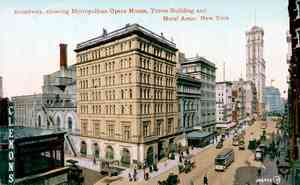
Metropolitan Opera House 1910
Source: Shutterstock
Returning to Europe in April 1908 for conducting engagements there, he was back to New York the same year in November to stay at the Savoy while conducting for the New York Symphony followed by the New York Philharmonic. Returning to Europe again in April of 1909, he was back in New York in October. He last conducted at the Met in March 1910, a performance of Tchaikovsky's 'The Queen of Spades' before sailing back to Europe again in April of 1910 where he took a walk for several hours in Holland with Sigmund Freud on 26 August. He was back in New York a fourth and final period in October that year. That tour occasioned his last performance as a conductor on 22 February 1911, premiering Ferruccio Busoni's 'Berceuse élégiaque' at Carnegie Hall [Wikipedia] within walking distance of the Savoy. Carnegie Hall had first opened its doors only twenty years prior in May of 1891 with Tchaikovsky performing, to become home to the New York Philharmonic from 1892 to 1962. As for Mahler, his usual return to Europe in April for the purpose of a summer season was made, instead, to having fallen ill. His death arrived on 18 May 1911 in Vienna of endocarditis [obit].
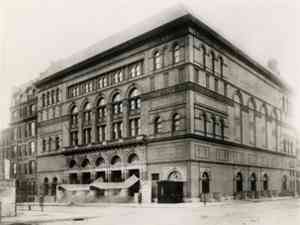
Carnegie Hall Circa 1900
Source: Concert Database
During the above period that Mahler spent floating back and forth across the Atlantic (1908-1911) he applied his hand to compositions that didn't see performance in his lifetime. The majority of 'Das Lied von der Erde' ('The Song of the Earth') had been written at Toblach in 1908, that a symphonic rendering of six songs for two vocalists categorized as a symphony. Bruno Walter conducted its first posthumous performance in Munich on 20 November 1911.
'Das Lied von der Erde' ('The Song of the Earth) GMW 49
Symphony by Gustav Mahler
Composed 1908-09
Premiere 20 Nov 1911 in Munich Pub 1912
Text: Hans Bethge from Ernst Toch's 'Die Chinesische Flöte' ('The Chinese Flute') of 1908
Texas Festival Orchestra / Vladimir Kulenovic
Round Top Music Festival 9 July 2016
Peter Gutmann IMSLP Henry-Louis de La Grange
Mahler Archives Text Wikipedia
Mahler composed 'Symphony No. 9' at Altschluderbach near Toblach in Italy in 1908-09, posthumously premiering in Vienna on 26 June 1912 with Bruno Walter conducting the Vienna Philharmonic Orchestra. 'Symphony No.10' was begun at Altschluderbach in summer of 1910 though left unfinished. There was no rush to complete a performable version of that, not premiering until 1924 only partially. The complete symphony wasn't performed until 13 August 1964 with Berthold Goldschmidt conducting the London Philharmonic Orchestra.
'Symphony No.9' GMW 50 Gustav Mahler
Composed 1909-10
Premiere 26 June 1912 in Vienna Pub 1912
Staatskapelle Berlin / Daniel Barenboim April 2009
Henry-Louis de La Grange Tom Service Wikipedia
'Symphony No.10 GMW F58 Gustav Mahler
Composed 1910
Premiere 12 Oct 1924 in Vienna (partial) 13 Aug 1964 in London (entire) Pub 1924
Bournemouth Symphony Orchestra / Simon Rattle
Tim Ashley Tony Duggan GustovMahler
Sources & References for Gustov Mahler:
VF History (notes)
Audio of Mahler: Catalogs: Classical Archives MuziekWeb International Naxos Presto
Audio of Mahler: Compositions:
Das Lied von der Erde (Vienna Philharmonic / Leonard Bernstein)
Symphony No.2 (New York Philharmonic / Leonard Bernstein)
Symphony No.2 (UC Davis Symphony Orchestra and Chorus / Kern Holoman)
Symphony No.4 (Filarmonica della Scala / Myung-Whun Chung / Milan / 2008)
Symphony No.6 (Vienna Philharmonic / Leonard Bernstein)
Symphony No.9 (Berlin Philharmonic / Leonard Bernstein)
Chronologies:
Andante Gustov Mahler (Español) Gustov Mahler (Europe) Mahler Foundation Mahleria
Compositions: Corpora:
Classic Cat (by date)
Grokipedia (by genre)
Gustov Mahler (Español)
Gustov Mahler (Europe / by title)
Johannes Hanstein (by genre)
IMSLP (by date)
IMSLP (by date / genre / key / title)
IMSLP (by title)
Internationale Gustav Mahler Gesellschaft (by GMW)
Klassika (by date / genre / title)
Mahler-Online (by GMW)
Heikki Poroila (by genre)
Wikipedia English (by genre)
Wikipedia Español (by date / genre / title)
Wikipedia Français (by genre)
Compositions: Symphonies:
GustovMahler: No.1 No.2 No.3 No.4 No.5 No.6 No.7 No.8 No.9 No.10
IMSLP: No.1 No.2 No.3 No.4 No.5 No.6 No.7 No.8 No.9 No.10
Henry-Louis de La Grange: No.1 No.2 No.3 No.4 No.5 No.6 No.7 No.8 No.9
Wikipedia: No.1 No.2 No.3 No.4 No.5 No.6 No.7 No.8 No.9 No.10
Contemporaries: Gustov Mahler (Europe) Mahler Foundation
Documentaries: Andante Mahler (Ken Russell / 1974)
Family: Gustov Mahler (Europe) Mahler Foundation Wikipedia English
Iconography: Europeana Gallica Wikipedia Commons
Lyrics / Texts: LiederNet
Publishers: CPH (Center for Performance History)
Recordings by Mahler: Select:
Mahler Plays Mahler | The Welte-Mignon Piano Rolls (Kaplan Foundation / 1993)
Recordings of Mahler: Catalogs:
DAHR (shellac 1929-1947) Discogs Mahler Foundation
Gustov Mahler (Español) Music Brainz Rate Your Music
Symphonies: No.1 No.2 No.3 No.4 No.5 No.6 No.7 No.8 No.9 No.10
Scores / Sheet Music:
Abe Books (vendor)
Internationale Gustav Mahler Gesellschaft (editions)
Musicalics (vendor)
Further Reading by Source:
Gabriel Engel (Gustov Mahler: Song Symphonist)
Gustov Mahler (Español)
Gustov Mahler (Europe)
Gustov Mahler Society of Chicago
Internationale Gustav Mahler Gesellschaft
F.R. Kinnett (Now His Time Really Seems to Have Come / University of North Texas / 2009)
Tom Service (Big bang theory: discovering Mahler / 2010)
Further Reading by Topic:
Composition Cabins: Mahler Foundation Alex Ross
Usage of Mahler in Film: IMDb
Sigmund Freud meets Mahler (1910):
Didi Balle / Marin Alsop Mahler Foundation Tom Schnabel
See also the film Mahler on the Couch directed by Percy and Felix Adlon / 2010
Mahler in New York:
David Patrick Stearns (Did Gustav Mahler Take the A Train? / 2919)
Mahler in Toblach: Aart van der Wal Toblach Culture Center
Trivia: Classic fM
Bibliography:
CPH (Center for Performance History)
Jens Malte Fischer (Gustav Mahler / Yale University Press / 2011)
Gustov Mahler (Español)
Donald Mitchell (Gustav Mahler: The Early Years / University of California Press / 1980)
Donald Mitchell / Andrew Nicholson (The Mahler Companion / Oxford University Press / 2002)
Mary H. Wagner (Gustav Mahler and the New York Philharmonic Orchestra Tour America / Bloomsbury Academic / 2006)
Authority Search: BMLO BnF Data
Other Profiles:
Deutsche Biography (Deutschsprachige) Encyclopedia Find a Grave
Larousse (Français) Lumen Learning New World Encyclopedia
Classical Main Menu Modern Recording
|
|