
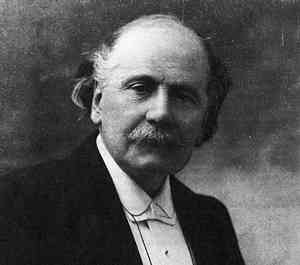
Jules Massenet
Source: Opera Arts
Born on 12 May 1842 in what is now Saint-Étienne, France, Jules Massenet has been generally regarded among the lighter class of composers. Yet he authored 34 operas in addition to four ballets, incidental music, orchestral suites and a large number of melodies for instrument or song. As a prolific composer, when possible he held to a general routine of writing from 4 AM to noon, also earning a large portion of his income by teaching. Though he was an excellent pianist he didn't care much for organ. Having an ironmonger for a father, he attended the Lycée Saint-Louis before winning admittance to the Paris Conservatoire in 1853. Massenet's first published composition was a work for piano in 16 sections after an opera by Meyerbeer, 'Le pardon de Ploërmel', in 1861.
'Le pardon de Ploërmel' B minor Piano piece after Meyerbeere Jules Massenet
Published 1861 in Paris
Piano: Stefan Irmer
In 1863 Jules won the Conservatoire's Prix the Rome, a scholarship to study in Italy for three years. Returning to Paris in 1866, he earned his living as a teacher while publishing compositions. He that year married Louise-Constance "Ninon" de Gressy, a daughter of one of Franz Liszt's patrons. Their only child, Juliette, would be born in 1868. Meanwhile, having worked on a couple of earlier operas, Massenet's first to premiere was his one-act 'La grand'tante' ('The Great-Aunt') at the Opera Comique on 7 April 1867. The great aunt in this opera is Alice, who inherits her deceased husband's property from the nephew to whom it was left, Marquis Guy de Kerdrel, because the latter has fallen in love with her.
Excerpt from 'La grand'tante' Opera by Jules Massenet
Premiere 3 April 1867 at the Opera Comique in Paris
Libretto: Jules Adenis / Charles Grandvallet
Venue above unknown
Directed by Catherine Dune Musical direction by Stéphane Petitjean 2008
Bob's World Bru Zane IMSLP Score Wikipedia
During the Franco-Prussian War, 1870-71, Massenet served in the National Guard [Wikipedia]. Like Gabriel Fauré, he was forced to flee Paris during the subsequent Commune of March to May of 1871. Having worked on a couple more operas since 'Grand-Aunt' and returning to Paris, his second to be performed there was 'Don César de Bazan' premiering at the Opera Comique on 30 November 1872. That boat sank but his revised version that appeared in Geneva on 1 January 1888 fared better. 'Don César de Bazan' surrounds a gypsy girl named Maritana who is the desire of Spanish King Charles II who can't approach her because of her low station. Whence one Don José plots to have her marry an imprisoned Don César de Bazan who is headed for a firing squad for dueling during Holy Week. That would make Maritana a countess with a dead husband, thus available to the king. This succeeds insofar as the two marry, but Don César de Bazan survives his execution due to bullets being removed from the rifles of the firing squad by his young friend, Lazarille, for whom he had been imprisoned. Since part of Don José's reason for assisting the king was to gain the queen's love as a result of the king being unfaithful with Maritana, Don César de Bazan kills him to keep the honor of the royal couple intact. As reward, he is then appointed Governor of Granada and Maritana finds herself lifted from a street singer to a governor's wife.
Overture to 'Don César de Bazan' Opera by Jules Massenet
Premiere 30 Nov 1872 at the Opera Comique in Paris
Libretto: Adolphe Philippe d'Ennery / Philippe François Pinel / Dumanoir Jules Chantepie
Above: Orchestra led by Pierre Dumoussaud at the Opera Comique 2021
Come Lecant de Lisle's 'Les Érinnyes' styled as a Greek tragedie at the Théâtre de l'Odéon on 8 January of 1873 [IMSLP]. The Greek Erinnyes, described in Virgil's 'Aeneid' of 29-19 BC, correspond to the Roman Furies as the chthonic (underworld) goddesses of vengeance. Or, what law can't or doesn't punish poetic justice may. Buddhists and Hindus might call it karma. The principal three of an indefinite number of Erinnyes are named Alecto, Megere and Tisiphone, each represented by a trombone in Massenet's score. Included in the popular 'Les Érinnyes' is the piece written for voice, violoncello or violin titled 'Elegie' which was borrowed from 'Dix Pièces de Genre' Op 10 No.5 for piano published in 1867 which was 'Melodie' in E minor [IMSLP].
'Mélodie' in E minor from 'Dix Pièces de Genre' No.5 of Op 10 Jules Massenet
Piano piece of 1867 Revised 1868
Piano above by Howard Brockway aka Andrei Kmita or Al Sterling
'Elegie' from 'Les Érinnyes' Jules Massenet 1873
BBC Philharmonic Orchestra / Yan Pascal Tortelier Cello uncredited
Massenet's oratorio, 'Marie-Magdeleine', saw performance at the Théâtre de l'Odéon in Paris on 11 April 1873. This is the account of Jesus' latter days according to Mary Magdalene as related in the libretto by Louis Gallet borrowed from 'La vie de Jésus' by Ernest Renan in 1863. Of Massenet's less popular works, this is one that is rarely performed.
'Marie-Magdeleine' Oratorio by Jules Massenet
Premiere 11 April 1873 at the Théâtre de l'Odéon in Paris
Libretto: Louis Gallet from Ernest Renan's 1863 'La vie de Jésus'
Ensemble Corale Ab Harmoniae / Orchestra Sinfonica Ab Harmoniae / Daniele Agiman
Robert Barefield IMSLP Wikipedia
Massenet premiered four more operas from 1874 to 1884 before arriving to his hugely popular 'Manon' with libretto by Henri Meilhac and Philippe Gille, that premiering at the Opéra-Comique on 19 January 1884. Manon is a sensitive young 18th century woman who in the opening of her story is traveling way by coach to live a devoted life in a convent. But along the way she meets one Chevalier des Grieux, traveling home to visit his father. This results in a pair of lovers now needing to stop what they were doing and flee to Paris. Des Grieux' father, however, disagrees and has his son kidnapped. Since des Grieux can't have Manon he devotes himself to the Saint-Sulpice Seminary. When Manon finds out and goes to visit him they fall in love again. The couple are next found gambling at the Hôtel de Transylvanie where they are arrested for cheating. Des Grieux is freed due to his powerful father but Manon is to be deported. Des Grieux is able to catch the convoy in which she is being taken to port. He tells her that they can now be happy together, but it is all to much (not to mention an opera, meaning high pitch dramatic) and Manon dies in his arms.
'Manon' Opera by Jules Massenet
Premiere 19 Jan 1884 at the Opéra-Comique in Paris
Libretto: Henri Meilhac / Philippe Gille
Berliner Staatsoper / Staatskapelle Berlin / Daniel Barenboim 2007
Edwin Ahearn Aaron Green IMSLP Metropolitan Opera Score Wikipedia
Massenet's 'Le Cid' is a grand opera which premiered in Paris on 30 Nov 1885 with libretto by Adolphe d'Ennery, Édouard Blau and Louis Gallet after Pierre Corneille's eponymous tragicomedy of 1637. In this version of the tale, Rodrigue kills the father of his lover, Chimène, to avenge his own father. This, of course, leaves Chimène with a torn heart as Rodrigue goes off to battle the Moors. He returns as Le Cid (Lord or Master), so named by the defeated Moors. The king wishes to reward his war hero, whence Rodrigue replies to let his fate to be decided by Chimène. As she can't choose between forgiving him or wanting him punished for killing her father in defense of his own father's honor, Rodrigue threatens to kill himself. She now realizes that their love is not to waste and pardons him.
Overture to 'Le Cid' Opera by Jules Massenet
Premiere 30 Nov 1885 at the Paris Opera
Libretto: Adolphe d' Ennery / Édouard Blau / Louis Gallet after Pierre Corneille's 'Le Cid' of 1637
Orchestre Philharmonique de Marseille / Jacques Lacombe
Aaron Green Gary Hoffman IMSLP Odyssey Opera Wikipedia
Another of Massanet's greater operas was 'Werther' premiering at the Hofoper in Vienna on 16 February 1892. Werther is 23 year-old poet in love with the wife, Charlotte, of one Albert. Charlotte loves Werther as well. Werther borrows a couple of pistols from Albert, to the purpose of protection on a journey. The drama ends when Werther shoots himself in despair that his darling belongs to another man.
Prelude to Act 1 of 'Werther' Opera by Jules Massenet
Premiere 16 Feb 1892 at the Hofoper in Vienna
Libretto: Édouard Blau / Paul Milliet / Georges Hartmann
After Goethe's 1774 'Die Leiden des jungen Werthers'
Paris Opera C & O / Georges Sebastian
Keith Anderson Aaron Green IMSLP
Metropolitan Opera Opera Online Score Wikipedia
Massenet wrote his single piano concerto in 1902 in dedication to composer and pianist, Louis Diémer, who performed it at its premiere at the Paris Conservatoire on 1 February 1903.
'Piano Concerto' Jules Massenet
Completed 5 Oct 1902 Premiere 1 Feb 1903 at the Paris Conservatoire
Westphalian Symphony Orchestra / Siegfried Landau
Piano by Marylene Dosse
Sometime in 1903 Massenet recorded on wax cylinder 'Pendant un an je fus ta femme' from his 1897 opera, 'Sappho', backing soprano, Georgette Leblanc, on piano. This was not intended to be issued but copies are held in various libraries. Most classical composers viewed recording during the early years of that industry as pointless due to poor fidelity until the advent of electrical recording and the microphone in 1925. Many did, however, make obligatory contributions to Edison, Columbia or Berliner (prior to Victor) for documentary rather than listening reasons. Sound quality wasn't such a bother, though, in the popular genre rising out of ragtime. Recordings didn't have to sound actual to sell a whole load of them scratchy and all.
Massenet presented 'Chérubin' at the Opéra de Monte-Carlo on 14 February 1905 with libretto by Francis de Croisset and Henri Cain. That was with Scottish soprano, Mary Garden, in the lead role, she six days shy of her 31st birthday at the premiere. Garden was the star of the Opera Comique [Wikipedia] whose fame would lead into the latter half of the 20th century, she not to die until 1967. Other works by Massanet that she performed both in Europe and the United States (he not present) were 'Thais', 'Sapho', 'Le Jongleur de Notre Dame' and 'Cléopâtre'. As for 'Chérubin', its namesake is the page of Count Almaviva. Chérubin has a lot of love to go around upon getting recruited into the army including a famous ballet dancer, L'Ensoleillad, and the wife of his Count. Meanwhile Nina, a lowly maid to Countess Almaviva, loves Chérubin and saves him from the Count's ire by claiming that Chérubin's discovered love letter to his wife was actually written to her. But Chérubin now serenades L'Ensoleillad. Not only his countess, but the listening wives of a baron and even the Duke believe that Chérubin is singing of his love to them. Such finds Chérubin challenged to not one, but three duels with a count, a baron and a duke. He is able to explain his serenading of L'Ensoleillad to the wives of the baron and the count, whence those duels get canceled. But once again Nina must save the day, convincing Chérubin to love her, thereat canceling his duel with the duke.
Overture to 'Cherubin' Opera by Jules Massenet
Premiere 14 Feb 1905 at the Opéra de Monte-Carlo
Münchner Rundfunkorchester / Pinchas Steinberg 1991
Massenet premiered another of his more appreciated operas, 'Don Quichotte', at the Opéra de Monte-Carlo on 19 February 1910. This version of 'Don Quichotte' opens at a festival in Spain during which old Don Quichotte joins several others in the serenading of his beloved Dulcinée who stops a swordfight between him and another suitor. She then assigns him the task of retrieving a pearl necklace stolen by bandits, the prospects of which doesn't' at all please his squire, Sancho. Along their way a group of windmills appear which Don Quichotte takes for giants, attacking one only to get caught in a sail and suspended midair. They later get caught by the bandits they are pursuing. Their leader, Ténébrun, admires old Don Quichotte's bravery and sense of nobility, willing to fight them all to retrieve his beloved's necklace, which he therefore hands over. Returning with Sancho to the home of his beautiful Dulcinée as the latter holds a party, Don Quichotte returns her necklace, then asks her to marry him. She denies him and others in her company make fun of the old man. In the fifth and final act in mountain forest Sancho looks on as Don Quichotte falls and dies, called to a world beyond by his imaginary Dulcinée.
'Don Quichotte' Opera by Jules Massenet
Premiere 19 Feb 1910 in Monte-Carlo
Performance above directed by Gilbert Deflo 2000
C & O of the Opéra National de Paris / James Conlon
Don Quichote: Samuel Ramey Lady Dulcinée: Carmen Oprisanu Sancho: Jean-Philippe Lafont
IMSLP Opera Folio Score Bruce Scott Wikipedia
The last opera that Massenet premiered was 'Roma' at the Opéra de Monte-Carlo on 19 February 1912 with libretto by Henri Cain [IMSLP]. 'Roma' takes place in 216 BC Rome after the August Battle of Cannae in which the Carthaginian general, Hannibal, is victorious. Unfortunately, Fausta, daughter of Fabius who is the son of Hercules, has let the fires at the Temple of Vesta go out, a sacrilege for which she must pay with her life by being buried alive. She has one way out, however, which cheer shows up in the person of her blind grandmother, Posthumia, who ends up stabbing her to death [Wikipedia].
Three of Massenet's operas had to wait until his death to be performed posthumously: 'Panurge' (a character in Rabalais' 16th century 'Gargantua and Pantagruel') in 1913, 'Cléopâtre' in 1914 and 'Amadis' in 1922, the last in which Amadis unknowingly kills his brother, Galaor. In 'Cléopâtre' which Massenet authored last, Roman Marc-Antoine and his Egyptian lover both die by suicide, one by sword the other by venomous snake.
'Cleopatra' Opera by Jules Massenet
Posthumous premiere 23 Feb 1914 in Monte-Carlo
Libretto: Louis Payen
Performance above 13 July 2002 in Rome
Orchestra of the Mediterraneo Unito / Miquel Ortega
Marc Antoine: Filippo Bettoschi Cleopatra: Montserrat Caballé
Bru Zane IMSLP Libretto Musikproduktion Höflich
Phil's Opera World San Francisco Opera Wikipedia
Massanet died on 13 August 1912 of abdominal cancer. His memoir, 'Mes Souvenirs', was published in France the same year, later translated into English.
Sources & References for Jules Massenet:
Nick Fuller VF History (notes) Wikipedia English
Audio of Massenet: Corpora:
Authorship: Mes Souvenirs (1912): English (scroll) Français
Compositions: Corpora:
All Music (alphabetical)
Chris Hapka (operas / Stanford University)
IMSLP (by date / genre / Op / title)
IMSLP (melodies)
IMSLP (operas)
Klassika (by date / genre / Op / title)
RYM (by genre)
Wikipedia English (by genre)
Wikipedia English (operas)
Wikipedia Russian (by genre)
Wikipedia Spanish (chronological)
Iconography: Find a Grave Gallica Wikimedia Commons
Recordings of Massenet: Catalogs:
45 Worlds Arkiv DAHR (shellac / 1901-1947)
Discogs Internet Archive Music Brainz
Recordings of Massenet: Individual:
Chérubin (Orchestra del Teatro Lirico di Cagliari / Emmanuelle Villaume / Dynamic / 2006)
Complete Solo Piano Works (piano by Stefan Irmer / 2011)
Manon (Symphony Orchestra & Choruses of the Monnaie / Antonio Pappano / Manon by Angela Gheorghiu / 2001)
Manon (Orchestra & Chorus of the Opéra National de Paris / Jesús López-Cobos / Manon by Renée Fleming / 2003)
Roma (Bratislava Chamber Choir / Orchestra Internazionale d’Italia / Marco Guidarini / 1999)
Werther (Paris Opera C & O / Elie Cohen / 1931)
Scores / Sheet Music:
Abe Books (vendor) IMSLP Internet Archive
Musicalics (vendor) MusOpen Scorser
Further Reading:
Association Massenet (France)
(Massenet, Mary Garden, and the Chicago Opera 1910-1932 / 1984)IMDb (usage of Massenet in film)
Opera Wire (favorite operas)
Bibliography: Classic Cat Internet Archive
Authority Search: BMLO BNF Data Deutschen Nationalbibliothek
Other Profiles:
Ю. А. Кремлёв (Музыкальная энциклопедия [Musical Encyclopedia] / 1973-82)
Musicologie (French)
Wikipedia: French German Russian Spanish
Classical Main Menu Modern Recording
|
|