
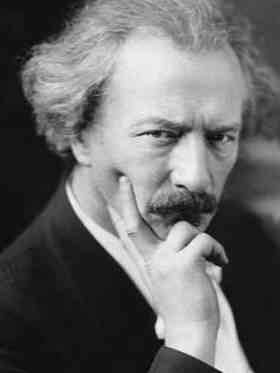
Ignacy Jan Paderewski 1920
Source: Polonia Music
Born on 18 November 1860 in Kuryłówka, Russia, Ignacy Jan Paderewski was a Polish composer and pianist who enrolled into the Warsaw Conservatorium in 1872. He was yet a student in 1876 when he wrote a lost 'Valse mignonne' and about 1876 when 'Waltz in F major' arrived, listed in Volume 4 of the DzW (Dzieła wszystkie Paderewskiego) of 1997. Another major authority of Paderewski well to reference from the start is the Bote und G. Bock publishing firm in Berlin (B&B) which published Paderewski since 1882. Bote & G. Bock had been founded in 1838 by Eduard Bote and Gustav Bock. These are the major sources in the cataloguing of Paderewski.
Paderewski became a private tutor at the Conservatory upon graduating in 1878. His original Op 1 of 1879 was 'Suite' in E=flat major for piano containing No.1 'Preludium a Cappriccio', No.2 'Menuetto', No.3 'Romans' and No.4 'Burleska'. This changed upon publishing 'Zwei Klavierstücke' in 1886 to the inclusion of only No.1 'Preludium a Cappriccio' and No.2 'Minuetto'. Paderewski's Op 2, 'Trois Morceaux' pour piano was published by Kruziński and Levi in Warsaw in 1881.
Paderewski's wedding to fellow student, Antonina Korsakówna, had occurred in 1880, the same year he dedicated 'Stara Suita' Op 3 to her. Perkowska has that published by B&B in 1882. His wife, Antonina, died in 1881 only several weeks after giving birth to a handicapped son, Alfred. Paderewski began studies in composition in Berlin in 1881 with Friedrich Kiel and Heinrich Urban. Come 'Elegy' in B flat major Op 4 published by B&B in 1882, not known just when he composed it.
'Danses Polonaises' Op 5 consisting of three pieces for piano had been composed in 1881 for publishing by B&B in 1882. Paderewski left Berlin for Vienna in 1884 to study with Theodor Leschetizky. His first professional performance was in Vienna in 1887, the year he published 'Humoresques de Concert' Op 14 consisting of Cahier I: 'à l'Antique' and Cahier II: 'Moderne' with three pieces each. Sequence below is by composition date excepting 'Elegia' published in 1882. Due to the two pieces of Op 1 being composed in 1879 and 1885 the Opus sequence tied to publishing will seem out of sequence, not to mention that Op 1 wasn't published until 1886, four years after Op 5 in 1882. Basically, Op 1 No.2 precedes Op 1 No.1 below. Data is per Małgorzata Perkowska who sequences Op 3 before Op 4, just as one might assume, though it isn't known when it was composed.
'Minuetto' Op 1 No.2 From 'Zwei Klavierstück' Op 1 Ignacy Paderewski
Comp 1879 Pub 1886
Piano: Michał Karol Szymanowski
'Trois Morceaux' ('Three Pieces') Op 2 Ignacy Paderewski
No.1 'Gavotte'
No.2 'Mélodie'
No.3 'Valse mélancolique'
Comp 1880 Pub 1881
Piano: Karol Radziwonowicz
'Stara Suita' ('An Old Suite') Op 3 Ignacy Paderewski
No.1 'Preludio'
No.2 'Intermezzo'
No.3 'Aria'
No.4 'Fuga'
Comp 1880 Pub 1882
Piano: Karol Radziwonowicz
'Elegia' Op 4 in B-flat major Ignacy Paderewski
Comp unknown Pub 1882
Piano: Michał Karol Szymanowski
'Danses Polonaises' Op 5 Ignacy Paderewski
No.1 'Krakowiak' in E major
No.2 'Mazurek' in E minor
No.3 'Krakowiak' in B-flat major
Comp 1881 Pub 1882
Piano: Karol Radziwonowicz
'Powódz' ('Flood') WoO in A minor Ignacy Paderewski
Comp 1884 Pub 1997
Piano: Karol Radziwonowicz
'Praeludium ŕ (à) Capriccio' Op 1 No.1 From 'Zwei Klavierstück' Op 1 Ignacy Paderewski
Comp 1885 Pub 1886
Piano: Michał Karol Szymanowski
'Humoresques de Concert' 'Cahier I' of II Op 14 Ignacy Paderewski
No.1 'Minuet' in G major
No.2 'Sarabande' in B minor
No.3 'Caprice' in G major
Comp 1885-87 Pub 1887
Piano: Jonathan Plowright
Leading a highly successful career from the start, Paderewski wrote numerous works for violin which fared not so well as his piano compositions, such as his 1888 'Violin Concerto', part of which he destroyed "under the spell of a weird melancholy.” This was later reconstructed by A. Roezler for premiere in Warsaw in 1991. His 'Piano Concerto' of 1888, however, survived toward premiere in Vienna in 1889. Upon performing at concerts throughout Europe in the latter eighties, Paderewski was rich by the time he gave his first performance in New York City at Carnegie Hall [Wikipedia] on 17 November 1891. Tchaikovsky had only recently officially opened Carnegie Hall in May of 1891. Busoni had also first arrived to New York in August before moving on to Boston. Paderewski would spend the coming years continually touring venues in America and Europe. His relationship with Steinway & Sons [Wikipedia] began per his tour of the United States and Canada in 1892, presenting problems for the 1893 World's Fair in Chicago, as he refused to play any piano but the one Steinway had made for him (see also Paderewski's 1925 Warsaw Musical Conservatory Steinway).
'Piano Concerto' Op 17 in A minor Ignacy Paderewski
Comp 1888 Premiere 1889 in Vienna Pub 1890
Deutsche Radio Philharmonie / Yves Abel
Piano: Claire Huangci
20 Dec 2020 in Paderborn, Germany
IMSLP Anna Iwanicka-Nijakowska Jeremy Nicholas Małgorzata Perkowska
It was 31 May of 1899 when Paderewski married Helena Maria von Rosen, having met her back in 1878 prior to his brief marriage to Antonina in 1880. Paderewski's solitary opera, 'Manru', premiered in Dresden on 29 May of 1901 with libretto by Alfred Nossig based on Jósefa Ignacego Kraszewski's 1843 novel, 'Chaty za wsią' ('The Cabin Behind the Woods'). This opera is a love story between one Manru and the Polish woman, Ulana. The trouble is that Manru is a Romani, and gypsies, naturally, aren't liked.
'Manru' Op 20 Opera by Ignacy Paderewski
Comp 1892-1901 Premiere: 29 May 1901 in Dresden Pub 1901
Libretto: Alfred Nossig after Kraszewski
Director music: Tadeusz Kozłowski
Director stage: Marek Weiss
Costumes / set: Kaaspar Glarner w Dorota Karolczak
Choreography: Izadora Weiss
Teatr Wielki in Poznan, Poland 2019
IMSLP Anna Iwanicka-Nijakowska MusicWeb International New York Times 1902
Małgorzata Perkowska Maja Trochimczyk Wikipedia James L. Zychowicz
Paderewski had begun sketching his 'Piano Sonata' in E flat minor back in April of 1887, not to complete it, though, until 1903 toward publishing in 1906.
'Piano Sonata' Op 21 Ignacy Paderewski
Comp 1886-1903 Pub 1906 Berlin
Piano: Benny Wollin Dec 2017
IMSLP Anne Marie Nelson Małgorzata Perkowska
Jed Distler indicates that Paderewski made 16 piano rolls for Welte-Mignon in 1906, fourteen of which are listed with a date of 27 February 1906 at Electronic Editorials Padstow (chart by Peter Phillips). Most of those were pieces by other composers like Chopin, Schubert and Liszt including one of his favorite works, Beethoven's 'Moonlight Sonata' requiring two cylinders per Welte-Mignon 1246 and 1247. His own 'Nocturne' Op 16 No.4 and 'Minuet' in G Op 14 No.1 saw issue on 1262 and 1263. Paderewski recorded that on multiple occasions. He also made rolls for Aeolian. See IAMMP.
Franz Liszt's 'Hungarian Rhapsody No.10' of 1847 Piano roll by Ignacy Paderewski
27 Feb 1906 in Leipzig, Germany Welte-Mignon 1251
With the exception of a hymn in 1917 Paderewski completed his last Opus, 'Symphony' in B minor ('Polonia'), in time for its first performance on 12 Feb 1909 by the Boston Symphony Orchestra conducted by Max Fiedler.
'Symphony' Op 24 in B minor Ignacy Paderewski
Comp 1903-1908 Premiere: 12 Feb 1909 in Boston Pub 1911
Symphony Orchestra of Pomerania / Bohdan Wodiczko
IMSLP Anna Iwanicka-Nijakowska Małgorzata Perkowska
Paderewski recorded multiple issues on flat disc for Gramophone (parent to HMV), the latter in 1911 at his residence in Switzerland to include five pieces by Chopin and his own 'Minuet' in G from 'Humoresques de concert' on 045530 (Gramophone matrix 345ai recorded in July of 1911). He would also issue numerous 78 rpms on Victor (see DAHR).
'Minuet' Op 14 No.1 in G major Ignacy Paderewski
From Cahier I of 'Humoresques de concert'
July 1911 at his home in Morges, Switzerland Matrix 345ai Gramophone 045530
Paderewski moved to the U.S. in 1913, there to purchase country in California for a vineyard. He later purchased land in Santa Maria toward oil exploration. The opening of World War I in 1914 saw Paderewski adding political activism to his schedule in 1915 as he began to make speeches toward the relief of Polish casualties and the establishment of an independent Poland, agendas meeting the support of Presidents Wilson and Hoover while raising millions of dollars for Polish victims of the Great War. In the meantime Paderewski composed his last work, 'Hej, Orle Bialy' ('Hey, White Eagle'), in 1917, that a patriotic hymn for male chorus and piano or wind orchestra with text by himself.
'Hej, Orle Bialy' ('Hey, White Eagle') F major Military anthem by Ignacy Paderewski
Comp 1917 New York Pub 1918
Cantores Minores led by Joseph A. Herter
IMSLP Małgorzata Perkowska Score Score Text
About the time of 'Hej, Orle Bialy' Paderewski's Polish activism developed toward statesmanship upon joining the Polish National Committee (PNC) in Paris, founded in 1917 to the purpose of creating the state of Poland. It was Paderewski's speech in Poznań in 1918 that instigated the Greater Poland Uprising against Germany. Paderewski became Prime Minister and Minister of Foreign Affairs of the new state of Poland on 18 January 1919, thereat the PNC closing shop [SPCHD]. He resigned as Foreign Minister the same year, becoming Polish Ambassador to the League of Nations instead. Serving as Prime Minister to 27 November 1919, he resigned from politics in 1922 to take up performing again, his first concert at Carnegie Hall. He next played at Madison Square Garden [Wikipedia], then toured the United States via his own private railway car. He hesitated, then consented to appear in the film, 'Moonlight Sonata', playing himself, in 1938 [1, 2, playing Beethoven, playing Chopin].
'Moonlight Sonata' (Beethoven 1801) Ignacy Paderewski
From the film 'Moonlight Sonata'
Directed by Lothar Mendes Released 9 May 1938
IMDb Letterboxd Darek Makowski Silver in a Haystack Wikipedia
Also in 1938 Scribner published 'The Paderewski Memoirs' written with the assistance of Mary Lawton (see Authorship below). The opening of World War II in September 1939 saw Paderewski back in politics, becoming head of the Polish parliament in exile in London. The next year he was eighty years old. Scheduled to appear at Madison Square Garden, he refused, his explanation that he had already played there, referring to his performance twenty years prior as if it had been only recently. His last visit to America commencing in November of 1940, Paderewski died of pneumonia while on tour on 29 June 1941 in New York. His burial at Arlington, Virginia, with military honors, was meant to be temporary, though his remains didn't see removal to St. John's Archcathedral in Warsaw until 1992. His heart, however, is buried separately in Doylestown, Pennsylvania [Arlington National Cemetery / Józef Piłsudski Institute].
Sources & References for Ignacy Jan Paderewski:
VF History (notes) Wikipedia English Wikipedia Polish
Audio of Paderewski: Individual:
Elegia (Op 4 in B-fat minor / comp unknown / pub 1882 / piano by Emmanuel Garnier)
Elegia (Op 4 in B-fat minor / comp unknown / pub 1882 / piano by Karol Radziwonowicz)
Humoresques de Concert (Op 14 / Cahier 1 & 2 / comp 1885-87 / pub 1887 / piano by Karol Radziwonowicz)
Piano Sonata (Op 21 in E-flat minor / comp 1896-1903 / pub 1906 / piano by Anderzej Stefanski)
Audio of Paderewski Recordings on Disc: Roger Wilmut
Audio of Paderewski Recordings on Piano Roll:
Chopin (Ballade / Op 47 No.3 in A-flat major / Welte-Mignon 6832 / Jan 1925)
Chopin (Etude / aka Butterfly / Op 25 No.9 in G-flat major / Welte-Mignon 1253 / 27 Feb 1906)
Paderewski (Minuet in G major / 1887 / Welte-Mignon 1236 / 27 Feb 1906)
Audio of Paderewski: Various: Hyperion Presto
Authorship:
University of Southern California (articles / books / lectures / speeches)
The Paderewski Memoirs (with Mary Lawton / 1938)
Poland Past and Present (address of 5 February 1916 / World War I):
Internet Archive (scroll) Polona
Awards / Honors: Wikipedia Polish
Chronology: Jagiellonian University (Kraków)
Collections:
IJ Paderewski Centre for the Documentation of Polish Music
Compositions: Corpora:
Classic Cat (by date / Opus / WoO)
IMSLP (alphabetical)
IMSLP (by Opus / WoO)
Jagiellonian University (Kraków / by Opus / WoO)
KF-Archive (by Opus / WoO)
Klassika (by date / genre / Opus / title)
Johannes Hanstein (by genre) (alt)
Paderewski Music Society (by date)
Małgorzata Perkowska (by genre) (alt)
Polska Biblioteka Muzyczna (by date)
Iconography: Jagiellonian University (Kraków) Wikimedia Commons
Lyrics / Texts: LiederNet
Recordings by Paderewski: Select:
His Final Recordings (HMV 1937 / 1938)
Paderewski on Welte-Mignon Rolls (DUX 0324-25 / 2013)
Piano Sonata in E flat minor / Op 21): BBC Classical Music Hyperion
Recordings of Paderewski: Catalogs: 45 Worlds Arkiv Discogs Music Brainz RYM
Recordings of Paderewski: Select:
Symphony (aka Polonia / Op 24 in B minor / 1908): All Music Hyperion
Scores / Sheet Music:
Abe Books (vendor)
(Kraków)Musicalics (vendor)
National Library of the Czech Republic
Further Reading by Author:
Antonina Adamowska / Maria Piłatowicz (The Private Life of Paderewski 1935)
Lynn René Bayley (comparing the mechanical piano roll to Paderewski)
Boston Symphony Orchestra (performance history of Paderewski)
Kąśna Dolna (Ignacy Jan Paderewski Chamber Orchestra)
Jagiellonian University (Kraków)
Jagiellonian University (Kraków / Paderewski in Kraków)
Henry E. Krehbiel (American Tour 1895-1896)
Sarah Linn (A Polish Patriot in Paso Robles: Celebrating Ignacy Jan Paderewski)
Keegan Morris (Meet the pianist and statesman who helped secure Poland’s independence / 2018)
Christopher Onzol (Paderewski in California)
Paderewski Music Society (various authors)
Małgorzata Perkowska (The Unknown Compositions of Ignacy Jan Paderewski / 1988)
Piano Forum-Pianists-Classical Music
Polskie Radio (Paderewski as statesman)
David A. Taylor (Paderewski's relationship with Steinway) (alt)
Maja Trochimczyk (Paderewski in Poetry: Master of Harmonies or Poland’s Savior?)
Zespół Szkół Muzycznych (Paderewski State Primary and Secondary School of Music in Tarnow)
Further Reading by Topic:
1893 Chicago World's Fair: Steinway controversy: Chicago History Today John R. Schmidt
Polish Coat of Arms: Alena Aniskiewicz Crazy Polish Guy Robert Strybel Wikipedia
Bibliography:
Jagiellonian University (Kraków)
Craig H. Roell (The Piano in America, 1890-1940 / University of North Carolina Press / 2018)
Maciej Siekierski (Helena Paderewska: Memoirs 1910–1920 / 2021)
Taylor & Francis (Encyclopedia of Recorded Sound / 2004)
University of Southern California
Authority Search: BnF Data
Other Profiles:
Adrian Corleonis (All Music)
Grove's Dictionary of Music and Musicians (1916) (scroll)
Ignacy Jan Paderewski Academy of Music (Poznań)
Georg Predota (Interlude)
Eve Sobolewski / Szymon Majcherowicze
University of Southern California
Wikipedia: Deutschsprachige Español Italiano Pусский
Classical Main Menu Modern Recording
|
|