
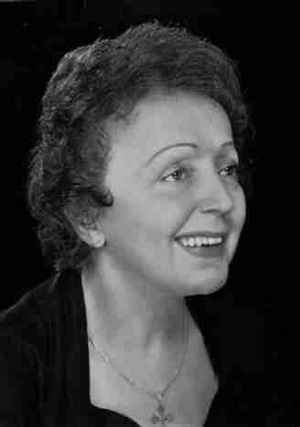
Édith Piaf
Source: Classical Source
Born Édith Giovanna Gassion in Paris on 19 December 1915, Édith Piaf was a cabaret, torch and chanson singer first professionally performed at age 14 as a singing acrobat with her father and half-sister Simone "Mômone" Berteaut. She obtained her first nightclub gig in 1933 at Juan-les-Pins. In 1935 she began singing at Le Gerny where owner, Louis Leplée, changed her name to La Môme Piaf (Little Sparrow) and she began to perform exclusively in black. The next year she changed her name to Edith Piaf to disassociate herself from bad company acquired thus far in her career. Louis Leplée had been murdered by mobsters she knew, and she herself had been suspect. Her first recordings appeared in January 1936: 'Les Momes de la Cloche' and 'L'Étranger' (Polydor 524.157). Piaf had recorded both songs on 5 November 1935 but they were rejected. She then recorded both songs twice again, all four matrices released as Polydor 524.157. Caveat this page: I've used alphabetical order where I've not been able to determine exact dates during the same year. Such may or may not be in correct chronological sequence.
'Les Mômes de la cloche' ('Kids of the Bell') Édith Piaf
Piaf's 1st recording to issue
18 Dec 1935 at Polydor Studio 2 in Paris Matrix HPP 2202 Polydor 524.157
24 March 1936 at Polydor Studio 2 in Paris Matrix WPP 2376 Polydor 524.157
Music: Vincent Scotto Lyrics: André Decaye
'L'Étranger' ('The Stranger') Édith Piaf
Piaf's 2nd recording to issue
18 Dec 1935 at Polydor Studio 2 in Paris Matrix HPP 2204 Polydor 524.157
13 Jan 1936 at Polydor Studio 2 in Paris Matrix WPP 2234 Polydor 524.157
Music: Juel (Chiara Panzieri) / Marguerite Monnot Lyrics: Robert Malleron
'Dans la Garçonne' ('In the Tomboy') Édith Piaf
From the film 'La Garçonne' ('The Tomboy') released 21 Feb 1936
Music: Jean Wiener Lyrics: Louis Poterat
'Quand Même' ('Anyway') Édith Piaf 1936
Music: Jean Wiener Lyrics: J. Mario / Louis Poterat
'Y'Avait du Soleil' ('There Was Sunshine') Édith Piaf 1936
Composition: Jean Lenoir
Piaf met composer, Marguerite Monnot [Wikipedia], in 1936 with whom she would begin collaborating in the early forties. Piaf saw her rise to stardom in France during World War II. Performing for German occupation forces, notably with members of the future Compagnons de la Chanson beginning in 1944. Le Compagnons de la Chanson consisted of eight or nine members and were founded in 1946 out the choir of the Compagnons de France formed in 1941, the latter performing for forty years until disbanding in 1985. Edith and others alike who performed for the German military were considered traitors by many, albeit she was a part of the French Resistance by her own claim and helped a number of people, including at least one Jew, escape Nazi persecution. After that conflict Piaf toured Europe, the United States and South America.
'Escales' ('Stop Over') Édith Piaf
1940 Polydor 524.669
Music: Marguerite Monnot Lyrics: Jean Marèse
'On danse sur ma chanson' ('We Dance to My Song') Édith Piaf 1940
Composition: Leo Poll / Raymond Asso
'Les Trois Cloches' ('The Three Bells') Édith Piaf
25 June 1946 in Paris Matrix: CLX2465 Columbia BFX-20 / DFX-242
Composition: Jean Villard
Piaf's career notably bloomed in post-war Paris in 1947, the year she wrote the lyrics to Yves Montand's 'Mais qu’est-ce que j’ai?' with music by Henri Betti. Piaf made contributions to a number of compositions. She is thought to have written the music and lyrics to 'Les yeux de ma mère' in 1947, the year she recorded 'La Vie en rose' which brought her to much attention in the United States upon its issue in English in latter 1950 with lyrics by herself translated by Mack David to music by Louiguy and Marguerite Monnot. The latter fifties brought association with lyricist, Georges Moustaki [Wikipedia].
'La Vie en Rose' ('Life In Pink') Édith Piaf
4 Jan 1947 in Paris Columbia DF-3152 / BF-136
Conducting: Guy Luypaerts
Music: Louiguy (Louis Guglielmi) Lyrics: Piaf
'La Vie en Rose' ('Life In Pink') Édith Piaf
English lyrics by Mack David
8 July 1950 in Paris Columbia 4053-F / 38948 / 3-38948 (45 rpm)
Conducting: Robert Chauvigny
Music: Louiguy (Louis Guglielmi) Lyrics: Piaf
'L'Hymne à l'Amour' ('Hymn to Love') Édith Piaf
From the film 'Paris chante toujours' ('Paris Still Sings') released 29 Nov 1951
Music: Marguerite Monnot Lyrics: Piaf
'L'Accordeoniste' Édith Piaf Television
3 April 1954 'La joie de vivre' ('The Joy of Living')
Composition: Michel Emer
1st title to sell a million copies upon it's release in 1940
'The Poor People of Paris' ('Les pauvres de Paris') Édith Piaf Television
23 Sep 1956 'Ed Sullivan Show'
Music: Marguerite Monnot Lyrics: René Rouzaud
'Les Amants d'un Jour' ('Lovers for a Day') Édith Piaf
Filmed live in concert sometime 1960 Venue unknown
Music: Marguerite Monnot Lyrics: Claude Delécluse / Michelle Senlis
'La Foule' ('The Crowd') Édith Piaf
Filmed live in concert sometime 1960 Venue unknown
Music: Ángel Cabral Lyrics: Enrique Dizeo / Michel Rivegauche
'Non Je ne Regrette Rien' ('No, I Regret Nothing') Édith Piaf 1960
Music: Charles Dumont Lyrics: Michel Vaucaire
'Milord' ('My Lord') Édith Piaf
Filmed live in concert sometime 1962 Venue unknown
Music: Marguerite Monnot Lyrics: George Moustaki
'L'Homme de Berlin' ('The Man From Berlin') Édith Piaf
Piaf's last-known recording made in April 1963
Music: Francis Lai Lyrics: Michèle Vendome
Piaf had lived in various locations in Paris until her death of liver cancer in France on 10 October 1963. Her last words were reportedly "Every damn thing you do in this life you have to pay for." Her funeral in Paris was attended by more than 100,000 people.
Sources & References for Édith Piaf:
Steve Huey (All Music)
VF History (notes)
Associates Musical:
Compagnons de la Chanson (formed 1946 from the choir of Le Compagnons de France):
Le Blog des Auteurs Libres Compagnons de la Chanson Wikipedia
Audio of Piaf: Internet Archive
Autobiography: The Wheel of Fortune (1958): Goodreads Rizzoli
Compositions: Music Brainz Second Hand Songs
Documentaries:
Edith Piaf: The Perfect Concert & The Documentary (2009)
Edith Piaf: The Little Sparrow (Sodeco Media)
Edith Piaf "The Little Sparrow" (Short Biographies)
The Last Days of an Icon: Edith Piaf (directed by Pilippe Pichon / 2005)
Piaf: Her Story, Her Songs (directed by George Elder and Bernard Salzmann / 2003)
The Tragic Real-Life Story of Edith Piaf (Short Biographies)
Without Love We Are Nothing (directed by Marianne Lamour / 2004)
Interviews:
9 April 1958 (with Pierre Tchernia)
6 Jan 1962 (with Pierre Desgraupes)
Recordings / Catalogs: 45 Worlds Discogs RYM Wikipedia
Recordings / Sessions: DAHR (1941-55)
Repertoire (mentioned herein / chronological by year issued):
Les Mômes de la cloche (1936 / Vincent Scotto / André Decaye)
L'Accordeoniste (1940 / Michel Emer)
La Vie en Rose (1947 / Louiguy / Piaf)
L'Hymne à l'Amour (1950 / Marguerite Monnot / Piaf)
Les Amants d'un Jour (1956 / Marguerite Monnot / Claude Delécluse / Michelle Senlis)
The Poor People of Paris (1956 / Marguerite Monnot / Piaf)
La Foule (1957 / Ángel Cabral / Michel Rivgauche)
Milord (1959 / Marguerite Monnot /Georges Moustaki)
Non Je ne Regrette Rien (1960 / Charles Dumont / Michel Vaucaire)
Wikipedia (songs recorded 1935-63)
Piaf in Visual Media: IMDb
Further Reading:
Brooke Allen (“No Regrets”: Discovering Edith Piaf’s epically messy love life / 2011)
Jeremy Allen (Europe Is Our Playground: The Declining Power of Edith Piaf / 2013)
Ewa Hanna Mazierska (Singing One’s Life: Biopics of Edith Piaf and Dalida / 2014)
Authority Search: BNF Data
Other Profiles:
Donald Clarke (Music Box)
Wesley Morris (Boston Arts & Entertainment / 2007)