
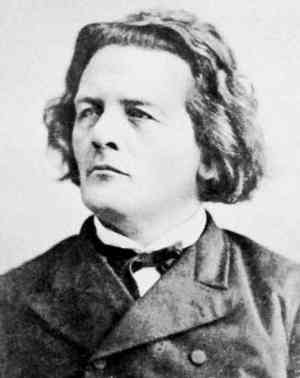
Anton Rubinstein
Source: Bach Cantatas
Born on 28 November 1829 at Vikhvatinets, Baltsky Uyezd, in the Podolia Governorate of the Russian Empire (what is presently Maldova southwest of Ukraine, Anton Rubinstein's father owned a pencil factory. He was the brother of composer and pianist, Nikolai Rubinstein. Writing nearly twenty works for stage, Rubinstein also composed chamber music, concertos, symphonies and pieces for solo piano or voice.
A piano virtuoso, Rubinstein began to play the instrument at age five. He was eventually placed under the tutorship of music teacher, Alexander Villoing, who recognized Rubinstein's potential, brought it to fruition and took him on a tour of Europe in 1840, starting in Paris. A second tour at age fourteen, confined to Russia, followed in 1843 with his brother, Nikolai, at age eight. Rubinstein's Op 1 is assigned to 'Ondine', an etude for piano in D flat major composed in 1842 and published in 1843.
'Ondine' Op 1 D-flat major Etude by Anton Rubinstein
1842 Published in Berlin 1843
Piano: Michel Cardinaux
In 1844 Rubinstein's mother took her boys to Berlin. She returned with Nikolai to Russia in 1846, Anton leaving a time later for Vienna, hoping to study with Franz Liszt, to disappointment. He was seventeen at the time and could no longer be billed as a child prodigy. Persuaded to return to Russia by the Revolution of 1848, Anton found a patron in Saint Petersburg in Princess Charlotte of Württemberg, sister to Tsar Nicholas I. Teaching and giving public concerts as well, by 1852 Rubinstein's was a leading name in the burgeoning growth of that city's musical climate. St. Petersburg wasn't Paris, but it would soon be a major player in classical music to come.
Rubinstein completed his first opera, 'Dmitry Donskoy', in 1852, its overture composed and performed in 1850, all that has survived. The remainder of the opera was delayed due to Russian censors who wished to manage the portrayal of Donskoy and rename the work to 'The Battle of Kulikovo' which Donskoy had won against the Mongol Golden Horde on September 8 of 1380. Nigh as soon as Russian composers began their rise to prominence in romantic classical music "authorities" were there to meddle in the interest of shaping the world. Such was simply the state of affairs over which Rubinstein didn't lose any sleep: authorities only wished Donskoy to be portrayed more a hero than a lover. But the matter reveals the degree to which Russian government, Tsarist at the time, already expected to influence music, and raises the matter of the role of government in the music, largely borderless like art or science. (Adrian Bryttan touches on such as Donskoy in relation to Russian propaganda in modern Ukraine.) Be as may, since the premiere of 'Dmitry Donskoy' (as 'The Battle of Kulikovo') was unsuccessful, Rubinstein repeated what seemed to work: touring, as of old since the troubadours, and began to travel Europe in 1854. Also find below examples of relatively early songs by Rubinstein followed by a work for chamber and a movement from his third of six symphonies.
Overture to 'Dmitry Donskoy' First opera by Anton Rubinstein
Premiere of overture 1850
Premiere of opera 30 April 1852 at the Bolshoi Kamenny Theatre in St. Petersburg
George Enescu Philharmonic Orchestra Horia Andreescu
'Twelve Persian Songs' Op 34 Anton Rubinstein
1854 Published 1855
Libretti: Friedrich Bodenstedt after Mirzə Şəfi Vazeh
Vocals: Boris Gmyrya
'Sonata for Piano and Viola' Op 49 Anton Rubinstein
Dedicated to viola player Hieronymus Weickmann who premiered it in 1855
Piano: Sophia-Maria Suvorova Viola: Anastasia Agapova
Adagio - Moderato to 'Symphony No.3' Op 56 Movement 2 of 4 Anton Rubinstein
Composed 1854-55
Slovak Radio Symphony Orchestra Barry Kolman
In 1862 Rubinstein founded the St. Petersburg Conservatory [Wikipedia], a major endeavor that helped put St. Petersburg on the musical map, despite later detractors such as Mily Balakirev and the Free School. Rubinstein became the second major composer in these histories to visit the United States in 1872-73 (Strauss II just prior in the summer of 1872). He left such wind through the States, playing 215 concerts in 239 days at $200 per, as to earn $43,000 (worth well over a million dollars in today's money).
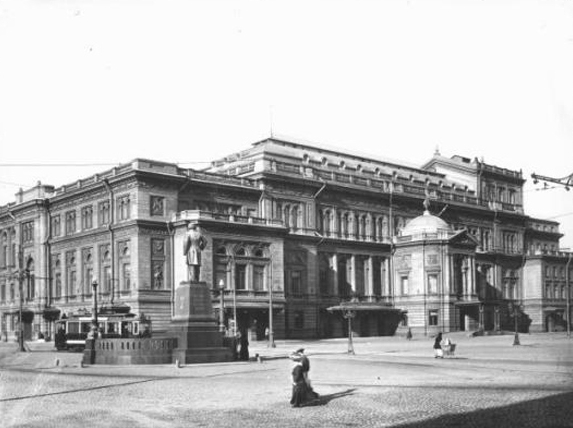
St. Petersburg Conservatory
Photo by Karl Bulla 1913
Source: Wikipedia
Like Strauss II before him, Rubinstein found America none too sophisticated, and was eager to get back to Russia where he bought a house, though nothing grand considering his overall worth. Rubinstein's survey of America would become a familiar one in Europe for decades to come. Though considered undeveloped by general consensus in artistic matters, Americans were notable at something else which appeared a good exchange: the honey that was money. Americans came a little in the rough, but they came rich and seemingly free with it. Come the fourth of Rubinstein's five existing piano concertos not long after his return to Russia. Nos.1 and 2 had been completed in 1850 and 1851. His third was transformed into 'Octet' Op 9 published in 1856. If I was in Rubinstein's house as it was burning down I'd grab his concertos first while shouting "Anton! Wait right there! I'll be right back!" Rubinstein's concertos amidst all else that he composed find Russia not only emerging for some time, but now in a major composer, indeed, a powerful rival to any in western Europe, and initiating a rumble to come from out of the east. Numerous elite composers and piano virtuosos have included Rubinstein's 'Piano Concerto No.4' in their repertoire, including Paderewski and Rachmaninoff. Following that below is the symphonic poem, 'Ivan the Terrible' Op 79 of 1869 which Tchaikovsky arranged for piano four hands the same year. Bringing up the bottom below is Rubinstein's 'Piano Concerto No.5' Op 94.
'Octet' Op 9 D minor Anton Rubinstein
Published 1856
Jupiter Symphony Chamber Players Piano: Maxim Lando
'Piano Concerto No.4' Op 70 D minor Anton Rubinstein
1864 Published 1865 Revised thrice to 1872
Curtis Institute Student Orchestra Fritz Reiner
Metropolitan Opera House in NYC Golden Jubilee Concert on 28 Nov 1937
Piano: Josef Hofmann
Forte-Piano-Pianissimo IMSLP Wikipedia
'Ivan the Terrible' Op 79 Symphonic poem by Anton Rubinstein 1869
Slovak State Philharmonic Orchestra Kosice Robert Stankovsky Feb 1989
'Piano Concerto No.5' Op 94 E-flat major Anton Rubinstein
1874 Published 1875
Slovak Radio Symphony Orchestra Bratislava Robert Stankovsky
Piano: Joseph Banowetz
IMSLP Bradford Robinson This album
Though Rubinstein had completed his opera, 'The Demon' ('Демон'), in 1871 it didn't see performance until 25 January 1875 at St. Petersburg's Hofoper. The demon in this work is in love with a woman named Tamara. Unfortunately, she is due to be married to Prince Sinodal. The Prince, therefore, must die, which is arranged. As the demon is supernatural, it both fascinates yet frightens Tamara. It finally succeeds in gaining a kiss with her, but an angel shows her the ghost of Sinodal and she drops dead. In the end, her soul is taken to Paradise for her torment while the demon is damned to eternal solitude.
'The Demon' Opera by Anton Rubinstein
1871 Premiere 25 Jan 1875 at the Hopfoper in St. Petersburg
Latvian National Opera Normunds Vaicis 2003
Wikipedia Talya Zax
In 1887 Rubinstein reassumed his position at the Saint Petersburg Conservatory. He resigned that post in 1891 upon Imperial demand that Conservatory admittance be per racial quota rather than skill. As that was disadvantageous to Jews, of which he was one, he moved to Dresden, there to teach as well as give largely charity concerts in both Germany and Austria. Rubinstein gave his last concert in St. Petersburg on 14 Jan 1894. He died nine months later on 20 November of heart disease at his home in Petergof (St. Petersburg). IMSLP has Rubinstein's 'Souvenir de Dresde' for piano Op 118 composed the same year. His final work is thought to have been completed in the summer of 1894, his 'Suite for Orchestra' Op 119.
'Polonaise' of 'Souvenir de Dresde' No.6 of 6 for piano Op 118 Anton Rubinstein
Sometime 1894
Piano: Joseph Banowetz
'Suite for Orchestra' Op 119 6 movements for piano in E-flat major
Final work by Anton Rubinstein
Summer of 1894
Bohuslav Martinů Philharmonic Orchestra Jon Ceander Mitchell
Sources & References for Anton Rubinstein:
Bach Cantatas VF History (notes) Wikipedia English
Audio of Rubinstein:
Специальное радио UCSB (cylinders 1902-1919)
Authorship: Correspondence
Compositions:
All Music (alphabetical)
IMSLP (by Opus / WoO / operas)
Klassika (by Opus / operas)
Rate Your Music (by genre)
Russisches Musikarchiv (by genre)
VIAF (alphabetical)
Wikipedia English (by genre)
Википедии русский (by genre)
Rubinstein Usage in Film: IMDb
Iconography: Deutsche Digitale Bibliothek Wikimedia Commons
Recordings of Rubinstein: Catalogs:
DAHR (shellac 1900-1947)
Recordings of Rubinstein: Select:
Anton Rubinstein / Piano Concerto No. 2 in F Major, Op. 35 | Suite in E-Flat Major, Op. 119 / Filharmonie Bohuslava Martinů w Grigorios Zamparas at piano / Centaur / 2014):
Challenge Records Classical Archives
The Demon (opera / premiere 1875 / Symphonic Orchestra and Academic Choir of the USSR All-Union Radio Moscow / Boris Khaikin / 1974)
The Demon (opera / premiere 1875 / Wexford Festival Opera Chorus / 1995)
Piano Music (Joseph Banowetz / Naxos 8.570942 / 2010):
About by Joshua Cheek
Scores / Sheet Music:
Internet Archive Musicalics (vendor)
Further Reading:
Prince Dmitry Donskoy of Moscow 1350-1389:
Jewry in Music (Networking Rubinstein / Jewish musical associates)
Bibliography:
Nikolai Fedorovich Fendeizen (Антон Григорьевич Рубинштейн / Harvard University / 1907)
Larry Sitsky (Anton Rubinstein: An Annotated Catalog of Piano Works and Biography / Greenwood Publishing Group / 1998)
Philip S. Taylor (Anton Rubinstein: A Life in Music / Indiana University Press / 2007)
Authority Search: BNF Data
Other Profiles:
Linda Davis (Find a Grave)
David Mason Greene (Greene's biographical encyclopedia of composers / Doubleday / 1985)
Herman Rosenthal / J. G. Lipman (Jewish Encyclopedia)
Wikipedia International: Español Français German Russian
Classical Main Menu Modern Recording
|
|