
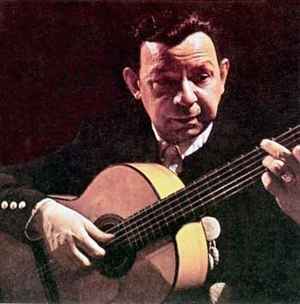
Sabicas
Source: Fernando Barros
Traditional flamenco had emphasized song and dance over instruments, relegating guitar to a supporting role. That was changed by Ramon Montoya (1879-1949), a major name in the history of flamenco who yet did little recording on his own. It was with Montoya that flamenco guitar began to be appreciated in itself, solos performed without lyric or stamping heels. One rare example of Montoya performing solo is this solea flamenco from 1936. Though Montoya toured across the Atlantic he didn't arrive to the international renown that guitarist and younger partner by 32 years, Sabicas, would. Chet Atkins, another world-class guitarist, thought Sabicas to be the finest guitar master in the world. Via globe-hopping virtuosity Sabicas made a major contribution to the international renown of flamenco. His contemporary counterpart in classical guitar was Spaniard, Andres Segovia.
Born Agustín Castellón Campos on 16 March 1912 in Pamplona, Spain, Sabicas began guitar at age four, performing publicly two years later. But Sabicas is another of those musicians concerning whom sources vary widely. He is also said to have given his first performance in Madrid at age nine. Howsoever, he is known to have gone by El Niño de las Habicas early in his career, called Habicas as a child by his mother due to his liking of broad beans.
Sabicas' initial recordings are given here as 1930 only tentatively. Sources range his first tracks from the latter twenties in Barcelona to the early forties. I mention 1930 due to an import issued in 1993 by Fonografica Del Sur, claiming a compilation from 1930 to 1940. The title of that release is 'Sabicas – Recital de guitarra flamenca Vol 1', the first of three. Other sources, however, doubt the authenticity of a 1930 date with good reasons [see Magnussen / Magnussen]. I must classify Sabicas' first recording as mystery of the cosmos. Though 1930 may well be incorrect it is the only thing resembling a date at all that I can discover. Nor have I found any samples of Sabicas at YouTube released before 1940 in his latter twenties. Nevertheless, find herein examples spanning nigh fifty years of performances.
Upon the outbreak of the Spanish Civil War in 1936 Sabicas left Spain for South America with Carmen Amaya. Touring eventually led to Mexico City where he supported Amaya's dancing career, including a trip to New York City in 1941 to perform at Carnegie Hall. The early forties in Mexico also brought marriage to Esperanza González Erazo. Wikipedia has three of his four children — Maricruz (b 1944), Carlos (b 1946 deceased), Agustine (b 1952) and Margaret (b 1956) — yet living as of this writing. The granadina below indicates authorship in the region of Granada, Spain, if not Granada proper. Similarly, the colombiana which follows means that it is of Columbian rather than Spanish origin.
'Embrujo del Fandango' ('Fandango Wrapping') Sabicas
Film w Carmen Amaya released in Cuba 26 Jan 1940
Granadinas from the film 'Martingala' Sabicas
Directed by Fernando Mignoni Music by Juan Álvarez García
With Lola Flores Released in Mexico 1940
Columbiana from the film 'Los Amores de un Torero' Sabicas
'The Loves of a Bullfighter'
Written and directed by
José Díaz MoralesWith Carmen Amaya Released in Mexico 1945
It was 1949 when Sabicas' album, 'Flamencan Guitar Solos', was issued in the U.S. on Decca CU 709. Later moving to New York City in the fifties, he returned to Spain in 1967.
'Danza Mora' Sabicas
From the album 'Flamencan Guitar Solos' on Decca DU-709 1949
Composition: Agustín Castellón
The bularia [Wikipedia] is a fast-tempo style originating in Jerez, Spain, applied below to cuentas, meaning of origin in the region where Argentina, Bolivia and Chile all share common borders. The cueca [RYM] is the national dance of Chile.
'Las dos puntas' w 'Entre Mendoza y San Juan'
Sabicas w Carmen Amaya
'The two ends'
Composed by Carlos Montbrun Ocampo w lyrics by Osvaldo Rocha
'Between Mendoza y San Juan'
Composed by Carlos Montbrun Ocampo / Hernán Videla Flores
Released 1957
'Gypsy Flamenco' Album by Sabicas
1958Compositions by Sabicas
'Flamenco Puro' Album by Sabicas
See Columbia W 304
1959Compositions by Sabicas
'La Zarzamora' Bularias by Sabicas
From the album 'Solo Flamenco' on ABC-Paramount ABC 304 1959
Composition:
Antonio Quintero Ramírez / Manuel López-Quiroga / Rafael de León
'Bulerias del Terremoto' ('Bulerias of the Earthquake')
Sabicas w Dolores Vargas
From the album 'Furioso' on Decca DL 8900 1959
Composition: Sabicas / Escudero
'Flamenco Fantasy' Album by Sabicas
1960Compositions by Sabicas
'La Malagueña' Sabicas
See the album 'Flaming Flamenco Guitar' United Artists UA 3236 1962
Composition: Ernesto Lecuona
'Aires de Puerto Real' Soleares by Sabicas
From the album 'El Rey Del Flamenco' on ABC Records ABCS-526 1965
Composition: ?
The rondena is a palo (form) of flamenco originating in Ronda, Malaga, forty or so miles west of Malaga for birds. The alegrias (joys) is a form of flamenco originating in Cadiz which developed alongside the basic solea (plural: solearas) [Wikipedia] perhaps originating in Seville, otherwise the Cadiz-Seville region.
'Viniendo del Alba' w 'Variaciones de Alegrias'
Compositions by Sabicas Television 1972
See 'Flamenco!: La Guitarra de Sabicas' on Polydor 2480 138 1972
Sabicas on television live in Seville 1986
Set of palos: taranta / seguiriya / cumparsita / granadina
Sabicas on television live in Arles 29 July 1988
Sabicas died of pneumonia in a Manhattan hospital upon multiple strokes on 14 April 1990.
Sources & References for Sabicas:
Donald Clarke (Music Box)
Castro Martín / María Jesús (The flamenco guitar in the 19th century / 2014)
VF History (notes)
Analysis: Charles Alexander Allred
Audio: Internet Archive
Documentaries: The Fabulous Sabicas (directed by Pablo Calatayud / 2012)
Sabicas in Film: IMDb
Interviews:
August 1982 (Paul Magnussen / text)
1989 (Manuel Curao / Spanish television)
Recordings: Catalogs:
RYM (1947-1990 / thrashdeathbanger)
Recordings: Sessions: DAHR (1941)
Sheet Music: Oscar Herrero (Centennial Tribute / 2012)
Further Reading:
Foro Flamenco (Sabicas's Advice to Non-Spaniards Playing Flamenco Guitar)
Robert Mundle (Sabicas's three rules for a passionate life)
Alberto García Reyes (Sabicas, Brief Reflections on Genius)
Authority Search: BNF Data VIAF
Sources & References for Flamenco:
Flamenco Composition and Ownership:
Flamenco Culture:
Flamenco Dance:
Flamenco Fusions:
Flamenco Guitar:
Flamenco History (University of California-San Diego):
D.E. Pohren:
John Moore (Professor of Linguistics at UCSD):
Flamenco Musicians:
Flamenco Rhythms:
Flamenco Terms:
The Malagueña (flamenco style derived of the fandango):
The Seguiriya (form of the cante jondo):
Further reading:
Classical Main Menu Modern Recording