
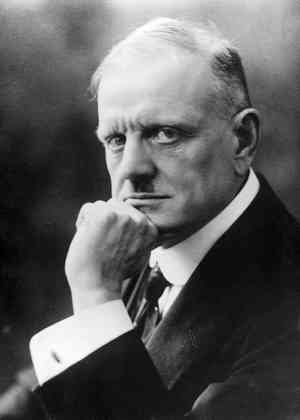
Jean Sibelius
Source: Counter-Currents
Jean Sibelius [pronunciation] was born on 18 December 1865 in Hämeenlinna, Finland, then part of Russia, to become a major composer in critical regard to remain so to this day. About age fifteen he aspired to become a violin virtuoso. Among his earliest compositions was his brief pizzicato (plucking) 'Vattendroppar' ('Raindrops') JS 216 for violin and cello circa 1881 [audio w violin by Justina Auškelytė; live performance w violin by Janine Jansen]. "JS" in Sibelius = WoO (Without Opus) or deest (lost).
'Vattendroppar' Jean Sibelius
Comp sometime 1875-81
Royal Concertgebouw Orchestra / Andris Nelsons
Violin: Janine Jansen
Het Concertgebouw in Amsterdam 17 Sep 2015
Sibelius began to study law upon graduation from high school in 1885, but quickly switched to the Helsinki Music Institute (now the Sibelius Academy) from which he graduated in 1889. He studied another year in Berlin with Albert Becker, then in Vienna with Karl Goldmark. About that time he changed his musical direction, thinking he'd begun to play violin too late in life to become virtuosic. So he studied another year in Italy before beginning a career in composition and conducting that would find him traveling to points in Scandinavia, the United Kingdom, France and Germany. Asami Hagiwara assists in understanding Sibelius by finding him in three periods according to piano works, beginning the first from 1890 to 1903 described as national romantic, citing 'Six Impromptus' Op 5 as representative of this period. Sibelius' middle period, labeled neo-classical from 1903 to 1919, with 'Ten Pieces' Op 58 representative of that period. Hagiwara describes Sibelius' final period as a synthesis, citing 'Six Pieces' Op 94 of 1919, 'Sechs Bagatellen' Op 97 of 1920 and 'Huit petits Morceaux' Op 99 of 1922 as representative of this last period.
Largely known for symphonic works, during his early period Sibelius premiered his set of five tone poems, 'Kullervo', on 28 April 1892 to considerable critical applause. Yet it was performed only five times during his lifetime. Text for 'Kullervo' was written by Sibelius after 'Kalevala', a book of Finnish epic poetry compiled by Elias Lonnrot published in 1835. The next year he composed 'Six Impromptus' Op 5 which Hagiwara cites as characteristic of his early period. This page descends chronologically by composition dates per IMSLP. Opus numbers will not sequentially correspond due to publishing concerns peculiar to Sibelius.
'Kullervo' Op 7 in E minor Tone Poem by Jean Sibelius
Comp 1892 Premiere 28 April 1892 Pub 1961
Libretto by Sibelius after 'Kalevala' of 1892
Finnish Radio Symphony Orchestra / Jukka-Pekka Saraste
Baritone: Jorma Hynninen Mezzo soprano: Lilli Paasikivi
Oliver Condy Flying Inkpot (alt) Daniel Grimley Raif Hermans IMSLP Score Wikipedia
'Six Impromptus' Op 5 Jean Sibelius
Comp 1893
Piano: Håvard Gimse
Alan Beggerow IMSLP Score Wikipedia
Sibelius' early period also includes 'Det Mörknar Ute' of 1897. This was compiled into his Opus 1 assigned to 'Five Christmas Songs' with text by Zacharias Topelius. The four remaining songs were written from 1901 to 1913 with arrangements to as late as 1954.
'Det Mörknar Ute' ('It's Getting Dark Outside') Op 1 No.3 Christmas song by Jean Sibelius
Comp 1897 Pub 1921
Libretto: Zacharias Topelius (Swedish)
Suomen Kansallisoopperan Orkesteri / Michael Güttler
Basso profundo: Jyrki Korhonen
IMSLP Sibelius One Text Text Wikipedia
A couple other works belonging to Sibielius' first period are 'Symphony No.1' in E minor Op 39 and 'Finlandia'. Jean's symphony was composed in 1899 toward its premiere on 26 April 1899 in Helsinki. 'Finlandia' Op 26 was finished in 1900 toward premiere on 2 July 1900, also in Helsinki. 'Finlandia' is another tone poem, this about eight minutes long, which premiere was conducted by Robert Kajanus.
'Symphony No.1' Op 39 in E minor Jean Sibelius
Comp 1899 Premiere 26 April 1899 in Helsinki Pub 1902
Singapore Symphony Orchestra / Hannu Lintu
26 Oct 2018 at the Esplanade Concert Hall in Singapore
Herbert Glass IMSLP Timothy Judd Steven Ledbetter Wikipedia
'Finlandia' Op 26 in F minor Tone poem by Jean Sibelius
Comp 1900 Premiere 2 July 1900 in Helsinki Pub 1900
Oslo Philharmonic Orchestra / Mariss Jansons 9 Sep 2009
Keith Bosley (alt) David Gilbert IMSLP Susan Key
Neil McCalmont (alt) Matthew Mendez Betsy Schwarm Wikipedia
Scores: DC Youth Orchestra MusOpen Wayne State University
'Violin Concerto' in D minor Op 47 premiered in Helsinki on 8 February 1904 during Sibelius' middle neoclassical period. 'Ten Pieces' Op 58, which Hagiwara cites as characteristic of Jean's middle period, was completed in 1909. The next year he finished 'Twelfth Night' consisting of two incidental songs for voice and piano or guitar written for a Swedish production of Shakespeare's 'Twelfth Night' first performed in 1602. Those are 'Kom nu hit, död' ('Come Away, Death') and '(Hög mod, uti storm och i regn' ('High Courage, in Storm and in Rain'). Come ''Berceuse' from 'Six Pieces for Violin and Piano' Op 79 completed in 1917 toward publication in 1922.
'Violin Concerto' Op 47 in D minor Jean Sibelius
Comp 1903-04 Revised 1905 Premiere 8 Feb 1904 in Helsinki Pub 1905
Orchestre Philharmonique de Radio France / Mikko Franck
Violin: Hilary Hahn
Flying Inkpot John Henken IMSLP Steven Ledbetter Wikipedia
'Ten Pieces' Op 58 Jean Sibelius
Comp 1909 Pub 1910
Piano: Olli Mustonen
'Kom nu hit, död' ('Come Away, Death') Op 60 No.1 Jean Sibelius
From 'Twelfth Night' Op 60 from Shakespeare's 'Twelfth Night' of 1602
Comp 1909 Pub 1910
Mezzo soprano: Marianne Beate Kielland Piano: Sergej Osadchuk
'Berceuse' ('Lullaby') Op 79 No.6 Jean Sibelius
From 'Six Pieces for Violin and Piano' Op 79
Comp 1917 Pub 1922
Piano: Katarina Krpan Violin: Katarina Kutnar
Finland was a Russian domain until declaring independence in December 1917 as of the Bolshevik Revolution amidst the climate of World War I. Per Hagiwara above, Sibelius' final period is marked by 'Six Pieces' Op 94 of 1919.
'Six Pieces' Op 94 Jean Sibelius
Comp 1914-19 Pub 1920
Piano: Håvard Gimse
'Sechs Bagatellen' Op 97 Jean Sibelius
Comp 1920 Pub 1921
Piano: Eero Heinonen
Scores: El Atril MusOpen Scorser Wedgebill Music
Sibelius was a Freemason, as had been composers such as Frederick II and Franz Liszt. Freemasonry had been banned from Finland under the Russian monarchy until winning independence in 1917 to become a republic in 1919. Sibelius became a founding member of Suomi Lodge 1 in Helsinki in 1922 while composing 'Symphony No.6' in D minor Op 104 toward its premiere by the Helsinki Philharmonic Orchestra on 19 February 1923. Sibelius' 'Symphony No.7' in C major Op 105 arrived to Stockholm on 24 March 1924 with Sibelius conducting.
'Symphony No.6' Op 104 in D minor Jean Sibelius
Comp 1921 Pub 1923
Swedish Radio Symphony Orchestra / Esa-Pekka Salonen
Breitkopf & Härtel Roger Dettmer IMSLP Stephen Johnson Timothy Judd
James M. Keller Inge Kjemtrup Dr. Ilkka Oramo Tom Service Wikipedia
'Huit Petits Morceaux' Op 99 Jean Sibelius
Comp 1922 Pub 1923
Piano: Annette Servadei
'Symphony No.7' Op 105 in C major Jean Sibelius
Comp 1918-March 1924 Pub 1925
Danish National Symphony Orchestra / Leif Segerstam
Robert Cummings Flying Inkpot IMSLP Dr. Ilkka Oramo Tom Service Wikipedia
Come incidental music for Shakespeare's 'The Tempest' of 1610-11 with 'The Tempest' JS 182 first performed on 15 March 1926. In 1929 Sibelius published the 'Overture' as a work in itself as Op 109 No.1, along with two Suites drawn from 'The Tempest'. 'Suite 1' Op 109 No.2 consisted of 9 movements finished in 1929. 'Suite 2' Op 109 No.3 consisted of nine movements completed earlier in 1927.
'Overture" to the The Tempest' Op 109 No.1 Jean Sibelius
Comp 1925-26 Revised 1927/29 Pub 1929
Orkiestra Opery i Filharmonii Podlaskiej / Young Chil Lee
Sibelius' final symphonic poem was 'Tapiola' Op 112 finished in August of 1926 toward its premiere on 26 December 1926. Tapio is the spiritual king of the forest in Finnish mythology.
'Tapiola' Op 112 Jean Sibelius
Comp completed Aug 1926 Premiere 26 Dec 1926 in New York Pub 1926 in Leipzig
Philharmonia Orchestra / Herbert von Karajan London 1953
Flying Inkpot IMSLP Timothy Judd Wikipedia
On 12 January 1927 Sibelius premiered the first eight pieces of 'Masonic Ritual Music' Op 113. Other titles were eventually added to as late as 1946 (revisions 1948) to complete the whole to twelve pieces, the first of which was the 'Finlandia Hymn' drawn from Sibelius' 1900 'Finlandia' Op 26 above in 1937, albeit added as No.12 (final piece). That was with a text for male choir by opera singer, Wäinö Sola, which mistakenly saw publishing in America the same year (1937) by the Grand Lodge of New York. Sibelius had worked with Sola in 1927 when he premiered the first several pieces of 'Masonic Ritual Music'. Though he arranged 'Finlandia Hymn' for Sola's male choir, its publication in the United States with Sola's text was unbeknownst to him. In 1940 Sibelius sanctioned a text supplied by Veikko Antero Koskenniemi. Not until 1948 did Sibelius become aware of "Finlandia Hymn' getting published in America with Sola's text eleven years earlier. Thusly did 'Finlandia Hymn' acquire two versions for voice, Sola's which Jean very liked though not for publishing, and the more commonly heard with text by Koskenniemi which Jean officially intended. It has been proposed that Finland make 'Finlandia Hymn' its national anthem. Though Finland has no "official" national anthem, what has ever been employed as such is 'Maamme' arriving in 1848 with music by Fredrik Pacius and text by Johan Ludvig Runeberge. The 'Finlandia Hymn' also supplied the setting for Lloyd Stone's patriotic 'This Is My Song' of 1934. It also supplies the setting to a couple of older Christian hymns, one of which is 'Be Still My Soul' with original text by Katharina Amalia Dorothea as of 1752. Another is 'We Rest On Thee' by Edith G. Cherry circa 1895. Per below, all but Pacius' 'Maamme' evolved from Sibelius' 'Finlandia' Op 26 of 1900.
'Vårt land' ('Our Land') aka 'Maamme' ('Our Country') Fredrik Pacius
Unofficial National Anthem of Finland 1848 Premiere: 13 May 1848
Text: Johan Ludvig Runeberge
Polyteknikkojen Kuoro 2014
IMSLP June Pelo This Is Finland Wikipedia Yle
'A Song of Peace: A Patriotic Song' aka 'This Is My Song' Jean Sibelius
Music from 'Finlandia' Op 26 1900 Text by Lloyd Stone / Georgia Harkness 1934
Based on the 'Lord's Prayer' in 'Matthew' 6:9-13
Piano: Brian Kenny Vocal: Alena Hemingway
Discipleship Ministries Text Text Wikipedia
'Finlandia Hymn' Jean Sibelius
Music from 'Finlandia' Op 26 1900 Text by Wäinö Sola 1937
Minnesota Boychoir / Mark Johnson Jan 2024
'Finlandia Hymn' Jean Sibelius
Music from 'Finlandia' Op 26 1900 Text by Veikko Antero Koskenniemi 1940
Text sanctioned by Sibelius
Svanholm Singers / Sofia Söderberg
Texts: Babelmatrix Hannah Murray This Is Finland
'Be Still My Soul' Jean Sibelius
Music from 'Finlandia' Op 26 1900 Text by Catharina von Schlegel 1752
Translation by Jane Borthwick 1855
Libera Choir
'We Rest on Thee' Jean Sibelius
Music from 'Finlandia' Op 26 1900 Text by Edith G. Cherry 1895
Vocal: Christina Maxwell 14 June 2020 in NYC
Devotional Treasues Hymnary Melody Publications Religious Affections
BBBBBBBBBnoveletteBBBBBBBBBBBBBBB
Sibelius' last Opus is 116 (listed as 117 in K.G. Fazer 1993 but not used) assigned to '3 Pieces for Violin and Piano' composed in 1929, published in 1930.
'Three Pieces for Violin and Piano' Op 116 Jean Sibelius
Comp 1929 Pub 1930
Piano: Christina Maxwell Violin: Ruggiero Ricci
Breitkopf Á Hartel IMSLP Scarlett Music Wikipedia
Sibelius One traces Jean composing 'Rakkaalle Ainolle' ('To My Beloved') JS 161 as late as 1931 in its listing of Sibelius JS (deest or WoO). This was a piano four hands composed for his wife, Aino, on her 60th birthday. They had married in 1892 and had six daughters.
'Rakkaalle Ainolle' ('To My Beloved Aino') JS 161 Piano four hands by Jean Sibelius
Comp 1931
Piano: Folke Grasbeck / Peter Lonnqvist
Sibelius spent his latter years attempting to finish 'Symphony No.8' begun back in 1926. This was such a troublesome work that he gave up on it in 1938, then destroyed it in 1945. His latter years were otherwise what came to be known as the ''silence of Jarvenpaa" during which he arranged revisions, such as those performed by Kim Borg on 14 June 1957 in Helsinki, one being 'Kullervon Valitus' ('Kullervo's Lament') from Jean's 1892 Op 7 above, another being 'Kom nu hit, död' ('Come Away, Death') from his 1909 Op 60 No.1 of Shakespeare's 'Twelfth Night' (1601-02). During these latter years Jean and Aino (wife) received many a visitor, but he endeavored nothing major likely due to exhaustion. He died of brain hemorrhage on 20 September 1957 in Järvenpää, Finland. Aino followed some years later on 6 June 1869, also in Järvenpää.
Sources & References for Jean Sibelius:
Sibelius VF History (notes) Wikipedia English
Audio of Sibelius: Corpora:
BBC Classical Archives Hyperion
Sibelius One Yle (Symphonies 1-2) Yle (Symphonies 4-7)
Audio of Sibelius: Individual: Chronological:
Vattendroppar (Raindrops / JS 216 / sometime 1875-81 / cello: Edmundas Kulikauskas / violin: Justina Auškelytė)
Symphony No.1 (Op 39 / 1899 / Lahti Symphony Orchestra / Jukka-Pekka Saraste)
Symphony No.1 (Op 39 / 1899 / Orchestre de Paris / Paavo Järvi)
Finlandia (Op 26 / 1900 / National Military Band / Edison Blue Amberol 23066 / sometime 1912-21)
Violin Concerto (Op 47 / 1904/05 / Chicago Symphony Orchestra / Daniel Barenboim / violin: Maxim Vengerov / 1997)
Violin Concerto (Op 47 / 1904/05 / Gothenburg Symphony Orchestra / Kent Nagano / violin: Ray Chen / 26 March 2015)
Violin Concerto (Op 47 / 1904/05 / Moscow Radio Symphony Orchestra / Gennady Rozhdestvensky / violin: David Oistrakh / 26 March 2015)
Dialogue (from Ten Pieces Op 58 No.6 / 1909 / piano by Havard Gimse)
Dialogue (from Ten Pieces Op 58 No.6 / 1909 / piano by Janne Mertanen)
Symphony No.6 (Op 104 / 1923 / Danish National Symphony Orchestra / Leif Segerstam)
Symphony No.7 (Op 105 / 1924 / Hallé Orchestra / Sir Mark Elder)
Symphony No.7 (Op 105 / 1924 / Minnesota Symphony Orchestra / Osmo Vänskä)
Tapiola (Op 112 / 1926 / Gothenburg Symphony Orchestra / Neeme Järvi)
Rakkaalle Ainolle (To My Beloved Aino / JS 161 / 1931 / piano 4 hands: Tuija Hakkila / Heini Kärkkäinen / 2021)
Chronology: Ainola
Compositions: Corpora:
Classic Cat (by Opus)
IMSLP (alphabetical)
IMSLP (by Opus / JS [WoO])
IMSLP (piano works)
IMSLP (songs)
IMSLP (Symphonies 1-7)
IMSLP (tone poems)
Heikki Poroila (by Opus / JS [WoO])
Pytheas (by genre)
Rate Your Music (by genre)
Sibelius One (by JS [WoO])
Sibelius One (by Opus)
Wikipedia English (by genre)
Wikipedia English (by genre / Opus)
Wikipedia Finnish (by Opus)
Wikipedia Français (by date / Opus / title)
Wind Repertory Project (works for winds)
Compositions: Individual:
Finlandia Hymn Op 113 No.12 (music from Finlandia Op 26 1900 / text 1937 Sola / text 1940 Koskenniemi):
Clearing Customs The Northern Voices Our Finnish Adventure Wikipedia
Masonic Ritual Music Op 113 (1927 to revisions as late as 1948):
All Music My Freemasonry Sibelius
Symphony No.8 (1926 / abandoned c 1938 / destroyed 1945):
Kari Kilpeläinen Chris Morrison David Nice Dr. Ilkka Oramo Jean Sibelius en Español
Documentaries: Looking Beyond the Sea (Aho & Soldan / 1961)
Discussion: Talk Classical
Family: Aino Sibelius (1871-1969 / wife): Georg Predota Sibelius One Wikipedia
Iconography: Wikimedia Commons
Interviews: 1948 (audio / Finnish)
Lyrics / Texts: Emily Ezust (Lieder Net) Oxford Lieder REC Music Foundation
Recordings of Sibelius: Catalogs:
DAHR (1910-1951)
Recordings of Sibelius: Select:
Sibelius: Masonic Ritual Music (Lahti Symphony Orchestra / Jaakko Kuusisto / BIS – BIS-CD-1977 / 2011)
Scores / Sheet Music:
Abe Books (vendor)
Musicalics (vendor)
Notenlager (vendor / Europe)
Further Reading:
Hugo Bergroth (Katalog öfver den svenska litteraturen i Finland / Svenska litteratursällskapet i Finland / 1892) (alt)
Leon Botstein (The Transformative Paradoxes of Jean Sibelius / 2011)
Finland: History: This Is Finland Wikipedia
Finland: Independence (6 December 1917):
Britannica Finland 100 Sophia Waterfield Wikipedia Wikipedia
Finland: Mythology: Encyclopedia Patheos Niina Pekantytär Spiritual Arts Wikipedia
Finland: Mythology: Tapio (spiritual king of the forest): Brickthology Britannica Finnish Myth Wikipedia
IMDb (usage of Sibelius in film)
Jean Sibelius en Español (Lost Works of Jean Sibelius)
Jean Sibelius Society of Germany
Henna-Leena Kallio (Sibelius Was a Conservative and a Revolutionary / 2012/2018)
Janne Mäkelä (Sibelius and radio)
Philadelphia Chamber Music Society
Silence of Jarvenpaa (latter years): Nathanal Bright Georg Predota
Trivia: ANAM Classic fM
Bibliography:
The Cambridge Companion to Sibelius (Cambridge University Press / 2004)
Glenda Dawn Goss (A Composer's Life and the Awakening of Finland / University of Chicago Press / 2009)
Tomi Mäkelä (Jean Sibelius / Boydell Press / 2011)
Rosa Newmarch (Jean Sibelius / C.C. Birchard Company / 1939)
Authority Search: BNF Data
Other Profiles:
Wikipedia Español Wikipedia Finnish Wikipedia Français
Classical Main Menu Modern Recording
|
|