
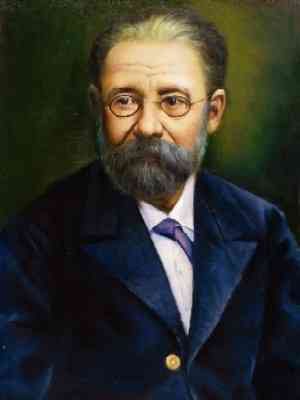
Bedrich Smetana
Source: Gimnazija Črnomelj
Born on 2 March 1824, Bedrich Smetana was a Bohemian born east of Prague, a portion of the Habsburg Empire at the time. Not to be confused by Russians with sour cream, the importance of Smetana was partially the alignment of his career with the rise of Czech and Slovak nationalism. Though Smetana spoke German as a Bohemian youth before he learned Czech, and though Czechoslovakia wouldn't attain independence from the Austro-Hungarian Empire until 1918, that nation (become the Czech Republic in 1993) could claim him as its own due to his early nationalist sympathies. Due to lay of the land Czech as well as Polish composing arrived late to classical music, and though a century and a half of not a few Bohemian composers have been profiled in the HMR Project by now, beginning with Zelenka born in 1679, Smetana is often considered the fountainhead of Czech composing. By way of comparison with Russia, that title is usually given to Glinka born a generation earlier in 1804.
Though Franz Liszt would be Smetana's most important musical associate, he was early influenced by Berlioz among others As well, albeit František Škroup preceded him by a generation, Smetana was the first major Czech composer to endeavor opera. Even so, and despite failure as a virtuoso, his works for piano are his most appreciated.
Smetana's works received opus numbers only to 21. Three other catalogues are employed: T numbers are per Karel Teige in 1893. B numbers are per František Bartoš in 1972(?). JB numbers are per Jiri Berkovec in 1999.
Smetana's father was a master brewer, both commercially and to royalty. Bedrich himself began composing music as a child at age six. His 'Kvapík' ('Galop') for piano is thought to have been written no later than 1832 at age eight.
'Kvapík' ('Galop') JB 2:1 B 3 D major
Early piano piece no later than 1832 by Bedrich Smetana
Upon finishing school in 1843 Bedrich went to Prague with 20 gulden (perhaps about $500 today) and in need of musical instruction, which he found in composer, Josef Proksch. He himself became a music teacher to the family of Count Thun until his resignation in 1847 to go on a concert tour in West Bohemia that was largely a failure. Smetana had begun his 'Six Characteristic Pieces' in 1847 which would later become his Op 1.
Upon returning to Prague, Smetana composed music for the democratic revolutionaries beginning to rebel against monarchical Habsburg rule. He was among the Svornost (Citizen's Army) to barricade the city from attack by the Austrian army of Prince Windisch-Grätz during the Prague Uprising of 12-17 June 1848. A stray bullet apparently killed Windisch-Grätz' wife on the 12th as she stood at a window to observe the fighting. That rebellion was swiftly settled and Smetana suffered nothing of it, opening his Piano Institute later in August with twelve pupils. It was after that uprising that Smetana wrote 'Three Revolutionary Marches' first for piano, then for orchestra: 'March of the Revolutionary Guard', 'March of the Students' Legion' and 'March of Freedom', the last also known as 'Song of Freedom' set to text by Ján Kollár.
'Three Revolutionary Marches' Bedrich Smetana 1848
1. March of the Revolutionary Guard
2. March of the Students' Legion
3. March of Freedom
From:
'March of the Prague Student Legion' for piano in F Major:
JB 1:36 B 58 T 45a
'National Guard March' for piano in D major: JB 1:37 B 59 T 45b
'Song of Liberty' for piano and male chorus: JB 1:38 B 60
MSU Concert Band 2009
Having completed 'Six Characteristic Pieces' in 1848, Liszt helped Smetana publish them as his Op 1 in 1851, the same year he accepted (as a firm Czech nationalist) the position of court pianist to Holy Roman Emperor Ferdinand I at Prague Castle.
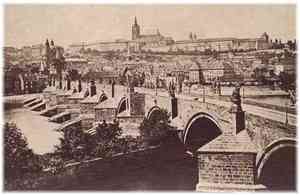
Prague Castle
Source: Wikipedia
Albeit Smetana's Piano Institute was well regarded his career as a concert pianist sputtered. So he left Prague for Gothenburg, Sweden, in 1856, where he assumed the wand for the Gothenburg Society for Classical Choral Music. He married in 1860, then attempted another concert tour in 1861, this time in Netherlands and Germany, only to meet failure once again.
'Six Characteristic Pieces' Op 1 Bedrich Smetana
Comp 1847-1848 Pub 1851 dedicated to Franz Liszt
1. 'Im Walde' ('In the Woods')
2. 'Erwachende Leidenschaft' ('Emerging Passion')
3. 'Das Schäfermädchen' ('The Shepherdess')
4.'Die Sehnsucht' ('Desire')
5.'Der Krieger' ('The Warrior')
6.'Die Verzweiflung' ('In Desperation')
Piano: Jan Novotný
'Piano Trio' Op 15 G minor JB 1:64 Bedrich Smetana 1855
Roma Piano Trio:
Piano: Angela Pardo
Violin: Alessandro D'Andrea
Cello: Marco Damiani
IMSLP LA Phil John Palmer Wikipedia
'Macbeth and the Witches' G minor JB 1:75 B 112 T 80
Bedrich Smetana After Shakespeare 1859
Piano: František Maxián
The appearance of Smetana's first of nine operas, 'The Brandenburgers in Bohemia', premiered on 5 January of 1866 at the Provisional Theater in Prague to great success. This opera concerns the invasion of Prague by the Prussian Margraviate of Brandenburg. Albeit Smetana is a Czech nationalist with Prague under the thumb of the Habsburg Austro-Hungarian Empire, this work has Bohemia invaded by Austria's nemesis which was Prussia. The Brandenburgers are defeated in this military romance which premiered only six months before the Austro-Prussian War in June and July of 1866 between the Austrian German Confederation and Prussian German states allied with Italy, a struggle via which the Habsburgs lost considerable territory to both Prussia and Italy.
'The Brandenburgers in Bohemia' 1st opera by Bedrich Smetana
JB 1:87 B 124 T 90
Premiere 5 Jan 1866 at the Provisional Theater in Prague
Libretto: Karel Sabina
Orchestr Narodniho divadia / Zdeněk Košler
National Theatre Praha 1985
IMSLP Martin Nedbal Phil's Opera World
Smetana's first of four versions of 'The Bartered Wife' came to a disappointing premiere on 5 May 1866, but his three revisions staged in 1869 and 1870 came to greater success such that this seems to be Smetana's most popular work for stage. In this tale one Mařenka has two suitors vying for her hand in marriage. One is Vasek employed as a circus bear. The other is Jenik who comes to an agreement with a marriage broker, one Kecal, that he will desist from courting Mařenka for 300 florins on condition that no one marry her except the son of Micha, a landowner, whom Jenik secretly is.
'The Bartered Bride' 2nd opera by Bedrich Smetana
JB 1:100 B 131 / 137 / 140 T 93
Premiere 5 Jan 1866 at the Provisional Theater in Prague
Libretto: Karel Sabina
Orchestr Narodniho divadia / Zdeněk Košler
National Theatre Prague 1985
Maureen Buja Fanny Po Sim Head John Henken
IMSLP University of Michigan Wikipedia
Smetana's third opera, 'Dalibor', arrived to the New Town Theatre in Prague on 16 May 1868 to be revised in 1870, the same year he became conductor at the Provisional Theater, so named since its construction in 1862 in preparation to become the greater National Theatre in 1881. In this story the violinist, Dalibor of Kozojedy, is a Czech knight of circa 1490 who is imprisoned for his participation in an uprising in Ploskovice against Vladislaus II of Hungary. His beloved, Milada, and her friend, Jitka, endeavor Dalibor's freedom but both he and Milada die in the end. Another version finds him executed before Milanda can save him. The actual Dalibor was jailed in the Daliborka Tower of Prague Castle until his execution in 1498.
'Dalibor' 3rd opera by Bedrich Smetana
JB 1:101 B 133 T 96
Premiere 16 May 1868 at the New Town Theatre Revised 1870
Libretto: German by Josef Wenzig Czech by Ervín Špindler
C & O of the National Theatre Prague / Jaroslav Kyzlink
Dalibor: Michal Lehotský
'The Two Widows' appeared on 27 March 1874 at the Prague Czech Theatre with libretto by Emanuel František Züngel. Many a hero ends up in prison in opera, who is Ladislav in this story in which his attraction to one of two young widows, the wealthy Karolina, isn't reciprocated. The latter would prefer to make a match between him and another young widow, her less happy cousin, Anezka.
'Dvĕ Vdovy' ('The Two Widows')
4th opera by Bedrich Smetana JB 1:108 T 109
Premiere 27 March 1874 at the Prague Czech Theatre
Libretto: Emanuel František Züngel
C & O of the National Moravian Silesian Opera
Chorus Master: Jurij Galatenko Conducting: Marek Šedivý
Anežka: Veronika Rovná Karolina: Lada Bočková
IMSLP Donald Pippin Opera Scotland Wikipedia
By October of 1874 Smetana had lost his hearing in both ears. He then granted the Provisional Theatre the right to perform his works in return for a pension of 1,200 guldens per annum. Widely around $30,000 today, that was about what an average composer might get paid in a year, no great sum compared to the wealth with which other operatic composers in Europe retired, but nothing to weep about either for only four years of service.
Smetana began to fall ill in 1875, so moved his family to Jabkenice. Having already completed the first two movements of his most famous work, the symphonic poem, 'Má Vlast' ('My Homeland'). The last four movements arrived in 1875, 1878 and 1879. In this work Smetana addresses various Bohemian themes: 1: Vyšehrad also known as the High Castle in Prague. 2: the Vltava River flowing through Prague also called die Moldua. 3: the female warrior, Sarka, who fought in the Maidens' War sometime in the 8th century. 4: Bohemian fields and groves titled 'Z českých luhů a hájů' in Czech or 'Aus Böhmens Hain und Flur' in German. 5: the Battle of Tabor between the Holy Roman Empire and the Hussites on 30 June 1420. 6: magic Blanik Mountain underneath which the knights of St. Václav await in slumber to save Bohemia when all other hope is lost.
'Ma Vlast' ('My Homeland') JB 1:112
6 symphonic poems by Bedrich Smetana
1. Vyšehrad 2. Vltava 3. Sarka
4. Z českých luhů a hájů 5. Tabor 6. Blanik
Comp 1874-79 Individual premieres 1875-80
Premiere complete set 5 Nov 1882 at Žofín Palace in Prague
Orchestre Philharmonique de Radio France / Peter Oundjian
Peter Gutmann Fran Hoepfner IMSLP Wikipedia
Smetana's fifth opera, 'Hubička' ('The Kiss') premiered at the Provisional on 7 November 1876. 'The Kiss' is about two lovers, the peasant, Lukas, and Vendulka, confronted with the problem of the latter's peasant father, Paloucký, who objects to their betrothal.
'Hubička' ('The Kiss')
5th opera by Bedrich Smetana JB 1:104 T 115
Premiere 7 Nov 1876 at the Provisional Theatre in Prague
Libretto: Eliška Krásnohorská / Karolina Světlá
Direction: Ema Mikeskova Piano: Richard Pohl
IMSLP John Palmer Georg Predota Bruce Scott
Wikipedia Czech Wikipedia English
Smetana's sixth opera was a not so popular comedy called 'Tajemství' ('The Secret') which premiered on 7 November 1878 at the Nové České Divadlo (New Czech Theater) with a libretto by Eliška Krásnohorská. 'The Secret' concerns a map to a hidden treasure given to one Kalina, a (male) councilor whose beloved is one Roza. Roza's brother who is Malina will not allow them to marry unless Kalina comes to his house to honorably ask him. That Kalina has a secret gets around to just about everybody as he descends into a tunnel to find his treasure. Upon some amusing complications among other characters, Kalina eventually emerges from the oven in Malina's house before a frightened Roza, she the treasure he was told about.
'Tajemství' ('The Secret')
6th opera by Bedrich Smetana JB 1:118 T 118
Premiere 18 Sep 1878 at the New Czech Theatre in Prague
Libretto: Eliška Krásnohorská
Direction: Ema Mikeskova Piano: Richard Pohl
Smetana's seventh opera, 'Libuše', had been composed back in 1771-72 for a coronation ceremony of Franz Joseph I of Austria that didn't occur. 'Libuše' got shelved instead until repurposed for the grand opening of the National Theatre nine years later on 11 June 1881 when it premiered. A couple months later the National Theatre saw considerable destruction by fire and was closed until its reopening on 18 November 1883. The libretto of 'Libuše' was written in German by Josef Wenzig, then translated into Czech by Ervín Špindler. Libuše is the legendary prophetess said to have founded Prague in the 8th century. In this tale Libuše must solve the problem of two brothers as to the inheritance of their father's property. Czech law would have the legacy split half and half equally. German law would that the estate go entirely to the elder.
Overture to 'Libuše'
7th opera by Bedrich Smetana JB 1:102 T 107
Premiere 11 June 1881 at the new National Theatre in Prague
Libretto: German by Josef Wenzig Czech by Ervín Špindler
Vienna Philharmonic Orchestra / Vaclav Neumann 20 Dec 1987
David Karlin Radio Prague International Wikipedia
Come the premiere at the New Czech of 'Čertova Stĕna' ('The Devil's Wall') on 29 October 1882, that another not so popular comedy with libretto by Eliška Krásnohorská. In this story, the central character who is Lord Vok despairs to find a wife and enters a monastery, though he will marry if a woman comes to him in true love on that night. In the meantime, the devil who is Rarach attempts drown Vok by flooding the monastery, that by building a wall across the Vitava River. But devils never win, such that Lord Vok accepts true love from one Countess Hedvika. The monastery in the Czech Republic with which this tale concerns itself is the Vyšší Brod in south Bohemia.
'Čertova stĕna' ('The Devil's Wall')
8th opera by Bedrich Smetana JB 1:122 T 129
Premiere 29 Oct 1882 at the New Czech Theatre in Prague
Libretto: Eliška Krásnohorská
C & O of the National Theatre in Prague / Zdeněk Chalabala
Smetana's health had begun to deteriorate in 1882 to the point that he couldn't sustain a project. His behavior becoming incoherent and violent, he was admitted to the Kateřinky Lunatic Asylum in Prague in April 1884, dying the next month on 12 May 1884. The cause of Smetana's death was registered as dementia, but syphilis is the wider consensus. He had left his ninth opera, 'Viola', unfinished, managing to orchestrate only four scenes. Those weren't performed until 15 March 1900 at the National Theatre.
'Viola' 9th opera by Bedrich Smetana JB 2:48
Unfinished Orchestration of four scenes only
Libretto: Eliška Krásnohorská from Shakespeare's 'Twelfth Night'
C & O of the National Theatre in Prague / Zdeněk Košler
Piano: Jiří Pokornı
Sources & References for Bedrich Smetana:
Kurt Honolka (Die Musik in Geschichte und Gegenwart / Bärenreiter-Verlag / 1986)
VF History (notes)
Audio of Smetana:
The Brandenburgers in Bohemia (first opera / 1866 / Orchestr Národního Divadla / Jan Hus Tichý / 1964)
UCSB (cylinders 1902-13)
Chronology: Operone
Compositions:
All Music (by title)
IMSLP (by date / genre / key / title / Op / B / JB / T)
Klassika (by date / genre / title / Op / B / JB / T)
Operone (operas)
Swedish Musical Heritage (Gothenburg period 1856-61)
Wikipedia (by date / genre / key / title / B / JB / T)
Usage of Smetana in Film: IMDb
Iconography: Gravsted Wikimedia Commons
Recordings of Smetana: Catalogs:
The Bartered Bride (opera / versions 1-4 1863-70)
DAHR (shellac 1902-45)
MuziekWeb (Netherlands)
Recordings of Smetana: Select:
Bedrich Smetana: Orchestral Highlights from Operas (Czecho-Slovak State Philharmonic Orchestra / Robert Stankovsky / Marco Polo / 1991)
Bedrich Smetana: Tajemství: The Secret (C & O of the Prague National Theatre / Jaroslav Krombholc / 2011)
Smetana: The Brandenburgers in Bohemia (Prague National Theatre Orchestra / Jan Hus Tichý / Supraphon 11 1804-2 / 1993)
Smetana: Czech Dances (piano by Jan Novotný on Supraphon SU 3070-2 / 1996)
Smetana: Dvĕ vdovy: The Two Widows (C & O of the Prague National Theatre Orchestra / Jaroslav Krombholc / Supraphon SU 3926-2 / 1956):
All Music MusicWeb International Supraphon
Smetana: Hubička | The Kiss (Prague National Theatre Chorus and Orchestra / Zdenĕk Chalabala on Supraphon SU 3878-2 / 1952)
Scores / Sheet Music:
Further Reading:
Holde Kunst (Smetana compared to Dvorak)
The Legend of Dalibor:
Mikayla Faires / James Travis (Daliborka Tower and the Legend of Dalibor)
Magic Bohemia (The dark meaning behind the legend of Dalibor’s violin)
Thomas McEnchroe (Daliborka: Prague Castle’s medieval prison whose first inmate inspired a national legend)
Martin Muller (Daliborka - a former Prague Castle dungeon)
Ivy Panda (The Relation of Music to Nationalism in the Work of Bedrich Smetana)
Bibliography:
Smetana, Bedrich (Marta Ottlová / Milan Pospíšil / John Tyrrell / Kelly St Pierre)
Authority Search: BNF Data VIAF
Other Profiles:
Bobb Edwards (Find a Grave)
Encyclopedia of Romantic Nationalism in Europe
Stéphane Friédérich (French)
Österreichisches Biographisches Lexikon (German)
Специальное радио (Special Radio / Russian)
Store norske leksikon (Norwegian)
Wikipedia International: French German Russian Spanish
Classical Main Menu Modern Recording
|
|