
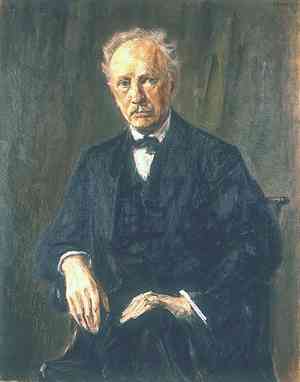
Richard Strauss 1918
Painting: Max Liebermann
Source: All World Art
Born in Munich on 11 June 1864, Richard Strauss was the son of Franz Strauss. He wasn't related to the waltzing Johann Strauss I or II. Strauss has been regarded by not a few to have been the preeminent composer of the first half of the 20th century. Of well over 300 works eighteen were operas and ten were tone poems, genres by which he is best known. Strauss began composing at age six before he could write, exampled by 'Schneiderpolka' for piano [audio by Dario Bonuccelli at piano]. That is catalogued in one of two ways: AV 1 or TrV 1. "AV" numbers with Strauss are per the 'Thematisches Verzeichnis' of E. H. Müller von Asow (Vienna 1959). AV numbers are no longer used, replaced by "TrV" numbers per the 'Werkverzeichnis' of Franz and Florian Trenner 3rd Edition (Munich 1999). Compare AV to TrV. Strauss' father, Franz, arranged 'Schneiderpolka' for strings in 1873.
'Schneiderpolka' ('Tailor Polka') TrV 1 Piano piece by Richard Strauss
Piano: 1870 Orchestration: Franz Strauss 1873
Piano: Dario Bonuccelli 2015
Orchesterverein Wilde Gung'l / Jaroslav Opela 1994
Strauss began with lied and piano pieces as a child, gradually moving upward through chorals and chamber music, then larger orchestral works. His first opera, never performed, had appeared at about age twelve, 'Der Kampf mit dem Drachen' ('The Fight with the Dragon') AV 206 TrV 44. Strauss assigned his first Opus number to another work composed in 1876, that being 'Festmarsch' in E flat major for orchestra, Op 1 TrV 44, which eventually premiered in Munich on 26 March 1881.
'Festmarsch' Op 1 TrV 43 E-flat major Festival March by Richard Strauss
Premiere 26 March 1881 in Munich
Royal Scottish National Orchestra / Neeme Järvi 1994
Strauss' initial tone poem was 'Aus Italien' ('From Italy') Op 16 finished in 1886, the result of a trip to Italy with Johannes Brahms. His initial opera to be performed was 'Guntram' Op 25 with libretto by himself. That premiered on 10 May 1894 at the Grossherzogliches Hoftheater in Weimar with the soprano role of Freihild filled by his wife to be, Pauline de Ahna. In this tale, Guntram is a knight who falls in love with Freihild upon saving her from drowning, a suicidal attempt wrought by her despair that her husband, Duke Robert, is a tyrant who oppresses the poor. Guntram was part of a failed uprising against Robert. Upon a second uprising Guntram kills Robert, upon which Robert's father imprisons him toward execution. Freihild realizes that she loves Guntram, but they are part of a fraternity which renounces romance toward serving the poor. Guntram is freed but he and Freihild must part in interest of the greater goal though servicing the fraternity. 'Guntram' isn't one of Strauss' more popular works, presented on stage only a few times during his lifetime.
'Aus Italien' Op 16 TrV 147 First tone poem by Richard Strauss
Comp completed 12 Sep 1886 Premiere 12 March 1887 in Munich
MDR Leipzig Radio Symphony Orchestra / Kristjan Järvi
20 March 2016 at the Gewandhaus in Leipzig
'Guntram' Op 25 TrV 168 First opera by Richard Strauss
Comp in Sicily 1888-93 Revised 1934-39 Premiere 10 May 1894 in Weimar
Libretto: Strauss
Hungarian State Orchestra / Eve Queller
Boosey IMSLP Ian Lace Libretto Opera Quarterly Wikipedia
Pauline and Richard married on 10 September 1894, the same day that he conducted for the first time at the Bayreuth Festival [Wikipedia], his wife singing soprano in the role of Elisabeth in a rendition of Wagner's 'Tannhäuser'. The premiere of Strauss' tone poem, 'Also Sprach Zarathustra' ('Thus Spoke Zarathustra') Op 30 AV 30 TrV 176, arrived in Frankfurt on 27 November 1896. 'Also Sprach Zarathustra' is needful mention in accounts of Strauss for two main reasons in the broader spectrum: It was an interpretation of one of the literary giants of the latter 19th century, Friedrich Nietzsche, the latter only recently publishing 'Also Sprach Zarathustra' in four parts from 1883 to 1885. The second is that Strauss' work is now far more famous in modern times than it was back then, due to its inclusion in the soundtrack of Stanley Kubrick's 1968 film '2001: A Space Odyssey'. Elvis Presley used the fanfare of 'Also Sprach Zarathustra' to open his concerts from 1971 until his death in 1977.
'Also Sprach Zarathustra' Op 30 TrV 176 Tone Poem by Richard Strauss
Comp 1896
Chicago Symphony Orchestra / Georg Solti
Marin Alsop College Sidekick Calvin Dotsey IMSLP Marianne Williams Tobias Wikipedia
It was upon the premiere of his tone poem, 'Don Juan' Op 20, in Weimar on 11 Nov of 1889 that Strauss began acquiring notable attention. Though he had conducted Mozart’s 'Don Giovanni' in Munich before composing 'Don Juan', he drew from the 1851 tale, 'Don Juan', by Nikolaus Lenau. Nigh thirty years later in 1917 Strauss recorded a version of that issued in four parts on Deutsche Grammophon 65856 and 65857.
'Don Juan' Op 20 TrV 156 Tone Poem by Richard Strauss
Comp 1889 Premiere 11 Nov 1889 in Weimar
Chicago Symphony Orchestra / Georg Solti
Andrew Clements Herbert Glass Houston Symphony IMSLP Wikipedia
Considerably more popular than 'Don Juan' was Strauss' one-act opera, 'Salome' Op 54, which premiered on 9 December 1905 at the Königliches Opernhaus in Dresden. The libretto for 'Salome' was written by Strauss [IMSLP] after Hedwig Lachmann's translation of Oscar Wilde's play by the same name (Salomé) published in Français in 1891, English in 1894 [Wikipedia]. Set at the time of the tetrarch, Herod Antipas (son of King Herod), in 33 A.D., this story opens at a feast under the moon in the palace of Herodes (Herod Antipas) and his wife Herodias (his sister-in-law). As the daughter of Herodias, Salome is Herodes' niece and attracted to Jochanaan (John the Baptist) who rejects her as he is a prophet concerning Jesus with no interest in romance. Herodes, however, has designs on his niece and asks her to dance for him for the reward of anything she desires up to half his kingdom. She agrees and performs a dance of seven veils during which she gradually strips naked. Pleased by Salome's performnace, Herodes asks what she would have, to which she replies the head of Jochanaan on a silver platter (for rejecting her). Herodes, who something fears Jochanaan, would rather not, but Salome insists. Upon being presented with Jochanaan's severed head Salome begins to caress and kiss its bloody aspect. Herodes finds this detestable and orders his soldiers to kill her. 'Salome' was a fairly scandalous opera, which only made it the more popular, and the 'Dance of the Seven Veils' in its final scene is widely cited to this day.
'Salome' Op 54 TrV 215 Opera by Richard Strauss
Comp 1903-05 Premiere 9 Dec 1905 in Dresden
Libretto: Strauss
Weiner Philarmoniker / Karl Boehm
Tim Ashley James Baker Norman Gilliland IMSLP Opera Online Alex Ross Scribd Wikipedia
Libretto: Opera Guide Opera Today Richard Strauss Ausgabe
'Dance of the Seven Veils' Op 54 TrV 215 Opera by Richard Strauss
From the opera 'Salome'
Comp 1903-05 Premiere 9 Dec 1905 at Königliches Opernhaus in Dresden
Royal Concertgebouw Orchestra / Daniele Gatti
Salome: Malin Byström Choreography: Wim Vandekeybus
Amanda Angel Calvin Dotsey John Mangum Wikipedia
Also much esteemed is Strauss' first of seven operas with librettos by playwright, Hugo von Hofmannsthal, that being 'Elektra' Op 58 premiering at the Königliches Opernhaus in Dresden on 25 January 1909. Elektra is a tale of revenge. Set during the time of the Trojan War (about the turn of the 13th and 12th centuries B.C.), Elektra is the daughter of Agamemnon, king of Mycenae. The opens with maids attempting to wash away the blood of Agamemnon where he was killed by axe due to a love plot between his wife, Klytämnestra, and her lover, Aegisth. Klytämnestra laughs off Elektra's intention to find who are responsible for her father's murder and avenge him. She hopes to accomplish such with the aid of Orest, her brother, who is away. Meanwhile Klytämnestra and Aegisth have plans to imprison Elektra. She then receives news of Orest's death. Elektra thus wants Chrysothemis, her sister, to help avenge their father's death but Chrysothemis declines. It turns out that the death of Orest was false news, such that he and Elektra reunite. Orest then kills both Klytämnestra and Aegisth. Unfortunately, Elektra's dance of triumph is what kills her as well.
'Elektra' Op 58 TrV 223 Opera by Richard Strauss
Comp 1906-08 Premiere 25 Jan 1909 at Königliches Opernhaus in Dresden
Libretto: Hugo von Hofmannsthal
Wiener Philharmoniker / Karl Bohm Elektra: Leonie Rysanek
Tim Ashley Boosey IMSLP Bruce Scott Wikipedia
Come 'Der Rosenkavalier' ("The Knight of the Rose') Op 59 TrV 227 with another libretto by Hofmannsthal premiering at the Königliches Opernhaus in Dresden on 26 January 1911. This comic opera is set in Vienna during the reign of Empress Maria Theresa (1740 to 1780). It opens with the fictional character, Princess Marie Therese von Werdenberg, lounging in bed with a much younger lover, Octavian. The Princess is more commonly known as the Marschallin (wife of a field marshall). Come Baron Ochs to announce his engagement to one Sophie von Faninal, thus his need of a knight to deliver the traditional silver engagement rose to his bride-to-be. The Marschallin assigns Octavian to this task. But Sophie and Octavian fall in love, meaning a fight between he and Baron Ochs. Both survive the scrape with Ochs slightly wounded, after which Octavian sets a trap for Ochs, the latter receiving a message from one Mariandel, a chambermaid, asking to meet at a disreputable inn. They rendezvous, but Sophie soon arrives with her father as well, followed by the Marschallin, then Octavian. Ochs disappears something embarrassed and the Marschallin releases Octavian from their relationship in order to pursue his romance with younger Sophie.
'Der Rosenkavalier' Op 59 TrV 227 Opera by Richard Strauss
Comp 1909-10 Premiere 26 Jan 1911 at Königliches Opernhaus in Dresden
Libretto: Hugo von Hofmannsthal
Wiener Philharmoniker / Herbert von Karajan Salzburg Festival 1962
Britannica IMSLP Met Opera Score Wikipedia
Strauss is thought to have made his first piano rolls in late 1905, perhaps issued in February 1906. Discographical data for Strauss has been compiled by Peter Morse made available by ARSC (Association for Recorded Sound Collections). Unfortunately, this extraordinary discography fundamental to Strauss has been removed from the internet. In this work Morse traces Strauss through 25 recording sessions on roll or flat disc, either playing piano or conducting, to as late as a September 1944 radio broadcast taped in either Vienna or Munich. Among titles issued in 1906 was 'Fragments' from 'Salome' on Welte-Mignon WM 1182. 'Dance of the Seven Veils' was issued on Welte-Mignon WM 1183. Morse doesn't have Strauss recording again until circa 1914 (World War I starts July 1914), making several rolls for Hupfeld. Circa December 1921 saw eight more rolls now for Ampico.
Strauss' tone poem, 'Eine Alpensinfonie' ('An Alpine Symphony') Op 64, saw its first performance in Berlin on 28 October 1915 with an orchestra of above 120 players. The first test pressing of a compact disc (CD) was of Herbert von Karajan conducting a performance of 'Eine Alpensinfonie' by the Berlin Philharmonic on 1-3 December 1980 [see Discogs]. The first commercial release of a compact disc was of Claudio Arrau performing waltzes by Chopin in 1979, transferred to CD 17 August 1982. The first commercially released compacts discs were in Japan [Wikipedia].
'Eine Alpensinfonie' Op 64 TrV 233 Richard Strauss
Comp 1911-15 Premiere 28 Oct 1915 in Berlin
Frankfurt Radio Symphony / Andrés Orozco-Estrada 14 Oct 2016
IMSLP Thomas Schulz Marianne Williams Tobias Wikipedia
Morse (above) estimates autumn of 1917 when Strauss recorded his first string of 78 rpm flat discs for Gramophone, those including a version of 'Don Juan' in four parts issued on Deutschsprachige Grammophon 65856 and 65857 [audio]. Strauss would also later record for Polydor (issued on Brunswick), Columbia and HMV (Gramophone branch). Most of his records were recorded in Germany, also holding sessions in London. Morse has Strauss documenting 'Salome's Dance' in 2 parts in Chicago, Illinois, as well, that likely on 2-6 November 1921 for issue on Brunswick 50002. Strauss also recorded a couple parts of 'Der Burger als Edelmann' at that time toward issue on Brunswick 50017.
'Don Juan' Op 64 TrV 233 Recording by Richard Strauss
1917 Grammophon 65856 / 65857
Berlin Hofkapelle
'Salome's Dance' Part 1 Op 54 TrV 215 Recording by Richard Strauss
Nov 1921 Brunswick 50002
Chicago Symphony Orchestra
Through the twenties up to the Third German Reich was the democratic period (not reich) of the Weimar Republic (1918-33) during which Strauss produced works for voice, chamber, opera, orchestra, a couple ballets and fanfares, as well as his song cycle, 'Die Tageszeiten' Op 76 TrV 256, performed by the Vienna Philharmonic on 21 July 1928 with the Wiener Schubertbund (Vienna Schubert Society).
'Die Tageszeiten' ('Times of Day') Op 76 TrV 256 Choral song cycle by Richard Strauss
Comp 1928 Premiere 21 July 1928 in Vienna
Ernst-Senff Chor w the Dresdner Philarmonie / Michel Plasson
Come Strauss' opera, 'Arabella' Op 79, on 1 July 1933, his last of six operas with text by Hofmannsthal. Set in Vienna during the 1860s, 'Arabella' is another of opera's favorite means of plot, that being the use of disguised identity (the history of opera is packed with masked balls). This time it is Arabella's sister, Zdenka, presenting herself as a male Zdenko which creates the confusion out of which "The End" arrives upon final clarity as to who is who. In this tale it is Matteo, a young officer, and Mandryka, a Croatian landowner, who must distinguish between Zdenka and Arabella.
'Arabella' Op 79 TrV 263 Opera by Richard Strauss
Comp 1930-32 Premiere 1 July 1933 at the Semperoper in Dresden
Libretto: Hugo von Hofmannsthal
Coro di Roma della RAI w the Orchestra Sinfonica Di Roma Della RAI / Wolfgang Rennert
Arabella: Montserrat Caballé Mandryka: Siegmund Nimsgern
Matteo: René Kollo Zdenka: Olivera Miljakovic
Tim Ashley IMSLP Opera Online Wikipedia
The German Reich of which Adolf Hitler's was the Third from 1933 to 1945 per National Socialism also referred to Hitler's notion of a millennial-long realm that it was his to establish. That would come to less glory, however, than surrender to the Allies during World War II along with a bad reputation per the Jewish Holocaust. That is to say, though Strauss had continued working largely as usual through World War I, World War II wrought some disturbance. Albeit Strauss wasn't Nazi, he was made president of the Reichsmusikkammer (Reich Music Bureau) in November 1933, that when Jews were being excluded from musical positions in Germany. Complicating that detour was a Jewish daughter-in-law. Strauss complied with the ban on Jewish composers until 1935 when he curved with 'Die schweigsame Frau' ('The Silent Woman') Op 80 adorning a libretto by Stefan Zweig, a Jewish writer. Premiering at the Semperoper in Dresden on 24 June 1935, the opera was banished and Strauss dismissed from his posts at the Reichsmusikkammer and the Bayreuth Festival. He yet owned the influence, however, to rescue his daughter-in-law from fate at a concentration camp. His to save others in her family were unsuccessful. As for 'Die schweigsame Frau', this comic opera is set in a London suburb about 1760. Its main character is one Sir John Morosus, a retired naval captain who cannot bear noise due to having survived an explosion at sea. He is therefore seeking a quiet woman to marry. But darn, his long-lost nephew Henry comes visiting. Henry is part of an opera troupe, and opera is something that Morosus decidedly hates to such degree that he throws Henry and his troupe out of his house and disinherits him. Schneidebart, Morosus' barber, then meets with Henry, whence they devise a plan to show Morosus their true abilities as actors. Schneidebart then visits Morosus with three prospective brides from which to choose. Morosus does, and a sham wedding ensues. From this point onward Morosus must suffer the terrible woman (actress) he married, until Henry arrives to save him from her. The next day others of the troupe arrive as intolerably noisy craftsmen, along with "lawyers" who tell him that he must keep the woman he married. By this time Morosus is having a pretty miserable time of it. All ends well, however, when Henry finally reveals that everything has been an act ever since Schneidebart arrived with three prospective brides. Morosus gets angry, but then starts to laugh as he must admit that he was fooled well. He restores Henry to his inheritance, also blessing his marriage with Aminta (the horrible "wife" he chose).
'Die schweigsame Frau' ('The Silent Woman') Op 80 TrV 265 Comic opera by Richard Strauss
Comp 1932-35 Premiere 24 June 1935 at the Semperoper in Dresden
Libretto: Stefan Zweig after Ben Johnson
Bard Festival Chorale / James Bagwell
American Symphony Orchestra / Leon Botstein
Direction and set: Christian Räth
Choreography: David Neumann Costumes: Mattie Ullrich
Bard SummerScape Opera 2022
Tim Ashley Boosey Fisher Center IMSLP
Peter Jungblut Georg Predota Curtis Rogers Wikipedia
Strauss' last opera to see performance in his lifetime was 'Capriccio' Op 85, arriving to the Nationaltheater in München on 28 October 1942, the Allies having yet to arrive to Germany. 'Capriccio' is one of Strauss' least popular works. Set in a château near Paris about 1775, the trouble is that Countess Madeleine has two prospective lovers from which to choose, a composer named Flamand and a poet named Olivier, but music and words go together, so she cannot.
'Capriccio' ('A Conversation Piece for Music') Op 85 TrV 279 Opera by Richard Strauss
Comp 1940-41 Premiere 28 Oct 1942 at the Nationaltheater in Munich
Libretto: Strauss / Clemens Krauss
Wiener Staatsoper / Christoph Eschenbach
Direction and lights: Marco Arturo Marelli
Choreography: Lukas Gaudernak Costumes: Dagmar Niefind
Boosey IMSLP Libretto Chanda VanderHart Wikipedia
Strauss began composing 'Metamorphosen' AV 142 TrV 290 in Vienna on 13 March 1945 beneath Soviet siege of the city, Vienna surrendering the day after Strauss completed his 23 studies for string instruments of which 'Metamorphosen' consists. The Allies claimed victory over the European theatre two months later, four months later in the Pacific per Japan's surrender. Paul Sacher conducted the premiere of 'Metamorphosen' in Zurich on 25 January 1946 after the War. Written for an orchestra of strings, Strauss took his inspiration for this work from Goethe's notions of metamorphoses in nature. Though it is regarded a masterpiece Strauss assigned it no Opus.
'Metamorphosen' TrV 290 C minor Richard Strauss
Comp 1944-45 Premiere 25 Jan 1946 in Zurich
Scored for 10 violins / 5 violas / 5 cellos / 3 basses
Norwegian Chamber Orchestra / Terje Tønnesen
Stanley Corngold IMSLP Steve Schwartz Wikipedia
Among Strauss' final compositions was 'Allegretto' in E major for violin and piano AV 149 TrV 295 with a date of 5 August 1948. This is a short little piece of a minute and so. Strauss' last four songs weren't entirely so, though he composed his 'Four Last Songs' ('Vier Letzte Lieder') TrV 296 from 5 May to 20 September of 1948 with texts related to death by Hermann Hesse and Joseph von Eichendorff. Albeit completed in 1948, they didn't see performance, posthumous, until 22 May 1950 by soprano, Kirsten Flagstad, at Royal Albert Hall in London. They were published that year as a compiled unit by Ernst Roth. Strauss had intended to include 'Besinnung' ('Reflection') with another text by Hesse but it became "too complicated" to finish.
'Allegretto' TrV 295 E major Richard Strauss
Comp completed 5 Aug 1948
Piano: Andrew Armstrong Violin: James Ehnes
'Vier Letzte Lieder' ('Four Last Songs') TrV 296 Song cycle by Richard Strauss
Comp: 5 May 1948-20 Sep 1948
'Frühling' ('Spring')
'September'
'Beim Schlafengehen' ('When Falling Asleep')
'Im Abendrot' ('At Sunset')
Lyrics from Hesse / Eichendorff
Munich Radio Orchestra / Roberto Abbado Soprano: Pamela Coburn
IMSLP R.M. Libonati Texts Texts Wikipedia
Strauss' swan song (last song) was actually 'Malven' TrV 297 completed on 23 November 1948 to a text by Betty Wehrli-Knobel. Strauss had been creating sketches for his comic Singspiel (opera genre), 'Des Esels Schatten' ('The Donkey’s Shadow') AV 300 TrV 294 when he died on 8 September 1949, three weeks shy of the official announcement of the existence of the People's Republic of China on October 1 of 1949. 'The Donkey's Shadow' eventually saw posthumous performance on 7 April 1964 to a score completed by Karl Haußner. This comedy concerns a legal battle between the owner of a donkey and a dentist. In the meantime they forget to feed the donkey and it dies.
'Malven' TrV 297 Song by Richard Strauss
Last finished composition
Completed: 23 Nov 1948
Lyrics: Betty Wehrli-Knobel
Piano: Martin Katz Soprano: Kiri Te Kanawa
Fisher Hall in New York City 1985
New York Times New York Times Text Roger Vignoles
Sources & References for Richard Strauss:
VF History (notes)
Audio of Strauss: Corpora:
Audio of Strauss: Individual: Chronological:
Festmarsch (Op 1 TrV 43 / E-flat major / 1876 / premiere 1881 / Nürnberger Symphoniker / Klauspeter Seibel)
Dance of the Seven Veils (from Salome Op 215 TrV 44 / 1905 / premiere 1905 / London Symphony Orchestra / Erich Leinsdorf)
Eine Alpensinfonie (Op 64 TrV 233 / 1915 / premiere 1915 / Tokyo Metropolitan Symphony Orchestra / Jakub Hrusa)
Eine Alpensinfonie (Op 64 TrV 233 / 1915 / premiere 1915 / Frankfurt Radio Symphony / Andrés Orozco-Estrada)
Fragments from "Salome" (1923 piano roll)
Die Tageszeiten (Op 76 TrV 256 / 1928 / Malmö Opera Orchestra w the Lunds Studentsångare / Alberto Hold-Garrido / 2011)
Metamorphosen (TrV 290 / premiere 1946 / Staatskapelle Weimar / Antoni Wit)
Allegretto (TrV 295 / 1948 / piano by Wolfgang Sawallisch / violin by Erno Sebestyen / Munich 1995)
Vier Letzte Lieder (Four Last Songs / TrV 296 / 1948 / premiere posthumous 1950 / Lee Abrahmsen / 2016)
Chronologies: Schott Music (pdf) Dr. Lutz Walther
Compositions:
All Music (by date)
Boosey (alphabetical)
Johannes Hanstein (by genre)
IMSLP (alphabetical)
IMSLP (by AV / date / Opus / title / TrV)
IMSLP (operas)
IMSLP (tone poems)
Klassika (by AV / date / genre / Opus / title / TrV)
Music Brainz (by Opus)
Music Brainz (by TrV)
Operone (by date)
Rate Your Music (by date / genre)
Richard Strauss (by genre)
Schott Music (by genre)
Wikipedia Deutschsprachige (by genre)
Wikipedia English (by AV / date / genre / Opus / title / TrV)
Wikipedia English (by genre)
Wikipedia English (operas)
Wikipedia English (tone poems)
Wikipedia Español (alphabetical)
Contemporaries: Richard Strauss
Correspondence: correspSearch Richard Strauss Ausgabe
Criticism: Guardian Richard Strauss Ausgabe
Discussion: Good Music Guide Google Groups
Documentaries:
Dance of the Seven Veils / Ken Russell / 1970: Part 1 Part 2 Part 3 Part 4 Part 5 Part 6
Documents / Manuscripts: Europeana Gallica Internet Archive
Iconography: Richard Strauss Wikimedia Commons
Lyrics: Operas (Elektra / Salome): Richard Strauss Ausgabe
Lyrics: Songs: Corpora: Emily Ezust (Lieder Net) Oxford Song Richard Strauss Ausgabe
Lyrics: Songs: Individual:
From Elektra premiering in January 1909:
Allein! Weh, ganz allein! (Alone! Alas, all alone!)
Ich hab's wie Feuer in der Brust (It feels like fire in my chest)
Wie stark du bist! (How strong you are!)
From Der Rosenkavalier (The Knight of the Rose) premiering in January 1911:
Di rigori armato (Armed with severity)
Wie Du warst! (How you were!)
Recordings by Strauss: Catalogs / Discographies:
DAHR (1921 / Richard Strauss Symphony Orchestra)
Catalogue of All 65 and 88 Note Music Rolls (up to July 1914 albeit dates are entirely absent / The Orchestrelle Company) (alt)
Recordings by Strauss: Individual:
Richard Strauss: 1906 Today (1906 Welte-Mignon piano rolls by Strauss)
Rosenkavalier (Introduction to Act 1 / Augmented Tivoli Orchestra conducted by Strauss / Queen's Hall in London / 13/14 April 1926 / made for the silent film Der Rosenkavalier)
Recordings of Strauss: Catalogs / Discographies:
DAHR (1904-1953)
Klassika (CDs)
Klassika (DVDs)
Wikipedia (Arabella premiering 1933)
Wikipedia (Capriccio premiering 1942)
Wikipedia (Four Last Songs premiering 1949)
Scores / Sheet Music:
Abe Books (vendor)
Musicalics (vendor)
Notenlager (vendor / Europe)
Richard Strauss Ausgabe (editions)
Further Reading: the German Reich:
Adolph Hitler (1889-1945): Biography History Jewish Virtual Library Wikipedia
The First Reich (Holy Roman Empire / Charlemagne 800 to dissolution by Napoleon 1806): Wikipedia
The Jewish Holocaust (1941-1945):
The Atlantic History Jewish Virtual Library National WW2 Museum USHMM Wikipedia
National Socialism (Nazism 1933-1945): Britannica Richard Evans Jewish Virtual Library Wikipedia
The Second Reich (German Empire 1871-1918): Wikipedia
The Third Reich (Nazi Germany 1933-1945): Britannica Smithsonian
Further Reading: Strauss:
Henry T. Finck (Richard Strauss: The Man and His Works / Little, Brown and Company / 1917)
(usage of Strauss in film and television)Christopher Madden (Toward a Discography of Composer-Pianists)
Guy A. Marco / Frank Andrews (Encyclopedia of Recorded Sound in the United States / Garland Publishing / 1903)
Ralph Moore (The less-well-known operas of Richard Strauss)
Ernest Newman (Richard Strauss / Books for Libraries Press / 1969)
Royal Opera House Covent Garden Foundation
Eugen Schmitz (Richard Strauss als Musikdramatiker)
Wikipedia (recordings by Strauss as conductor)
Kenneth Woods (Re-rating Richard):
Part 1 (Strauss, he was no Mahler, he was no Wagner)
Part 2 (Strauss, innovation and absolute music)
Part 3 (Strauss, personality and politics)
WQXR Radio:
Part 1 (Epic Tales Well Told: Strauss's Tone Poems)
Part 2 (Strong Women Dominate Strauss Operas)
Part 3 (The Enigma of Richard Strauss)
Charles Youmans (Richard Strauss: A Tireless Advocate of “Modern” Works)
Bibliography:
Bryan Gilliam (Richard Strauss and His World / Princeton University Press / 1992)
Rufus Hallmark (German Lieder in the Nineteenth Century / Routledge / 2010)
Internationale Hermann Hesse Gesellschaft (Hermann Hesse Jahrbuch / De Gruyter / 2009)
Michael Kennedy (Richard Strauss: Man, Musician, Enigma / Cambridge University Press / 2006)
Laurenz Lütteken (Richard Strauss: Die Opern / C.H. Beck / 2013)
Laurenz Lütteken (Strauss / Oxford University Press / 2019)
Willi Schuh (Richard Strauss: A Chronicle of the Early Years 1864-1898 / Cambridge University Press / 1982)
Authority Search: BMLO BNF Data Deutsche Digitale Bibliothek
Other Profiles:
Guido Maria Gatti (Enciclopedia Italiana /1936)
Georg Predota (Interlude)
Gregor Quendel (Claasicals)
Rovi Staff (All Music)
Classical Main Menu Modern Recording
|
|