
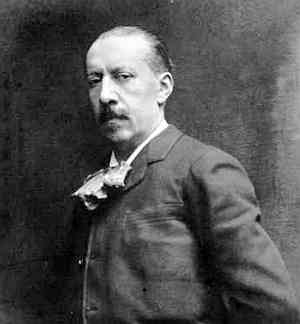
Charles-Marie Widor
Photo: Paul Berger
Bibliothèque Nationale de France
Source: Wikipedia
Born on 21 February 1844 in Lyon, France, organist Charles-Marie Widor composed for chamber, chorus, stage and orchestra, along with songs and a considerable number of pieces for solo organ and solo piano. He was the son of an organ builder who was a friend of with whom Widor's career was intertwined: organ builder, Aristide Cavaillé-Coll. Widor composed a lot of music especially for the Cavaillé-Coll organ, also premiering their installment at locations such as Notre-Dame de Paris, Saint-Germain-des-Près, Saint-Ouen de Rouen and the Trocadéro. Just what sort of organ we're talking about is such that, though Widor's "symphonies" were written for one organ alone, they were called such due to the wide orchestral range along with other features that helped the Cavaillé-Coll organ to approximate symphonic effects. Cavaillé-Coll planted organs all over Europe: Mainz-Bretzenheim; Manchester; Paris: St. Sulpice; Tarn; various. As a performer, however, Widor's venues extended widely beyond only those for the Cavaillé-Coll organ, he having traveled internationally including Russia (where is built another Cavaillé-Coll organ in the Grand Hall of the Moscow Conservatory).
It was Cavaillé-Coll who got young Widor sent to Brussels in 1863 to study organ under Jacques-Nicolas Lemmens and composition beneath the director of the Brussels Conservatoire, François-Joseph Fétis. Widor's Opus 1 is assigned to a work for piano titled 'Variations de concert sur un thème original' published circa 1867. By 1868 he was ready to become assistant to Camille Saint-Saëns at the Catholic Eglise de la Madeleine in Paris in 1868. In 1870 he became organist at the Catholic Church of Saint-Sulpice in Paris, where he remained until 1933.
It was 1870 that Widor wrote 'Sérénade' in C major Op 10 for piano, flute, violin, cello and harmonium. He published 'Organ Symphony No.1' in C minor Op 13 No.1 in 1872. The first of two piano concertos arrived in 1876. Continuing with earlier works, 'Organ Symphony No.5' in F minor Op 42, the most famous of his organ symphonies, premiered at the Palais du Trocadéro in Paris on 19 October 1879. Widor himself recorded the Toccata from this work at Saint-Sulpice in Paris in 1932.
'Sérénade' in C major Op 10 Charles-Marie Widor
For piano / flute / violin / cello / harmonium
1870 published 1871
Flute: Thies Roorda Violin: Junko Naito Piano: Alessandro Soccorsi
'Organ Symphony 1' in C minor Op 13 Charles-Marie Widor
7 movements for organ
1872 published 1872 Revised 1901 / 1918
Organ: Suzanne Chaisemartin 1988
'Piano Concerto 1' in F minor Op 39 Charles-Marie Widor
3 movements for piano
1876
Utrecht Symphony Orchestra / Jean Fournet
Piano: Ronald Brautigam
The first edition of Widor's 'Vieilles chansons pour les petits enfants' ('Old songs for little children') arrived in 1883 containing 28 pieces. Of his ten Suites, his fourth which was Op 34 in four movements arrived for flute and piano in 1887. He published 'Quatre Pièces en Trio' for violin, piano and cello circa 1889, the fourth movement of which is the Serenade.
Toccata of 'Organ Symphony 5' in F minor Op 42 Charles-Marie Widor
5 movements for organ recorded by Widor in Oct 1932
1879 Revised 1901 / 1918
Organ: Widor Oct 1932
Wikipedia
'Au clair de la lune' ('By the Light of the Moon') 1 of 28 Charles-Marie Widor
'Vieilles Chansons et Danses pour les Petits Enfants'
('Old songs for little children')
28 pieces for piano and voice
1883
Les Comptines de Gabriel
'Suite' Op 34 Charles-Marie Widor
4 sections for flute and piano
1887
Flute: Leonard Garrison Piano: Rajung Yang
'Quatre Pièces en Trio' Charles-Marie Widor
1889 published 1890
Tier3 Trio:
Violin: Joseph Wolfe Piano Daniel Grimwood Cello Jonathan Ayling
In 1890 Widor succeeded César Franck as an organ, and later composition, teacher at the Paris Conservatoire. His Preface appeared in André Pirro's 'Johann Sebastian Bach' in 1895 [edition 1902]. Into the 20th century Widor published 'Organ Symphony 10 ('Romane') in D major Op 73 in 1900. In 1904 he published 'Technique de l'orchestre moderne'.
Finale of 'Organ Symphony 10' in D major 'Romane' Op 73 Charles-Marie Widor
1899 published 1900
Organ: William Sullivan Third Baptist Church / St. Louis 2017
'Fugue sur le nom d'Haydn' Charles-Marie Widor
1909 published 1910 for piano
Piano: Henrik Berg Third Baptist Church / St. Louis 2017
It was 1910 when Widor was appointed to the Institut de France, later to become Secretary of the Académie des Beaux-Arts. Widor had waited until he was 76 years old to get married on 26 April 1920 at Charchigné to 36 year-old Mathilde de Montesquiou-Fézensac of one of Europe's wealthier families. It was 1920 when King Alfonso XIII officially founded the Casa de Velázquez in Madrid, a school to which formation Widor was key [Wikipedia]. Widor was a founder of the American Conservatory at Fontainebleau in 1921, there director until 1934 [Wikipedia]. He published his study of various facets of music, 'Initiation Musicale', in 1923. Eleven years later he published his final compositions at age ninety as 'Trois Nouvelles Pièces' Op 87 in 1934 [IMSLP / Ateş Orga]. .
'Salvum fac populum tuum' ('Save Your People') Op 84 Charles-Marie Widor
1916 published 1917 for 3 trumpets / 3 trombones / timpani / organ
Saint Joseph Cathedral Columbus OH 25 Jan 2015
Pastorale from 'Bach's Memento' Op 84 Charles-Marie Widor
Movement 1 of 6 published 1925
Organ: Bernhard Schneider
'Lauda Sion' from 'Suite Latine' Op 86 No.6 of 6 Charles-Marie Widor
1927
Organ: Eric Meece (Eric Mystic)
'Classique d'hier ('Yesterday's Classic') Charles-Marie Widor
From 'Trois Nouvelles Pièces' Op 87 No.1 of 3
1934 Age 90
Organ: Bernhard Schneider
'Classique d'aujourd'hui' ('Today's Classic') Charles-Marie Widor
From 'Trois Nouvelles Pièces' Op 87 No.3 of 3
1934 Age 90
Organ: Bernhard Schneider
Franklin Roosevelt had been elected to his second term as President of the United States when Widor died at his home in Paris on 12 March 1937, three months before Picasso's 'Guernica' was painted that June.
Sources & References for Charles-Marie Widor:
Blair Johnston (All Music) VF History (notes)
Wikipedia English Wikipedia French
Audio of Widor:
Serenade (of Quatre Pièces en Trio / 1889 / The Tollefsen Trio on Edison Amberol cylinder 1052 of 1912)
Authorship:
Initiation Musicale (1923): Wikisource
Technique de l'orchestre moderne (1904): Gallica IMSLP Internet Archive (scroll)
Aristide Cavaillé-Coll (organ builder / 1811-99):
Compositions: Corpora:
IMSLP (by date / genre / opus / title)
Klassika (by genre)
Wikipedia English (by genre)
Wikipedia Dutch (by genre)
Wikipedia French (by genre)
Wikipedia German (by date / instrument / opus)
Wikipedia Portuguese (by genre)
Wikipedia Spanish (by genre)
Documents / Manuscripts: Gallica
Iconography: Find a Grave Wikimedia Commons
Recordings of Widor: Catalogs:
45 Cat DAHR (shellac 1904-29) Discogs Music Brainz Rate Your Music
Scores / Sheet Music: Corpora:
Musicalics (vendor)
Scores / Sheet Music: Individual:
Adagio to Organ Symphony 5 in F minor Op 42
Further Reading:
IMDb (usage of Widor in film)
John R. Near (The Complete Organ Symphonies of Charles-Marie Widor)
George Predota (A Vision of Eternity)
Authority Search:
BMLO BNF Data Deutsche Digitale Bibliothek Deutsche National Bibliothek
Other Profiles:
Orgues & Vitraux (French) Wikipedia Italian Wikipedia Russian
Classical Main Menu Modern Recording
|
|