
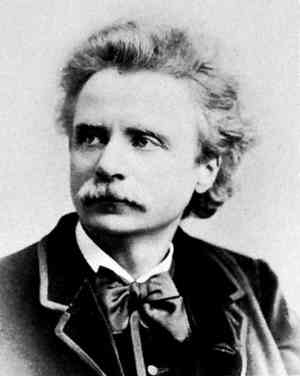
Edvard Grieg
Source: Wikipedia
Born on 15 June of 1843 in Bergen, Norway, Edvard Hagerup Grieg is the first composer from the Nordic regions to find this history. Beginniing piano at age six, Edvard was sent at age fifteen to study at the Liepzig Conservatory in Germany. His Opus 1 is assigned to 'Four Piano Pieces' written between 1861 and 1863. Grieg's catalog extends to 74 Opuses and 85 WoO. The WoO were given "EG" numbers in 2008 by Dan Fogg, Kirsti Grinde and Øyvind Norheim in 'Edvard Grieg (1843-1907), thematisch-bibliographisches Werkverzeichnis' published in Frankfurt by Peters.
'4 Piano Pieces' Op 1 Edvard Grieg 1861
Piano: Gavin Koh
Before finishing his studies in 1862 Grieg gave his first concert the year before in Karlshamn, Sweden. In 1863 he went to Copenhagen to work for three years, there to realize his 'Sinfonie C Moll' in 1864. He later pulled a couple of piano 4 hands pieces out of that symphony in 1875. He finished his solitary 'Piano Sonata' in 1865 dedicated to his contemporary, Danish composer, Niels Gade (1817-1890). It was 1866-67 when Grieg composed Book I Op 12 of 'Lyric Pieces'. Nine more would follow to Book X Op 71 in 1901 to a total of 66 pieces:
Book I Op 12 of 8 pieces published 1867
Book II Op 38 of 8 pieces published 1883
Book III Op 43 of 6 pieces published 1886
Book IV Op 47 of 7 pieces published 1888
Book V Op 54 of 6 pieces published 1891
Book VI Op 57 of 6 pieces published 1893
Book VII Op 62 of 6 pieces published 1895
Book VIII Op 65 of 6 pieces published 1897
Book IX Op 68 of 6 pieces published 1899
Book X Op 71 of 7 pieces published 1901
'Symphony in C minor' EG 119 Edvard Grieg 1864
Malmö Symphony Orchestra / Bjarte Engeset
Clssical Source IMSLP Talk Classical
'Piano Sonata' Op 7 Edvard Grieg 1865 Revised 1887
Piano: Katarina Andjelkovic
Wikipedia
'Lyric Pieces' Op 12-Op 71 Edvard Grieg 1867-1901
Piano: Chris Breemer
Grieg had married his Unitarian wife, Nina, on 11 June 1867, she a soprano with whom he made his home in Christiana, which was Oslo at the time. He and Nina often performed together. Grieg wrote his famous 'Piano Concerto' in A minor Op 16 in 1868 toward performing on 3 April 1869 and publishing in 1872. Grieg wrote this shortly after Nina gave birth to his daughter, Alexandria, who would die at age one. No further children followed. Grieg would begin a second concerto in the early eighties, but didn't finish it.
'Piano Concerto' Op 16 in A minor Edvard Grieg 1868
Premiere 3 April 1869 in Copenhagen
London Symphony Orchestra / André Previn Piano: Arthur Rubinstein
Fort Worth SO IMSLP Rhode Island Phil Terez Rose Wikipedia
Grieg found a champion in Franz Liszt in Rome in 1870. Liszt was the Stan Kenton of classical music, the go-to guy to advance one's musical career, he of assistance in one manner or another to not a few composers. Grieg premiered his incidental music to Henrik Ibsen's 1867 play, 'Peer Gynt', in Christiana on 24 February 1876. He later published a couple of suites from out of 'Peer Gynt', the first being 'Peer Gynt Suite No.1' Op 46 composed in 1875 toward publishing in Leipzig in 1888. 'Peer Gynt Suite No.2' wasn't composed until 1891 toward publishing in 1893.
'In the Hall of the Mountain King' Op 23 Incidental music by Edvard Grieg
From Act 2 Scene 6 of 'Peer Gynt'
Comp 1875 Premiere 24 Feb 1876 in Christiania (Oslo)
See also No.4 of 4 of 'Peer Gynt Suite No.1'
Warsaw Philharmonic Orchestra / Jacek Kaspszyk
Warsaw Philharmonic Concert Hall 21 Feb 2016
'Morning Mood' Op 23 Incidental music by Edvard Grieg
From Act 4 Scene 4 of 'Peer Gynt'
Comp 1875 Premiere 24 Feb 1876 in Christiania (Oslo)
See also No.1 of 4 of 'Peer Gynt Suite No.1'
Warsaw Philharmonic Orchestra / Jacek Kaspszyk
Warsaw Philharmonic Concert Hall 21 Feb 2016
Edvard Grieg
'Peer Gynt Suite No.1' Op 43 Comp 1875 Pub 1888
1. Morning Mood
2. Death of Åse
3. Anitra's Dance
4. In the Hall of the Mountain King
"Peer Gynt Suite No.2' Op 55 Comp 1891 Pub 1893
1. The Abduction of the Bride (Ingrid's Lament)
2. Arabian Dance
3. Peer Gynt's Homecoming (Stormy Evening on the Sea)
4. Solveig's Song
Kristiansand Symphony Orchestra / Bjarte Engeset
Both Edvard's parents died in 1875, whence he began his most aspiring piano piece, finishing his 'Ballade' in G minor in the spring of 1876. With the folk song 'Den nordlanske bondestand' ('The Northland Peasantry') for its theme, that was a series of fourteen variations ending with a coda. Come the second of his three string quartets in 1878. His first during the early sixties was lost. His third was left unfinished in 1891.
'Ballade' Op 24 in G minor Edvard Grieg 1876
Piano: Gregory Martin Holberg
G. Henle Verlag IMSLP Pallimed Wikipedia
'String Quartet No.1' Op 17 in G minor Edvard Grieg
Premiere Oct 1878 in Cologne
Performance above: Copenhagen String Quartet
Grieg became director of the Bergen Philharmonic Orchestra in 1880 for a couple of years. Per above, his 'Piano Concerto' in B minor EG 120 was begun in 1882 but left largely undone. Come his only 'Cello Sonata' Op 36 in 1883, dedicated to his brother, John. Grieg also composed two violin sonatas, one in 1867, finishing the other in 1887. In 1884 he honored Norwegian playwright, Ludvig Holberg (1684–1754), with his 'Holberg Suite' Op 40 in five movements.
'Cello Sonata' Op 36 in A minor Edvard Grieg 1883
Cello: Mischa Maisky Piano: Copenhagen String Quartet
Verbier Festival in Switzerland 2008
IMSLP Steven Isserlis Wikipedia
'Holberg Suite' Op 40 Edvard Grieg 1884
1. Praeludium
2. Sarabande
3. Gavotte
4. Air
5. Rigaudon
Netherlands Chamber Orchestra / Gordan Nikolic
Classic FM IMSLP Jessica Getman Matthew Mendez Jeremy Nicholas TŌN Wikipedia
In 1894 Grieg accepted an honorary doctorate from Cambridge University, another to follow from Oxford in 1906. In 1897 he completed his 'Symphonic Dances' Op 64 toward performance in 1898.
'Symphonic Dances' Op 64 Four dances by Edvard Grieg 1897
University of Washington Campus Philharmonia Orchestra / Ryan Farris
Robert Cummings IMSLP Vincent Osborn Score
Grieg isn't the first classical composer of note to document his music on flat disc. That was female composer and pianist, Cecil Chaminade, in London in 1901. He is, however, the first composer in these histories to have recorded on flat disc, that being nine titles on 2 May of 1903 in Paris for the Gramophone & Typewriter Company. Camille Saint-Saëns would record for the same enterprise in 1904. Among titles that Grieg documented were, in the order that they were composed, 'Humoresque' Op 6 No.2 of 4 from 'Humoresken' which premiered no later than 5 October 1866, 'Bridal Procession' Op 19 No.2 of 3 from 'Scenes of Country Life' composed circa 1870, 'To Spring' Op 43 No.6 of 6 from 'Lyric Pieces' composed in 1886 and 'Wedding Day at Troldhaugen' Op 65 No.6 of 6 from 'Lyric Pieces' composed in 1896. Grieg's experimental recordings weren't intended to be released to the general public. In the order that they were authored:
'Humoresque' from 'Humoresken' Op 6 No.2 Piano recording by Edvard Grieg
Premiere 5 Oct 1866 Recorded 2 May 1903 in Paris
IMSLP Score Wikipedia Dutch Wikipedia Norwegian
'Bridal Procession' from 'Scenes of Country Life' Op 19 No.2 Piano recording by Edvard Grieg
C 1870 Recorded 2 May 1903 in Paris
'To Spring' from 'Lyric Pieces' Op 43 No.6 Piano recording by Edvard Grieg
1886 Recorded 2 May 1903 in Paris Matrix 2147F Gramophone 0355110
'Wedding Day at Troldhaugen' from 'Lyric Pieces' Op 65 No.6 Piano recording by Edvard Grieg
1896 Recorded 2 May 1903 in Paris
Robert Cummings IMSLP Score Wikipedia
Grieg is also the first composer in these histories to have produced piano rolls for player pianos, thought to have slightly preceded Carl Reinecke who also made piano rolls in 1904. Grieg punched 'Butterfly' Op 43 No.1 for Aeolian on an unidentified date that year. 'Butterfly' is also known as 'Papillon', 'Schmetterling' or 'Sommerfugl'. Grieg made another piano roll of 'Butterfly' in April of 1906. Other of his piano rolls of 1906 were 'Berceuse' Op 38 No.1 from 'Lyric Pieces' [score] and 'Erotikon' Op 43 No.5 from 'Lyric Pieces'.
'Papillon' (Butterfly') from 'Lyric Pieces' Op 3 No.1 Piano roll by Edvard Grieg
1896 Recorded April 1906
Grieg's last Opus is assigned to '4 Psalms' Op 74 for baritone and choir composed in 1906, published 1907 [IMSLP / score].
'4 Psalms' Op 74 No.1 Edvard Grieg
'Hvad est du dog skjön' 'What Are You, Beautiful?'
Comp 1906 Published 1907
Malmö Chamber Choir
'4 Psalms' Op 74 No.2 Edvard Grieg
'Guds Sön har gjort mig fri' 'The Son of God Has Set Me Free'
Comp 1906 Published 1907
Gloriæ Dei Cantores led by Elizabeth C. Patterson 2009
This album
'4 Psalms' Op 74 No.3 Edvard Grieg
'Jesus Kristus Er Opfahreni' 'Jesus Christ Rises'
Comp 1906 Published 1907
Huygens Vocal Ensemble led by Hans Tijssen
De Bergkerk in Deventer, Netherlands 27 Nov 2011
'4 Psalms' Op 74 No.4 Edvard Grieg
'I Himmelen' 'In Heaven'
Comp 1906 Published 1907
Grex Vocalis / Carl Høgset
This album at Grex Vocalis This album at Tidal
Grieg's final words were reportedly "Well, if it must be so" upon his death in Bergen, Norway, on 4 September 1907. About 35,000 attended his funeral. His wife, Nina, lived onward until passing in Copenhagen on 7 December 1935.
Sources & References for Edvard Grieg:
Unitarian Universalist Historical
VF History (notes)
Audio of Grieg:
Recordings by Grieg (1903 / 1906)
Recordings by Grieg (Papillon Op 43 No. 1 / 17 April 1906)
Recordings by Grieg (Wedding Day at Troldhaugen / comparison of 1903 recording to 1906 piano roll)
Compositions: Corpora:
All Music (alphabetical)
Classic Cat (by Opus and EG)
Grieg Society (by Opus)
IMSLP (by Opus and EG)
IMSLP (piano)
IMSLP (piano and voice)
Klassika (by date / genre / Op / EG / title)
Piano Library (by difficulty)
Piano Society (by Opus and EG)
RYM (by genre)
Wikipedia English (by date / genre / Op / EG / title)
Compositions: Individual:
Lyric Pieces (10 Books from Op 12 of 1866/67 to Op 71 of 1901):
Peer Gynt (10 Books from Op 12 of 1866/67 to Op 71 of 1901):
Classic FM IMSLP Michael Jameson Wikipedia
Correspondence / Letters: Europeana
Documentaries:
Edvard Grieg: What Price Immortality? (directed by Thomas Olofsson / 1999)
Gramophone Company (1897) / Gramophone & Typewriter Company (1900):
MusicWeb International Wikipedia
Iconography: Find a Grave Wikimedia Commons
Grieg and the Pianola:
Grieg and the Player Piano (Grieg Piano Concerto)
Phonola Piano Rolls (1906)
Recordings by Grieg:
The Grieg 1903 Recordings (Sigurd Slåttebrekk / Tony Harrison)
Recordings of Grieg: Catalogs:
45 Cat Ampico Piano Rolls Ampico Piano Rolls
Arkiv DAHR (shellac / 1900-1949) Discogs
Internet Archive Klassika Music Brainz
Recordings of Grieg: Select:
Grieg | Evju (piano by Carl Peterson / Grand Piano GP689 / 2015)
Grieg: Piano Music Vol. 1 (piano and introduction by Einar Steen-Nøkleberg / Naxos 8.550881 / 1995)
Grieg: Symphonic Dances (Utah Symphony Orchestra / Maurice Abravane / notes by Joseph Braunstein / 2024)
Grieg: Symphonic Dances (Bergen Philharmonic Orchestra / Edward Gardner / Chandos CHAN5301W / 2024)
Lyric Pieces (piano by Sir Stephen Hough / Hyperion CDA68070 / 2015)
Lyric Pieces (piano by Einar Steen-Nøkleberg / Naxos 8.554051 / 1997)
Welte-mignon Piano Rolls Vol 2 (1905-15)
Scores / Sheet Music:
Choral Wiki (works for voice) IMSLP Musicalics (vendor)
MusOpen Notenlager (vendor) Scorser
Further Reading:
Grieg Society (Moscow)
Terez Rose (The Many Musical Moods of Edvard Grieg / 2024)
Authority Search: BNF Data
Other Profiles:
L'Agora (French) Britannica
Encyclopedia Enciclopedia Italiana (Italian / 1933)
Famous People Galaxy Music Notes
Liber Liber (Italian) mfiles
New World Encyclopedia Store norske leksikon (Norwegian)
Video: Biograph pianoTV VIS MUSIC
Wikipedia: Asturian French Italiano Neadersassisk Russian Slovenian
Classical Main Menu Modern Recording
|
|