
Charles Koechlin
Like Scriabin and Ravel, Charles Koechlin (kek-lin) was a secondary composer whilst a strong bridge figure between the Romantic and Modern periods. Koechlin hasn't, however, weathered time well, becoming relatively obscure since his death. Also like Scriabin and Ravel, Koechlin was associated with the Impressionism of the late Romantic period. Impressionism in music is to considerable degree a label derived by critics who saw similarities in Impressionistic art of the same period. That is, impressionistic was less a thing to compose like than a happy resemblance. Koechlin joins others with whom to describe as impressionistic would be highly confining, his music of a greater scope with concerns more actual to address. But if they called some of his work impressionistic so be it. Renoir and Monet are a couple of impressionist painters whose misty canvases blur as like the softly blending passages of some composers of the late 19th century.
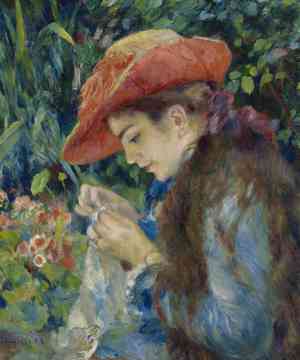
Mademoiselle Marie-Therese Durand-Ruel Sewing
Pierre-Auguste Renoir 1882
Source: Art History News
Bridge Over a Pond of Water Lilies
Claude Monet 1899
Koechlin had been a prolific composer, producing a good number of chamber, orchestral and symphonic works in addition to other instrumental music and works for voice, the latter for which he is presently best-known. Born on 27 November 1867 in Paris to a family wealthy in textile manufacturing, Koechlin became a student at the Paris Conservatoire in 1890, the same year he commenced his Op 1, '6 Rondels' with the libretto of the first written by Charles d' Orléans, the remaining five by Théodore de Banville. Koechlin later orchestrated '6 Rondels' in 1895 toward the first performance of all six complete on 20 January 1897.
'La Nuit' ('The Night') Op 1 No.2 Charles Koechlin
From '6 Rondels' comp 1890-1895 Pub 1896
Premiere of all 6 on 20 Jan 1897
Lyrics: Théodore de Banville
Piano: Christophe Durrant Soprano: Michele Command
Koechlin began '4 Poèmes d'Edmond Haraucourt' Op 7 in 1890 as well, to be orchestrated sometime 1894-97. His Op 5 is assigned to '5 Melodies' begun in 1893 as well as orchestrated that year. This page descends by composition dates, causing Opus numbers to seem out of sequence.
'Pleine Eau' ('Full Water') Op 7 No.2 Charles Koechlin
From 'Quatre Poèmes d'Edmond Haraucourt' comp 1890-1897 Pub 1900
Premiere of all 4 in Dec 1897 at the Société des compositeurs
Revised 1931 Arranged w choir 1937
Lyrics: Edmond Haraucourt
Piano: Christophe Durrant Soprano: Michele Command
'Chanson d'Amour' ('Song of Love') Op 5 No.3 Charles Koechlin
From 'Cinq Melodies' comp 1893-1897 Premieres 1898-1928 Pub 1898/99/1905
Lyrics: Louis Bouilhet
Piano: Christophe Durrant Soprano: Michele Command
'Si tu le veux' ('If You Want To') Op 5 No.5 Charles Koechlin
From 'Cinq Melodies' comp 1893-1897 Premieres 1898-1928 Pub 1898/99/1905
Lyrics: Maurice de Marsan
Piano: Ingo Dannhorn Tenor: Emilio Pons
Among Koechlin's professors at the Conservatoire was Gabriel Fauré in 1896. Upon graduation he himself began teaching, later beginning 'Trois Poèmes du ‘Livre de la Jungle’ Op 18 in 1899 with orchestration to follow in 1903-04. Texts for those were written by Louis Fabulet and Robert d' Humières after Rudyard Kipling's 'The Jungle Book' of 1894. 'Trois Poèmes' Op 18 is the first of a symphonic cycle addressing Kipling's 'Jungle Book'. The remaining four are 'La course de printemps' Op 95 completed in 1927, 'La méditation de Purun Baghat' Op 159 finished in 1936, 'La Loi de la Jungle' Op 175 completed in 1940 and 'Les Bandar-log' OP 176 also finished in 1940.
'Troix Poemes' Op 18 Charles Koechlin
No.1 of the symphonic cycle 'La Livre de la Jungle' by Kipling
1. 'Berceuse phoque'
2. 'Chanson de nuit dans la jungle'
3. 'Chant de Kala Nag'
Comp 1899-1901/1903-04 Premiere 11 March 1908 in Paris Pub 1905 in Paris
Lyrics: Louis Fabulet / Robert d' Humières after Kipling
Berlin Radio Chamber Choir and Symphony Orchestra / David Zinman
Baritone: Ralf Lukas Mezzo soprano: Iris Vermillion Tenor: Johan Botha
Koechlin became a critic for the 'Chronique des Arts' in 1909, then helped to found the Société musicale indépendante with Ravel in 1910. Soon upon the end of World War I in November 1918 Koechlin made a lecture tour in the United States to as far west as San Francisco into 1919, then joined Érik Satie's brief-existing Nouveaux Jeunes (New Young) in 1920 back in Europe (precursor to Les Six).
Koechlin had begun working on 'La course de printemps' ('the Spring Race') Op 95 in 1911, his second symphonic poem addressing Kipling's 'The Jungle Book'. Completed in 1927, it premiered five years later in Paris on 29 November 1932.
'La Course de printemps' ('The Spring Race') Op 95 Charles Koechlin
No.2 of the symphonic cycle 'La Livre de la Jungle' by Kipling
Comp 1911-27 Premiere 29 Nov 1932 at the Salle Playel in Paris Pub 1973
Radio Sinfonie Orchester Stuttgart des SWR / Heinz Holliger
Koechlin began working on his symphonic poem, 'Vers la Voitte Etoilee' ('Toward the Starry Sky') Op 129, in 1923, orchestrated it ten years later in 1933, revised it substantially in 1939.
'Vers la Voitte Etoilee' ('Toward the Starry Sky') Op 129 Symphonic poem by Charles Koechlin
Comp 1923/33 Revised 1939 Premiere 1989 Pub 1995
Radio Sinfonie Orchester Stuttgart / Heinz Holliger
Rob Barnett Adrian Corleonis IMSLP Evan Kassof Wikipedia
Writing numerous books addressing music theory, 'Précis des règles du contrepoint' appeared in 1926 per IMSLP, that preceding his 1927 biography of Gabriel Fauré [scroll]. His 'Traité de l'Harmonie' began its appearance toward 3 Volumes in 1928 [IMSLP], the same year he taught a term at the University of California in Berkeley, returning for a second term in 1929. 'Études sur le Choral d'école', another book in music theory, arrived in 1929 as well [IMSLP].
In 1934 Koechlin came to his 89 pieces composed for an imaginary film called 'The Portrait of Daisy Hamilton' Op 140. 'Sept Chansons pour Gladys' Op 151 arrived in 1935, bespeaking Gladys O'Halloran, main character in the French-German comedy film 'Calais-Dover' ('Calais-Douvres') of 1931. His third symphonic poem addressing Kipling's 'The Jungle Book' arrived in 1936 as 'La méditation de Purun Baghat' Op 159 but wouldn't see performance for another decade in late 1946 in Brussels.
'M'a dit Amour' ('Love Told Me') Op 151 No.1 by Charles Koechlin
From 'Sept Chansons Pour Gladys' comp 1935
Text: Koechlin
Soprano: Caroline MacPhie
'La méditation de Purun Baghat' Op 159 Charles Koechlin
No.3 of the symphonic cycle 'La Livre de la Jungle' by Kipling
Comp 1936 Premiere 13 Dec 1946 in Brussels Pub 1986
Radio Sinfonie Orchester Stuttgart des SWR / Heinz Holliger 2017
Koechlin made a fourth and final visit to the States in 1937 to teach in San Diego. In 1940 he finished his final two symphonic poems addressing Kipling's 'The Jungle Book': 'La Loi de la Jungle' Op 175 and 'Les Bandar-log' Op 176.
'La Loi de la Jungle' Op 175 Charles Koechlin
No.4 of the symphonic cycle 'La Livre de la Jungle' by Kipling
Comp 1939-40 Premiere 13 Dec 1946 in Brussels Pub 1986 in Paris
Radio Sinfonie Orchester Berlin / David Zinman
IMSLP Frederik Reitz / Keith Anderson
'Les Bandar-log' Op 176 Charles Koechlin
No.5 of the symphonic cycle 'La Livre de la Jungle' by Kipling
Comp 1939-40 Premiere 13 Dec 1946 in Brussels Pub 1967 in Paris
Radio Sinfonie Orchester Berlin / David Zinman
Koechlin began to write 'Le Docteur Fabricius' Op 202 in 1941 toward orchestration in 1946, though not to see its first performance until 14 January 1949 in Brussels by the INR Orchestra directed by Franz André.
'Le Docteur Fabricius' Op 202 Symphonic poem by Charles Koechlin
Comp 1941-44/46 Premiere 14 Jan 1949
Stuttgart Radio Symphony Orchestra / Heinz Holliger
Wikipedia
Koechlin's last Opus was assigned to 'Quinze Motets de style archaïque' Op 225 dans paroles (without words) dated 8-9 June 1950 [IMSLP].
'Voix d'hommes' ('Male voices') Op 225 No.1 Charles Koechlin
From 'Quinze motets de style archaïque' ('Fifteen Motets In Style Archaic')
Comp all 8-9 June 1950 Pub c 1998
Ensemble Vocal Francais
'Monodies' Op 225 No.11 Charles Koechlin
From 'Quinze motets de style archaïque' ('Fifteen Motets In Style Archaic')
Comp all 8-9 June 1950 Pub c 1998
Clarinet: Deborah Marshall Flute: Irmela Nolte
'Mystique et Lumineux' Op 225 No.15 Charles Koechlin
From 'Quinze motets de style archaïque' ('Fifteen Motets In Style Archaic')
Comp all 8-9 June 1950 Premiere 21 Oct 1952 Pub c 1998
Ensemble Vocal Francais
Having been a communist-leaning pantheist, Koechlin died on 31 December 1950, New Year's Eve.
Sources & References for Charles Koechlin:
Michael Rodman (All Music) VF History (notes) Wikipedia English
Audio of Koechlin:
Classical Archives Classical Music Only Hyperion MuziekWeb Naxos Presto
Authorship: Internet Archive Monoskop
Chronology: Musicologie
Compositions:
Johannes Hanstein (by genre)
IMSLP (alphabetical)
IMSLP (by genre / Opus)
Klassika (by date / genre / Opus / title)
Musicologie (by date)
Rate Your Music (by date / genre)
Wikipedia English (by genre)
Wind Repertory Project (winds)
Discussion: GMG Classical Music Forum
Iconography: Wikimedia Commons
Lyrics / Texts: Emily Ezust (LiederNet) Oxford Lieder
Manuscripts: Gallica
Recordings of Koechlin: Catalogs: Arkiv Music
Billaudot Discogs Music BrainzRecordings of Koechlin: Select:
Le Docteur Fabricius / Op 202 / comp 1944 / Stuttgart Radio Symphony Orchestra / Heinz Holliger / 2004:
Musique de Chambre (SWR19047CD / 7 CDs / 2017):
MusicWeb International PrestoOeuvres Orchestrales (SWR19046CD / 7 CDs / 2017)
: MusicWeb International PrestoSongs by Charles Koechlin (piano: Boaz Sharon / soprano: Claudette Leblanc / 2010)
Scores / Sheet Music: Abe Books (vendor / Amazon subsidiary) Musicalics (vendor) ScorSer
Further Reading:
Impressionism: Musical: Elliott Jones Piano TV Karla Walker Wikipedia
The Jungle Book (Rudyard Kipling / 1894): Gutenberg Internet Archive
Robert Reilly (Charles Koechlin—‘Alchemist of Sound' 2006)
Bibliography:
Robert Orledge (Charles Koechlin (1867-1950): His Life and Works / Harwood Academic Publishers / 1989)
Authority Search: BNF Data
Other Profiles: Classical Net David Wend (Find a Grave)
Wikipedia: Deutschsprachige Español Français Italian Portuguese Pусский
Classical Main Menu Modern Recording
|
|