
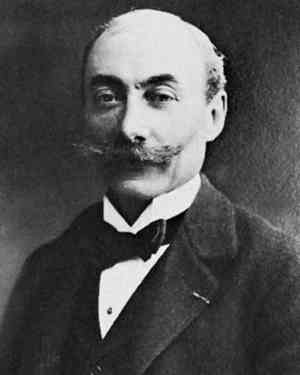
André Messager
Source: Britannica
Born on 30 December 1853 in Montluçon, France, André Charles Prosper Messager was the son of a tax collector and playing piano by age seven in preparation for a highly successful career of composing largely operas, operettas and ballets. Though Messager composed several instrumental works his oeuvre, when not conducting, was nigh exclusively theatrical, completing above forty works for stage. He was sent to board at a Marist school until the financial ruin of a bank crash made that no longer feasible. Fortunately, Messager won a scholarship to the École de Musique in Paris, run by composer, Louis Niedermeyer. During the Paris Commune of 1871 Niedermeyer moved his school to Switzerland. Messager followed, there to meet Gabriel Fauré, his next teacher.
Messager became choirmaster at the Church of Saint-Sulpice in 1874. In 1875 he composed a symphony (his only) that won a gold medal from the Société des Compositeurs in 1876. Messager composed his first work for stage in 1876, 'Les Païens' ('The Pagans'), an operetta with libretto by Henri Meilhac now lost. He won another gold medal in 1877 from La Société académique de Saint-Quentin for his cantata for three voices, 'Don Juan et Haydée', after George Byron's poem of 1819, 'Don Juan' ['Le Guide Musical'].
'Symphony in A Major' André Messager
Comp 1876 at age 22 Premiere 20 Jan 1878 in Colonne
Orchestre Symphonique du Mans / José André Gendille
In 1878 Messager and Fauré went on a tour of Wagner operas in Germany, also working together. Messager was also appointed conductor at the Folies Bergère [Wikipedia] in 1878. He worked at another theatre and a couple more churches until 1884. In the meantime he experienced the strong success of 'François les bas-bleus' at the Théâtre des Folies-Dramatiques on 8 November 1883. 'François les bas-bleus' had actually been begun by Fermin Bernicat who died on 5 March of 1883, Messager to complete the work with libretto by Ernest Dubreuil, Eugène Humbert and Paul Burani.
'François Les Bas-Bleus' Opéra comique by André Messager
Premiere 8 Nov 1883 at the Folies-Dramatiques in Paris
Libretto: Ernest Dubreuil / Eugène Humbert / Paul Burani
ORTF / Marcel Cariven Sep 1962
IMSLP Parnassus Books Wikipedia English Wikipedia Français
From 'François les bas-bleus' onward Messager pumped out one popular theatrical after the next, his works to eventually be produced in both Great Britain and the United States. His ballet, 'Les deux pigeons', saw performance at the Paris Opéra on 18 October 1886 with libretto by Louis Mérante and Henri de Régnier based on the 17th century fable by Jean de La Fontaine.
Suite to 'Les Deux Pigeons' Ballet by André Messager
Premiere 18 Oct 1886 at the Paris Opera
Dedication to Camille Saint-Saëns
Libretto: Henri de Régnier / Louis Mérante
Orchestre de Paris / Jean-Pierre Jacquillat
Messager's conte des fées (fairy tale), 'Isoline', wasn't quite so popular as 'Les deux pigeons'. That premiered at the Théâtre de la Renaissance in Paris on 26 December 1888. Isoline is a teenage princess who has been condemned to be transformed into a man upon her bridal bed when she gets married. To avoid this she is cloistered in a castle with her maids of honor, upon which the opera becomes a contest between Oberon and Titania, which original quarrel was the cause of Oberon's curse on Isoline. Be as may, in the end Isoline yet gets transformed into a male, that upon kissing one Prince Isolin, whom Titania, however, transforms into a girl.
Pavane (first movement) of the Suite to 'Isoline'
Conte des fées (fairy tale) by André Messager
Premiere 26 Dec 1888 at the Théâtre de la Renaissance in Paris
Libretto: Catulle Mendès
Orchestre Du Théâtre Des Champs-Elysées / Paul Bonneau 2016
IMSLP Wikipedia English Wikipedia Français
Messager's opera comique, 'La Basoche', went down at the Opéra-Comique in Paris on 5 May 1890 w libretto by Albert Carré. Though an artifact now, that was sufficiently popular at the time to see continual performance into the 20th century. La Basoche was a legal guild formed in France during the Middle Ages which operated until the French Revolution (1789-99). Messager's 'La Bosache' is set in 1514 Paris concerning a competition for "king" of the bosachians between one Marot and one Roland. This is complicated for Marot in that the "king" must be a bachelor, but he is married to one Colette. Along the progress of this opera Colette gets sent to England by Louis XII with the Duc de Longueville where the latter begins to believe that she loves him. Thus the self-deceived air, 'Elle m'aime' ('She Loves Me') in the third act:
'Elle m'aime' ('She Loves Me') from 'La Basoche' Opéra comique by André Messager
Sung by Longueville in Act 3 (final)
Premiere 5 May 1890 at the Opéra-Comique in Paris
Libretto: Albert Carré
Orchestra of the Opéra Comique / Gustave Cloez
Bass: Etienne Billot
Bandcamp IMSLP Wikipedia English Wikipedia Français Score Score Text
Messager's 'Les p'tites Michu' ('The Little Michus') premiered in Paris on 16 November 1897, at Daly's Theatre in London on 29 April 1905, yet another strong success with libretto by Duval and Vanloo (above) that enjoyed 401 performances. Michu and his wife adopt an infant girl from the Marquis des Ifs who is on the run during the French Revolution. Unfortunately, Michu also has an infant daughter, then manages to confuse them while giving them a bath. Years later, upon the girls - Blanche-Marie and Marie-Blanche - growing up to believe they are twins, the Marquis wants to give his daughter in marriage to one Lieutenant Gaston Rigaud. The problem which all must work out is that Michu doesn't know which young woman is the daughter of the Marquis and which is his own.
'Je viens d'entendre un roulement' ('I Just Heard a Rumble') from 'Les p'tites Michu'
Opéra comique by André Messager
From the Finale of Act 1
Premiere 16 Nov 1897 in Paris 29 April 1905 in London
Libretto: Albert Vanloo / Georges Duval
Orchestre National des Pays de la Loire / Pierre Dumoussaud 2019
Alexandre Dratwicki IMSLP Ralph Locke
In 1898 Messager became musical director for the Opéra-Comique [Wikipedia] in Paris. His highly popular operetta, 'Veronique', premiered at the Bouffes Parisiens on 10 December 1898 with text by Albert Vanloo and Georges Duval. Perhaps Messager's best-known work, 'Veronique' was popular enough to see 175 performances. This opera is set at a floral shop in 1840 Paris. One Vicomte Floristan faces either prison or an arranged marriage with rich Hélène de Solanges, due that his uncle is weary of paying Floristan's bills. Hélène, whom Floristan hasn't yet met, nor knows that she is wealthy, isn't real pleased with this arranged marriage. Before such wedding occurs, however, Hélène visits the flower shop to purchase corsages to wear to a ball celebrating her engagement. During this visit she learns to dislike Floristan who also enters the shop and complains about his immanent marriage to someone he knows not. Hélène then decides to avenge herself, disguising herself as a working girl, calling herself Veronique, in order to attend a party which Floristan is having to celebrate his coming marriage. Floristan then falls in love with humble Veronique pretending to be an assistant at the floral shop, after which he decides he'd rather go to jail than marry a stranger (Hélène). All ends well, however, upon Floristan learning that Veronique is Hélène.
'De-ci, de-là, cahin-caha' from 'Veronique' Opéra comique by André Messager
Sung by Florestan and Veronique in Act 1
Premiere 10 Dec 1898 at the Bouffes Parisiens in Paris
Libretto: Albert Carré
Orchestra Le Palais Royal / Jean-Philippe Sarcos Paris
Baritone: Adrien Fournaison Mezzo-soprano: Marion Vergez-Pascal
IMSLP Wikipedia English Wikipedia Français
Also writing works for other than stage, Messager published 'Solo de concours' ('Competition Solo') for clarinet and piano in 1899:
'Solo de concours' ('Competition Solo') For clarinet and piano by André Messager
1899 for a contest at the Paris Conservatoire (Wikipedia) Pub 1899
Clarinet: Woytek Mrozek Piano: Krzysztof Herdzin Kreuth, Germany 1995
IMSLP Score Score Wikipedia Français
From 1901 to 1907 Messanet was a director with the Grand Opera Syndicate in London, whereof he would conduct a number of concerts at Covent Garden (now the Royal Opera House) for several years.
Covent Garden Theatre in London Circa 1897
Living London History Arthur Lloyd
Royal Ballet and Opera Collections Wikipedia
In 1902 Messager conducted the Opéra-Comique premiere of Claude Debussy's opera, 'Pelléas et Mélisande'. Messager conducted his own opera, 'Fortunio', at the Salle Favart in Paris on 5 June 1907 with libretto by Gaston Arman de Caillavet and Robert de Flers. 'Fortunio' would see only seventy performances in Paris in the next fifty years. Fortunio is a clerk with a problem: He loves one Jacqueline, but she is married to one Maître André who neglects her.
'Je ne voir rien' ('I Don't See Anything') from Act 4 of 'Fortunio'
Comédie lyrique by André Messager
Premiere 5 June 1907 at the Salle Favart in Paris
Libretto: Gaston Arman de Caillavet / Robert de Flers
Orchestra Le Palais Royal / Jean-Philippe Sarcos Paris
Baritone: Adrien Fournaison Mezzo-soprano: Marion Vergez-Pascal
IMSLP Wikipedia English Wikipedia Français
In 1908 Messager traded the Opéra-Comiques for conducting for the Société des Concerts du Conservatoire. He took the Conservatoire orchestra to Argentina in 1916, Switzerland the next year, and above 50 cities in the United States and Canada in 1918-19. While in New York he conducted a number of flat disc recordings for Columbia, his first on 17 October 1918 consisting of Georges Bizet's 'Arlesienne' and his own 'Marche Bohemienne'. DAHR has him in fourteen sessions to the 24th on which he recorded a waltz along with Léo Delibes' 'Les chasseresses' from the ballet 'Sylvia'.
'Capriccio Espagnol' by Rimsky-Korsakov
'Danse Bacchanale' from Saint-Säens' 'Samson and Delilah'
'Capriccio Espagnol' recorded 19 Oct 1918 in NYC
Orchestre de la Société des concerts du Conservatoire
Matrix 49532 Columbia A6122
'Danse Bacchanale' recorded 22 Oct 1918 in NYC
Orchestre de la Société des concerts du Conservatoire
Matrix 49537 Columbia A6122
Like other composers in France during World War I, Messager had been pressured to boycott German music by a league led by Camille Saint-Saëns. But Messager, with a history of conducting music by Richard Wagner, believed that music oughtn't be contained within national boundaries, a position that lead to his resignation from the Conservatoire in April 1919 due in part to poor morale among members of the orchestra who weren't of the same sentiment while touring America. Messager's resignation arrived the same month as his premiere of 'Monsieur Beaucaire' at the Prince of Wales Theatre in Birmingham, England, on 7 April 1919 w libretto by Adrian Ross. The prologue to 'Monsieur Beaucaire' contains 'Red Rose' sung by Beaucaire. Beaucaire is actually the Duc d'Orleans, son of the King of France, in disguise as a barber. He loves one Lady Mary Carlisle, but must vie for her hand against the Duke of Winterset.
'Red Rose' sung by Beaucaire from Act 1 of 'Monsieur Beaucaire'
Operetta by André Messager
Premiere 7 April 1919 at the Prince of Wales Theatre in Birmingham, England
Libretto: Frederick Lonsdale / Adrian Ross
Baritone: Bruno Laplante Piano: Janine Lachance Montreal July 1974
Upon resigning from the Conservatoire Messager conducted at the Opéra-Comique for a season, including another performance of Wagner's 'Tristan und Isolde'. Come 'L'amour Masqué' at the Théâtre Édouard VII in Paris on 15 February 1923 with libretto by actor, Sacha Guitry. 'L'amour Masqué' concerns one Elle who is in love with one Lui upon seeing him in a photograph which she steals. She soon meets Lui when he comes to retrieve the photo, but he tells her that the image is of his son. Elle asks Lui to invite his son to a masked ball which he attends, pretending to be his son. After the ball Lui presents Elle with a farewell letter from his supposed son. The news leaves her too unhappy to read the letter, but the prick of a rose thorn makes Elle realize that the father and the son are the same, and all ends well.
''J'ai deux amants' ('I Have Two Lovers') from Act 1 of L'amour Masqué' ('Masked Love')
Comédie musicale by André Messager
Premiere 15 Feb 1923 at the Théâtre Édouard VII in Paris
Libretto: Sacha Guitry
Philharmonia Orchestra / Lawrence Foster Soprano Barbara Hendricks
Anaclase Bru Zane IMSLP ResMusica Score
Wikipedia English Wikipedia Español Wikipedia Français
Guitry and Messager also worked together on the 1826 comedy, 'Deburau'. In 1928 Messager sued the BBC (British Broadcasting Corporation founded 1922) for airing his works without consent. He lost, due he had assigned his British performing rights to theatre manager, George Edwardes, who had granted BBC permission. Messager died the next year on 24 February 1829, leaving his operetta, 'Sacha', unfinished. The major portion was completed by Marc Berthomieu with a libretto by Maurice Donnay, André Rivoire and Léon Guillot de Saix toward its posthumous performance at the Théâtre Garnier in Monte-Carlo on 23 December 1933.
Sources & References for André Messager:
R.J. Lambert (All Music) VF History (notes) Wikipedia English
Audio of Messager:
(early disc recordings) (Isoline Suite / 1888 / Orchestre du Théâtre National de l`Opéra / Louis Fourestier)UCSB (early cylinder recordings)
Compositions (1875-1928):
Википедия Русская
Iconography:
Wikimedia Commons
Lyrics / Texts:
LiederNet
Recordings by Messager
(sessions 1918):
DAHR
Recordings of Messager: Catalogs:
DAHR
(shellac / 1905-1938)
Recordings of Messager: Select:
Les Deux Pigeons (1886 / Bournemouth Symphony Orchestra / John Lanchbery / 2021)
Fortunio (1907 / Choeurs et Orchestre de l'Opéra de Lyon / Sir John Eliot Gardiner / 1987)
Fortunio (1907 / Les Éléments / Orchestre des Champs-Élysées / Louis Langrée / Naxos NBD0119V / 2020)
Review (Agnès Terrier / Susan Baxter)
Les p'tites Michu (1897 / Orchestre National des Pays de la Loire / Chœur d’Angers Nantes Opera, Pierre Dumoussaud / Bru Zone BZ1034 / 2019): Musicweb International Presto
Veronique (1898 / Orchestre Lamoureux / Martha Angelici / Jules Gressier / Camille Maurane / 2023)
Scores / Sheet Music:
Internet Archive Musicalics (vendor)Further Reading:
H. van den Berg (The Musiclovers Calendar / Vol.1 No.1 / 1905)
Daly's Theatre / Westminster / open 27 June 1893 / close 1937 to become a movie theater:
Everything Explained Kiddle Arthur Lloyd Wikipedia English
Folies-Dramatiques / Paris / open 1831 / close 1830? to become a movie theater:
IMDB (performances of Messager on Broadway)
(usage of Messager in film)Orchestre de la Société des Concerts du Conservatoire / 1828-1967:
BnF DAHR (shellac recordings 1918-1941) Larousse Wikipedia English Wikipedia Français
The Salle Favart / Paris / open 28 April 1873:
Around Us Thomas Herremans Georg Predota Wikipedia English
Société des Concerts du Conservatoire / 1828-1967:
BnF D. Kern Holoman (University of California Press / 2004)
Théâtre des Bouffes Parisiens / Westminster / open 27 June 1893 / close 1937 to become a movie theater:
Hotel Gramont Theatre in Paris TPA Wikipedia English Wikipedia Français
Théâtre Edward VII / Paris / open 1911:
Audiala Theatre in Paris Wikipedia English Wikipedia Français
Théâtre Garnier / Monte-Carlo, Monaco / open 1879:
Musée d'Orsay Opéra Garnier Wikipedia English
Théâtre de la Renaissance / Paris / 1838:
Grokipedia Théâtre de la Renaissance Wikipedia English Wikipedia Français Theatre Online
Authority Search: BMLO
Other Profiles: Encyclopedia
Christophe Mirambeau Wind Repertory Project
Classical Main Menu Modern Recording
|
|
About Contact Privacy