
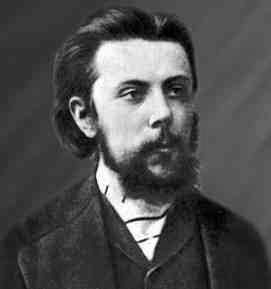
Modest Pyotrovich Mussorgsky
Source: Audio Sparx
Born on 21 March 1839 in Kerova, some sixty miles northeast of modern Belarus, Modest Pyotrovich Mussorgsky composed chiefly operas, choral and orchestral works as well as pieces for solo piano or voice. He was a member the Mighty Handful (The Five) led by Mily Balakirev. The Five (the Пятерка, the Kuchka) were a group of composers who met in St. Petersburg from 1856 to 1870 in the interest of creating national music peculiar to Russia apart from European styles. Other members were Alexander Borodin, César Cui and Nikolai Rimsky-Korsakov.
Mussorgsky's father was a wealthy landowner whose son published his first piano piece, 'Porte-enseigne Polka', at age twelve in 1852. The next year he became a cadet in the School of Guards, graduating to the Russian Imperial Guard in 1856, the year he met Borodin, also in the military. Soon attending soirees held by Alexander Dargomyzhsky, his abilities at piano began to impress such that he resigned from the military in 1858 to pursue music. Easier planned than done, it was needful for him to be employed as a civil servant, which steady status ended in 1867, becoming a supernumerary, leaving him to make a living largely by music alone.
'Porte-enseigne Polka' Modest Mussorgsky
Composed 1852 at age twelve
Piano: Giacomo Scinardo
Mussorgsky composed both the music and librettos for a load of operas, leaving all but one unfinished, meaning that not all the Mussorgsky one might hear may actually be by Mussorgsky, having been completed by others. Mussorgsky's first such incomplete opera was 'Oedipus in Athens' ('Эдип в Афинах') described as incidental music at IMSLP. It was written between 1858 and 1861.
Temple scene: 'Chorus of the People' in 'Oedipus in Athens' Modest Mussorgsky
Abandoned 1861 Completed by Rimsky-Korsakov
Text by V.A. Ozerov from Sophocles
Berliner Philharmoniker / Claudio Abbado Chorus Master: Pavel Kühn
Mussorgsky's 'Salammbô' ('Саламбо' or 'Ливиец') borrowed from Flaubert was left incomplete after working on it from 1863 to 1866. His 'Night on Bald Mountain' was featured in the Walt Disney animation film, 'Fantasia', in 1940. Modest left 'Marriage' ('Zhenitba' or 'Женитьба') unfinished in the summer of 1868. Excerpts from that first saw stage at the Mariinsky Theatre [Wikipedia] in St. Petersburg in 1873. In 'Marriage' a bachelor not up to a lot, namely Podkolyosin, gets picky about finding a wife.
''Night on Bald Mountain' aka 'Night on the Bare Mountain'
Symphonic tone poem by Modest Mussorgsky
Theme: Witches Sabbath on St. John's Eve
Authored St. John's Eve 23 June 1867
Revised for publication by Rimsky-Korsakov in 1886
Radio Filharmonisch Orkest / Markus Stenz
Utrecht, Netherlands 23 Sep 2016
Michael Clive Hollywood Bowl IMSLP LA Phil Terry Rose Wikipedia
''Marriage' Opera by Modest Mussorgsky
Only the vocal score of Act I completed
Finished by Ippolitov-Ivanov
Libretto: Mussorgsky from Gogol's eponymous play of 1842
Performance above directed by Pavel Sorokin
Orchestra of the Rostov-on-Don State Musical Theatre / Alexey Shakuro
Set: Elena Moroz Costumes: Natalia Zemalindinova Lights: Max Maximov
Rostov-on-Don State Musical Theatre 2015
The only opera Mussorgsky finished was 'Boris Godunov'. The libretto again by Mussorgsky refers to the Tatar (Chet) Tsar of Russia from 1598 to 1605 following Ivan IV. The first version was written from October of 1868 to December of 1869, performed at the Mariinsky Theatre in 1870. The second version [audio] went down at the Mariinsky Theatre on 27 January 1874. Godunov assumed the throne in 1598 upon the death of Ivan's son, Fydor I, seven years after the death of his younger brother, Dmitry, who, legend has it howsoever true or not, was murdered by Godunov in order to acquire the throne in his place. Godunov died of stroke in April of 1605, succeeded by his son Fydor II. The opera opens with Godunov accepting the throne of Russia, but ends with him dying of madness as a false Dmitry invades Moscow.
''Boris Godunov' Opera by Modest Mussorgsky 1872
Libretto: Mussorgsky
Performance above:
Bolshoi Theatre Chorus & Orchestra / Boris Khaikin
Boris: Yevgeny Nesterenko
IMSLP John Lanigan-O'Keeffe LA Phil NPR Opera Online Wikipedia
Later in 1874 Massorgsky finished another of his best-known works, 'Pictures at an Exhibition', a suite of ten movements for piano in honor of a friend of his who had died the year before, the artist, Viktor Hartmann. Each movement refers to a painting by Hartmann. Among songs that Mussorgsky set were four poems by Arseny Golenishchev-Kutuzov in 'Songs and Dances of Death' in1875.
''Pictures at an Exhibition' Pieces for piano by Modest Mussorgsky 1874
Piano: Jose Andres Navarro Silberstein
Classic FM Galaxy Music Notes IMSLP WikipediaHartmann's exhibition: Good Music Guide Houston Symphony Colin Kelly
''Pictures at an Exhibition' Pieces for piano by Modest Mussorgsky 1874
Orchestrated by Ravel in 1922
NYO-USA / David Robertson / Carnegie Hall on 22 July 2014
IMSLP WikipediaHartmann's exhibition: Good Music Guide Houston Symphony Colin Kelly
'Serenade' from 'Songs and Dances of Death' No.2 of 4
Song setting by Modest Mussorgsky 1875
Poems of Arseny Golenishchev-Kutuzov
Piano: Vladimir Krainev Bass: Yevgeni Nesterenko
Texts Wikipedia
The writer(s) at Wikipedia trace Mussorgsky's songs to as late as 1879 when he set 'Song of the Flea' from Goethe's 'Faust' written from 1772 to 1831:
'Song of the Flea' Song setting by Modest Mussorgsky 1879
From Goethe's 'Faust' authored 1772-1831
Piano: Ken Smith Bass-baritone: Mark S. Doss
Liederabend Musical Musings Text
In 1880 Mussorgsky was resigned from the civil service altogether, alcoholism making him unable to function. Mussorgsky is the first composer in these histories notable for considerable use of alcohol, a love of drink that had begun in the military. Armies had been marching for centuries on mead or beer, and militaries in general promoted such as drunken Saturday nights as bravado. Mussorgsky's Imperial Guard was notable in such during his two years in its service back in 1856-58. As well, liquor was interwoven with the Russian "romantic" lifestyle. Mussorgsky drank such as cognac and vodka, but his taste for wine was preceded by Beethoven who may have developed cirrhosis of the liver for it. Other big drinkers of wine were Liszt and Brahms, lending rise to the phrase, "Let's get Brahms and Liszt" for "Let's get drunk". Others known to have liked their wine were Rossini and Schumann.
Associates and friends raised funds to keep Mussorgsky going, particularly to finish works in progress. One of those was the opera, 'Khovanshchina', which Modest nevertheless abandoned in 1880, leaving the greater part of the vocal score finished, but little of the orchestration. This work saw completions by Rimsky-Korsakov (1883), Stravinsky with Ravel (1913), as well as Shostakovich (1959). Set in Moscow in the year of 1682, 'Khovanshchina' concerns the fatal rebellion of Prince Ivan Khovansky [Wikipedia] against the new nobility of Peter the Great and his older sister, regent Sophia.
'Khovanshchina' Opera by Modest Mussorgsky
Abandoned 1880 w much of the vocal score complete but little orchestration
Performance above orchestrated by Shostakovich in 1959
Libretto by Mussorgsky
Performance above conducted by Valery Gergiev
Prince Ivan Khovansky: Sergey Aleksashkin
Kirov Theater in Leningrad 25 Nov 1960
John Henken John Mangum Marianne Williams Tobias Wikipedia
Not long after Mussorgsky left the civil service he endured four seizures, then died on 28 March 1881, having drank himself to death at age forty-two.
Sources & References for Modest Pyotrovich Mussorgsky:
Classical Net VF History (notes) Wikipedia English
Alcohol and classical composers:
BBC Music (various)
Desiree Ho (Beethoven and Mussorgsky)
Joseph W. Lewis (Mussorgsky / What Killed the Great and Not So Great Composers? / AuthorHouse / 2010)
Ludwig Van (various)
Music Spoke (Mussorgsky)
Audio of Mussorsky: Corpora:
Audio of Mussorsky: Individual:
Night on Bald Mountain (1867 / revised by Rimsky-Korsakov 1886 / Stokowski Symphony Orchestra / Manhattan Center in NYC 14 April 1953)
Compositions: Corpora:
All Music (by title w dates)
Classic Cat (by title w dates)
IMSLP (by date / genre / title)
(by date / genre / title)Wikipedia English (by date / genre / title)
Documents: Gallica
The Five (The Mighty Handful: Balakirev / Borodin / Cui / Mussorgsky / Rimsky-Korsakov 1856-70)
Britannica Austin M. Doub (Cedarville University / 2019)
Kseniia Tereshchenko Ella Uren (Northern Michigan University / 2020)
Wikipedia Russian Wikipedia Spanish
Iconography: Find a Grave Wikimedia Commons
Recordings of Mussorgsky: Catalogs:
45 Cat Arkiv DAHR (shellac / 1911-47) Discogs Music Brainz RYM
Scores / Sheet Music:
Musicalics (vendor)
Further Reading:
Anastassia Boutsko (Musical Serendipity / Mussorgsky's friendship w Rimsky-Korsakov / 2014)
IMDb (usage of Mussorgsky in film)
Bibliography: Damian Thompson (Brahms’s Benders [Brahms and alcohol] / 2016)
Authority Search: Deutschen Nationalbibliothek
Other Profiles:
Encyclopedic:
Larousse (Français)
Musical:
Symphozik (Français)
Wikipedia: Deutsch Español Français
Classical Main Menu Modern Recording
|
|
About Contact Privacy