
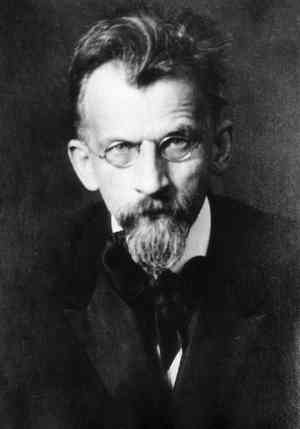
Hans Erich Pfitzner
Source: Music Douban
Born in Moscow on 5 May 1869, Hans Erich Pfitzner was taken with his family to Frankfurt at age three where he would grow up to become a composer of works for stage, chamber, orchestra and voice with piano. He received training in violin from his father who was a professional violinist, and began composing at age eleven. His earliest known works are songs dating from 1884. Pfitzner studied at the Hoch Conservatory from 1886 to 1890 during which period his Op 1 arrived per 'Cello Sonata' in F sharp minor with four movements in 1888 toward publication in 1892.
'Cello Sonata' Op 1 No.4 in F-sharp minor Hans Pfitzner
Comp 1888 Pub 1892 Leipzig by Breitkopf und Härtel
Cello: Roger Lebow Piano: Gayle Blankenburg
Upon graduation from Hoch Conservatory Pfitzner taught piano and theory at the Koblenz Conservatory until becoming conductor at the Staatstheater Mainz in 1894. Known more for his musical dramas than anything else, Pfitzner's first opera was 'Der Arme Heinrich' ('Poor Heinrich') WoO 15 premiering at the Staatstheater Mainz on 2 April 1895 with a libretto by James Grun from the 12th century eponymous poem by Hartmann von Aue ['Encyclopedia Americana' / Wikipedia]. This tale concerns one terminally ill Knight Heinrich whose only way to become well, or so says a highly regarded monk, is through sacrifice of a virgin. One Agnes volunteers, but is her death really the only way to save Heinrich?
'Der Arme Heinrich' ('Poor Heinrich') WoO 15 First opera by Hans Pfitzner
Comp 1890-94 Premiere 2 April 1895 in Mainz Pub 1895 in Frankfurt by B. Firnberg
Libretto: James Grun
Philharmonische Orchester Dortmund / Alexander Rumpf 2000
Agnes: Michaela Kaune Heinrich: Norbert Schmittberg
IMSLP Robert Layton Libretto Naxos Michael Oliver Score (autograph) Wikipedia
Come 'Die Rose vom Liebesgarten' with another text by Grun on 9 November 1901. 'The Rose from the Garden of Love' concerns one Siegnot to whom the Star Maiden gives a magical rose whilst appointing him guardian of the Spring Gate of the Garden of Love. But Siegnot gives the rose to the elf queen, Minneleide, with whom he has fallen in love. Too bad, because she is blinded by the light of the Garden and can't open its Spring Gate with the rose until she renounces her Elven kingdom. In events which follow Siegnot dies upon Minneleide's inability to deliver the rose into the light of the Garden. But she will try again, knowing Siegnot trusted her, and the Star Maiden prefers Siegnot alive.
'Minneleide ruft' ('Minneleide Calls') WoO 16 Second opera by Hans Pfitzner
From the opera 'Die Rose vom Liebesgarten' ('Rose of the Garden of Love')
Comp 1897-1900 Premiere 9 Nov 1901 in Elbergeld Pub 1901 in Berlin by Deneke
Libretto: James Grun
Stuttgart Radio Symphony Orchestra / Bertil Wetzelsberger May 1950
Soprano: Lore Wissmann
IMSLP Libretto Wikipedia Deutsch Wikipedia English
Songs during this period include Pfitzner's '5 Lieder' Op 11 published in 1902, of which 'Gretel' No.5 is quite popular.
'Gretel' Op 11 No.5 Song by Hans Pfitzner
From '5 Lieder' Op 11
Pub 1902 in Berlin by Max Brockhaus
Lyrics: Carl Busse
Piano: Paul Ulanowsky Soprano: Lotte Lehmann
Pfitzner served as kappellmeister at the Theater des Westens in Berlin from 1903 to 1906. He obtained directorship of the conservatory in Strasbourg in 1908. On 10 June of 1912 Pfitzner recorded 15 piano rolls for Duca beginning with #1162 that is the song 'Michaelskirchplatz' ('Michael's Church Square') which is No.2 of '2 Lieder' Op 19 published in 1906. Fourteen pieces follow to #1177 which is 'Knecht Ruprecht's Song' from Pfitzner's opera 'Das Christ-Elflein' of 1906. Gemini suggests a few other piano rolls punched by Pfitzner, including for Welte-Mignon in 1914 and 1923, but Gemini does AI things and I've not been able to confirm such. Gemini mentions Pfitzner recording an arrangement of his 'Das Christ-Elflein Overture' Op 20 in 1922 toward Hupfeld DEA 29910.
Pfitzner also recorded on disc. In December of 1923 he conducted Beethoven's 'Symphony No.6' ('Pastoral') Op 68 toward issue on Deutsche Grammophon / Polydor 69642 through 69647. Those being acoustic recordings, he later documented an electrical version in 1930. Pfitzner also recorded his own 'Das Christ-Elflein Overture' acoustically in 1924 toward Polydor 65936.
As indicated, Pfitzner also made electrical recordings. In 1928 he conducted Beethoven's 'Symphony No.1' toward issue on Deutsche Grammophone / Polydor 95093, 95094 and 95095 [Naxos]. Beethoven's 'Symphony No.4' also went down in 1928 toward Deutsche Grammophone / Polydor 95096 through 95100. It was Beethoven's 'Symphony No.3 ('Eroica') Op 55 in 1929, issued on Polydor 66939 through 66944. In early June of 1931 Pfitzner put away several piano pieces toward issue on Electrola DB 4448 and DB 4449: 'An den Mond' Op 18, 'Einsame Nadeln' Op 26 No.2, 'Sehnsucht' Op 10 No.1 and 'Zum Abschied meiner Tochter' Op 10 No.3. Also during those first several days in June Pfitzner conducted the Preludes of Acts 1-3 of 'Palestrina' toward release on Electrola / HMV DB 4443 and DB 4444. In 1933 Pfitzner conducted Beethoven's 'Symphony No.8' Op 93 toward issue on Polydor 27311 through 27313. It was circa 1944, yet World War II, when Pfitzner conducted Carl Martin Reinthaler 'Das Käthchen von Heilbronn Overture' Op 17 in a film directed by Walter Felsenstein for the Reichsfilmarchiv. All information above concerning recordings by Pfitzner is per Google Gemini. I've not confirmed most of it and Gemini is not a credible source, owning a tendency to both confuse and imagine data, as well as contradict itself. More reliable is DAHR which has Pfitzner recording symphonies by Robert Schumann and Beethoven in 43 sessions from 1926 into 1930 for Brunswick.
Among Pfitzner's numerous literary works was 'Vom musikalischen Drama: Gesammelte Aufsätze' ('On Musical Drama: Collected Essays') of 1915 in which he elaborated on his position as a successor to his cultural and musical hero, Richard Wagner.
It was yet World War I when Pfitzner premiered the work for which he is best-known at the Prinzregententheater in Munich on 12 June 1917, his opera, 'Palestrina' with libretto by himself borrowed from a legend about the 16th century composer, Palestrina.
'Prelude' to Act 1 of 'Palestrina' WoO 17 Third opera by Hans Pfitzner
Comp 1912-15 Premiere 12 June 1917 in Munich Pub 1916
Libretto: Pfitzner
Berliner Philharmoniker / Ferdinand Leitner
IMSLP Libretto Rodoni Wikipedia
PFitzner's comic opera 'Das Christ-Elflein' ('The Christ-Elf') premiered in Dresden on 11 December 1917. He had first composed this in 1906 as incidental music for Ilse von Stach's eponymous play. Critics have found this opera to be but silly. It is Christmas, thus time to chop down a Christmas tree to celebrate, during which process Elfein acquires a soul from the Christ Child and becomes Christ-Elfein as his friend, an old tree spirit named Tannengreis, comes to not wholly dislike humans.
'Tannenjunker!' ('Fir Tree Elves!') Op 20 Fourth opera by Hans Pfitzner
From Act 1 of 'Das Christ-Elflein' ('The Christ-Elf')
Libretto: Ilse von Stach
Premiere 11 Dec 1917 in Dresden Pub 1918
Munchner Rundfunkorchester / Claus Peter Flor
Upon the annexation of Alsace by France after World War I Pfitzner lost his position in Strasbourg. In 1923 he was in the hospital for gall bladder surgery when he was visited by Adolf Hitler. As Pfitzner voiced disagreement with Hitler's negative view of Jewish philosopher, Otto Weininger, their dialog came to more harm than good for Pfitzner. Pfitzner didn't recognize it at the time, but his career saw various interferences and he was considered a Jewish sympathizer, if not a Jew, until an investigation showing otherwise was made. Pfitzner continued his career in Germany while at once largely ignorant that he wasn't as favored as he presumed. What kept him in business while at once compromised was his notion of romantic German heroism a la Wagner and his reactionary view of the Weimar Republic which he deemed decadent, thus welcoming the rise of National Socialism. There were reasons to believe that Pfitzner was reluctant to tow the Party line when it came to Jews. He made at least one intercession, kept Jewish associations and was disinclined to denounce certain Jewish personages. However, Pfitzner did reason Jewry to be ideologically and racially antithetical to German aspirations and was apathetic overall to their plight, rationalized as needful to the greater glory of humankind wrought by German culture. Those Jews he favored were exceptions, to be determined by himself, to the general rule. Though Pfitzner never joined the National Socialist Party he aligned himself to the same as a musical propagandist of National Socialism to further, not only romantic idealism, but his career. He was the composer of the Third Reich and that was his motivation. During Nuremburg denazification Pfitzner was referred to as one of the greatest criminals of all for having helped to inspire those sentiments by which the Nazis waged war and cleaned the world of Jews. But there was no law against raising patriotic fervor. In the end, World War II left Pfitzner's home a ruin, after which he lived in a residence for the elderly until his death on 22 May 1949. His last completed Opus was 56 assigned to 'Fantasie' in A minor for orchestra with a date of 1946-47. He'd left his cantata, 'Urworte Orphisch' Opus 57 unfinished, to be completed by Robert Rehan.
'Liebesmelodie' ('Love Melody') Op 39 Fifth and final opera by Hans Pfitzner
From 'Das Herz' ('The Heart')
Premiere 12 Nov 1931 at both the Staatsoper in Berlin and the Nationaltheater in Munich
Pub 1931 in Berlin by Adolph Fürstner
Libretto: Hans Mahner-Mons
This recording: Pfitzner conducts the Berlin Philharmonic Orchestra probably 1932
Issued on Grammophon 25273: eBay Gripsweat Record Vault
Carl Martin Reinthaler's 'Das Käthchen von Heilbronn Overture' Op 17
Hans Pfitzner conducts the Munich Philharmonic Orchestra Film 1944
Incidental music by Reinthaler published 1905 in Berlin by Ries & Erler
'Sextet' Op 55 in G minor Hans Pfitzner
From 'Das Herz' ('The Heart')
Premiere 12 Nov 1931 at both the Staatsoper in Berlin and the Nationaltheater in Munich
Pub 1931 in Berlin by Adolph Fürstner
Scored 1945 for clarinet / violin / viola / cello / contrabass / piano Pub 1947
Clarinet: Sergey Muninkin Violin: Alexandra Demchenko Viola: Tatiana Krylova
Cello: Pavel Vorobyov Contrabass: Igor Kukuev Piano: Elena Yakovleva
'Fantasie' Op 56 in A minor Hans Pfitzner
Comp 1946-47
Bamberger Symphoniker / Werner Andeas Albert Violin: Walter Forchert
'Urworte Oterphisch' ('Primal Words Orphic') Op 57 Hans Pfitzner
Incomplete upon Pfitzner's death in 1949 Finished by Robert Rehan 1949
From Goethe's poem 'Urworte Orphisch' of Oct 1817 pub 1820
Five themes:
1. Dämon (Daemon or Soul)
2. Tyche (Chance)
3. Eros (Love)
4. Ananke (Necessity)
5. Elpis (Hope)
Chor und Symphonieorchester des Bayerischen Rundfunks / Eugen Jochum
Pfitzner had been a Romantic composer decidedly not a modernist, finding the popular progressive music which Jews were composing during the Weimar Republic both conformist and decadent. Nor did Pfitzner have any use for American jazz. The Roaring Twenties had been as decadent in America as the Weimar Republic in twenties Germany, and Pfitzner thought a few Jews in the entertainment industry were exploiting a lot of negroes. What he actually thought concerning Jews may never be resolved because he himself may have never come to a complete resolution on the matter, despite his anti-Semitic invectives and written intellectual rationalizations. Pfitzner had been pumped on romantic idealism, National Socialism its convenient manifestation in the real world, the glories of which made the Jewish purge to later arise a little easier for Germans to follow. But for Nazi pressures and the need of a livelihood amidst such a zeitgeist, Pfitzner likely could have done without both National Socialism and its campaign against Jews. Yet, being not so heroic as his musical ideal, he didn't. A life of limousine transport and chatter with leading German figures was tempting honey. Though works of his were highly regarded by such as Gustav Mahler and Richard Strauss, Pfitzner has generally been regarded as a barely minor composer. He occupies a post-Romantic position neither utterly conservative nor quite modern either.
Sources & References for Hans Erich Pfitzner:
Wayne Reisig (All Music) VF History (notes) Wikipedia Deutsch Wikipedia English
Audio of Pfitzner: Corpora:
Classical Archive Europeana Hyperion Internet Archive MuziekWeb Naxos
PrestoAuthorship:
Vom musikalischen Drama: Gesammelte Aufsätze (On Musical Drama: Collected Essays / 1915):
Google Books HathiTrust Internet Archive
Compositions:
(by Opus)IMSLP (alphabetical)
IMSLP (by Opus / WoO)
Klassika (by date / genre / Opus / title)
Mahler Foundation (by genre)
MusiclandBW (lieder)
Rate Your Music (by genre)
Wikipedia Deutsch (by genre)
Wikipedia English (by genre)
Wikipedia English (by genre)
Wikipedia Français (by genre)
Wikipedia Italian (by genre)
Iconography: Wikimedia Commons
Lyrics / Texts: Emily Ezust (LiederNet) Oxford Lieder
Recordings of Pfitzner: Catalogs: Arkiv Music
Discogs Klassika Music BrainzRecordings of Pfitzner: Select:
Palestrina (Bavarian State Orchestra & Opera Chorus / Joseph Keilberth / Orfeo 515993 / 3 CDs / 1963)
Palestrina (Bavarian State Opera Simone Young / 2010)
Scores / Sheet Music:
(vendor / Amazon subsidiary) (vendor) (vendor / Europe)Further Reading:
Adolph Hitler (1889-1945 / Chancellor and Führer of the Greater German Reich):
Biography Britannica History UK History US Jewish Virtual Library Wikipedia
Mahler Foundation (Pfitzner and Mahler)
Music and the Holocaust (Pfitzner and Nazism)
National Socialism (Nazism): Britannica Richard J Evans Wikipedia
Max Nyffeler (Hans Pfitzner, the Indigestible / 2007)
The Third Reich: Britannica Ron Rosenbaum Smithsonian
Weimar Republic (1918-1933):
Alpha History Britannica Deutsche Welle Encyclopedia
Facing History History The Holocaust Explained Wikipedia
Wikipedia Deutsch (students)
ZBW Press Archives (newspapers)
Bibliography:
Ludwig Bieler (Hans Pfitzner's "Palestrina" / Studies: An Irish Quarterly Review / Vol 64 No.253 / 1975)
Marc Weiner (Undertones of Insurrection: Music and Cultural Politics in the Modern German Narrative / Taylor & Francis / 2017)
Other Profiles:
(Find a Grave)
Classical Main Menu Modern Recording
|
|
About Contact Privacy