
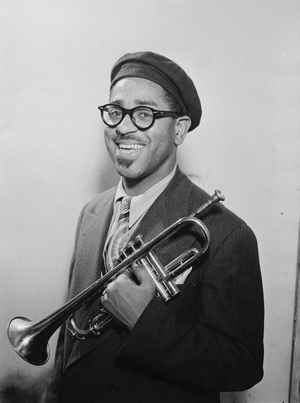
Dizzy Gillespie
Source: Rate Your Music
Born John Birks Gillespie on 21 October 1917 in Cheraw, South Carolina, trumpeter Dizzy Gillespie was to bebop what Miles Davis was to cool jazz. Born the youngest of nine children, Gillespie had begun playing piano at age four. He was well into trombone and trumpet by age twelve. He was later a student at the Laurinburg Institute on scholarship. Gillespie's first professional position was in 1935 with the Frank Fairfax Orchestra. He next joined Eddy Hayes' outfit, before replacing Roy Eldridge in Teddy Hill's orchestra. His first recorded solo, 'King Porter Stomp' (Bluebird B6988 with 'San Antone' flip side), was with Teddy Hill's band on 17 May 1937 in New York City [Lord]. That initial session also saw 'Blue Rhythm Fantasy' (Bluebird B6989) with 'I'm Happy, Darling, Dancing with You' sung by Bill Dillard flip side. Hill and Gillespie also supported Dillard on 'Yours and Mine' / 'I'm Feelin' Like a Million' (Bluebird B7013).
'King Porter Stomp' Dizzy Gillespie w Teddy Hill & His Orchestra
Fifth track of Gillespie's first-known session
17 May 1937 in NYC Matrix 010210-1 Bluebird B6988
Trumpet: Gillespie / Shad Collins / Bill Dillard Trombone: Dicky Wells
Clarinet / alto sax: Russell Procope / Howard Johnson
Tenor sax: Robert Carroll / Teddy Hill
Guitar: John Smith Piano: Sam Allen
Bass: Richard Fullbright Drums: Bill Beason
Composition: Jelly Roll (Ferdinand) Morton 1923
In 1939 Gillespie replaced Doc Cheatham in Cab Calloway's orchestra, first recording with Calloway on 30 August 1939, after which he joined Lionel Hampton's band for tracks on 11 September 1939. Gillespie kept with Calloway's operation for a couple of years, their final recording session on 10 September 1941. Unfortunately Gillespie and Calloway didn't get along. Gillespie had a sense of humor that Calloway found irritating. In the summer of 1941 the two eventually went to fisticuffs while rehearsing for a concert. Gillespie pulled a switchblade on Calloway, who had punched him during an argument that had exploded over someone tossing a spitball. Christopher Popa identifies that someone to have been Milt Hinton. A later interview with Calloway, however, identifies the culprit as Jonah Jones. Whichever the case, Gillespie managed a couple of superficial wounds before they were pulled apart. Gillespie was, of course, fired from Calloway's band, after which Gillespie found more peaceful work composing big band music for such as Woody Herman and Jimmy Dorsey. He had already held his first sessions as a leader at Minton's Playhouse in New York City in May of 1941, recording 'Star Dust' twice and 'Kerouac'.
'Hot Mallets' Dizzy Gillespie w Lionel Hampton & His Orchestra
Gillespie's third-known session
11 Sep 1939 in NYC Matrix 041408-1 Victor 26371 / RCA Victor EJB100
Trumpet: Gillespie
Alto sax: Benny Carter (arrangement)
Tenor sax: Coleman Hawkins / Chu Berry / Ben Webster
Guitar: Charlie Christian Piano: Clyde Hart Vibes: Hampton
Bass: Milt Hinton Drums: Cozy Cole
Composition: Hampton
'Pickin' the Cabbage' Dizzy Gillespie w Cab Calloway & His Orchestra
8 March 1940 in NYC Matrix WC-2983-A Vocalion 5467 / CBS 62950
Trumpet: Gillespie / Mario Bauza / Lammar Wright
Trombone: Tyree Glenn / Quentin Jackson / Keg Johnson
Alto sax: Jerry Blake (clarinet) / Hilton Jefferson / Andrew Brown (baritone)
Tenor sax: Chu Berry / Walter Thomas
Guitar: Danny Barker Piano: Benny Payne
Bass: Milt Hinton Drums: Cozy Cole
Composition: Gillespie
'Stardust' Dizzy Gillespie
One of two recordings of 'Stardust' made at Minton's Playhouse in NYC in May 1941
See Musidisc 30JA5122 (France) / Estoteric ESJ4
Trumpet: Gillespie Bass: Nick Fenton Drums: Kenny Clarke
Composition: Hoagy Carmichael
In 1942 Gillespie worked with Ella Fitzgerald, then Earl Hines. He then joined Billy Eckstine's orchestra until 1945. Gillespie had begun pulling away from the big band sound while with Hines, starting to compose for small combos, and what would soon come to be called bebop. Gillespie's 'A Night In Tunisia', composed in 1942 though not recorded until January 1944, is among the earliest examples of such. Other of bebop's preeminent early masters were Coleman Hawkins and Charlie Parker. The term, "bebop" is said to have arisen as a result of Gillespie's scat singing: when fans didn't know the name of a song they would ask for "bebop" which the press picked up. Also called "rebop," "bebop" was common by 1945, Gillespie's collaborations with Parker ensuring that. Per the Town Hall concert in New York City below, only the first seven tracks were recorded in NYC on 22 June 1945. Discogs and Lord have the rest of the album below filled out with dates in Hollywood on 10 December 1945 and 24 January 1946 ('Salt Peanuts'). The last track, 'Blue n' Boogie', appears to have been recorded first on 5 June 1945 in Philadelphia with Parker (sax), Al Haig (piano), Curley Russell (bass) and Stan Levey (drums). See Comet Records UV 171 and Definitive Records DRCD 11250. Lord has the seven titles of the Town Hall concert alone issued on Uptown UPCD27.51. Credits below are per the Town Hall concert only.
Town Hall Concert Dizzy Gillespie Quintet
22 June 1945 in NYC (first seven titles only) See issues above
Personnel (Town Hall concert only):
Trumpet: Gillespie Alto sax: Charlie Parker
Tenor sax: Don Byas Piano: Al Haig
Bass: Curley Russell Drums: Max Roach / Sydney Catlett
After that period of work with Parker, Gillespie went on to form both smaller combos and larger orchestras. He also often performed with Norman Granz' Jazz at the Philharmonic, seventeen dates from January 28, 1946, at the Philharmonic Auditorium in Los Angeles to November 26, 1966, at Royal Festival Hall in London [Lord]. During that period he also featured with Helen Humes in the film, 'Jivin' in Be-bop', recorded in September [Lord]. Wikipedia has that released in 1947.
'Jivin' in Be-bop' Dizzy Gillespie & His Orchestra Film
Recorded Sep 1946 in NYC Released 1947 On CD per Jazz Up JU-304 (Italy)
Directed by Leonard Anderson / Spencer Williams
Trumpet: Gillespie / Dave Burns / Elmon Wright / Matthew McKay / John Lynch
Trombone: Taswell Baird / Gordon Thomas
Alto sax: John Brown / Howard Johnson
Tenor sax: James Moody Baritone sax: Bill Frazier
Piano: John Lewis Vibes: Milt Jackson
Bass: Ray Brown Drums: Joe Harris
Voice: Gillespie / Helen Humes / Kenny Hagood
In 1947 Gillespie began experimenting with the Afro-Cuban beat. He composed, for example, 'Manteca' with Cuban percussionist, Chano Pozo, in 1947:
'Manteca' Dizzy Gillespie & His Orchestra w Chano Pozo
30 Dec 1947 in NYC Matrix D7VB3090-1 Victor 20-3023
Trumpet: Gillespie / Benny Bailey / Dave Burns / Elmon Wright / Lamar Wright
Trombone: Ted Kelly / William Shepherd
Alto sax: Howard Johnson / John Brown
Tenor sax: Big Nick Nicholas / Joe Gayles Baritone sax: Cecil Payne
Piano: John Lewis
Bass: Al McKibbon Drums: Kenny Clarke Bongos / congas: Pozo
Composition: Gillespie / Pozo
It was 1954 when Gillespie began playing trumpet with an upturned bell, his first manufactured for him that year by Martin. It's said that Gillespie had tested such a trumpet in 1937 and liked the tone. Another account has a couple of dancers crashing into it while it rested on a trumpet stand on stage at Snookie's in Manhattan in January 1953. Gillespie put his trashed trumpet to his mouth and liked what it blew. (Christie's auction house sold Gillespie's first bent Martin for $63,000 in 1995.)
'A Date with Dizzy' Dizzy Gillespie Quintet Italian television 1956
Trumpet: Gillespie Alto sax: Sahib Shihab
Piano: Wade Legge Bass: Nelson Boyd Drums: Charlie Persip
In 1956 Gillespie toured the Middle East, then appeared at the Newport Jazz Festival the following year. That was recorded, as well as nine more appearances at Newport in 1957, 1959-60, 1963-68 and 1972.
'Dizzy's Blues' Dizzy Gillespie & His Orchestra
6 July 1957 at the Newport Jazz Festival in Rhode Island Verve MGV8242
Trumpet: Gillespie / Benny Bailey / Dave Burns / Elmon Wright / Lamar Wright
Trombone: Melba Liston / Al Grey / Chuck Connors
Alto sax: Ernie Henry / Jimmy Powell
Tenor sax: Billy Mitchell / Benny Golson Baritone sax: Pee Wee Moore
Piano: Wynton Kelly Bass: Paul West Drums: Charlie Persip
Composition: A.K. Salim
'DOWNBEAT' magazine inducted Gillespie into its Jazz Hall of Fame in 1960.
Concert in Italy Dizzy Gillespie Quintet Italian television 1960
Trumpet: Gillespie Alto sax: Leo Wright (flute)
Piano: Junior Mance Bass: Art Davis Drums: Teddy Stewart
Concert in Italy Dizzy Gillespie Quintet Television
Jazz 625 Aired 17 Aug 1966
Trumpet: Gillespie Tenor sax: James Moody
Piano: Kenny Barren Bass: Christopher White Drums: Rudy Collins
Circa 1970 Gillespie began to involve himself with the Bahá'í Faith. In 1979 he published his autobiography, 'To Be or Not to Bop' with assistance from writer, Al Fraser.
Concert in Denmark Dizzy Gillespie Television
4 Nov 1970 Tivoli Gardens Concert Hall in Copenhagen
Trumpet: Gillespie / Benny Bailey / Art Farmer / Dusko Goycovich / Idrees Sulieman
Trombone: Nat Peck / Ake Persson / Erik van Lier
Alto sax: Tony Coe / Derek Humble
Tenor sax: BIlly Mitchel / Ronnie Scott Baritone sax: Sahib Shihab
Piano: Francy Bolland Bass: Jimmy Woode Drums: Kenny Clarke
Montreux Jazz Festival Dizzy Gillespie Big 7
16 July 1975 Switzerland
Trumpet: Gillespie Tenor sax: Eddie "Lockjaw" Davis / Johnny Griffin
Piano: Tommy Flanagan Vibes: Milt Jackson
Bass: Niels-Henning Ørsted Pedersen Drums: Mickey Roker
This album on Pablo Records 2310 749: Discogs Wikipedia
During the eighties Gillespie led the United Nations Orchestra. In 1989 he is proposed to have given 300 performances in 27 countries, appeared on three television specials, performed with two symphonies and recorded four albums. One busy musician. France also made him Commandeur de l’Ordre des Arts et des Lettres in 1989, in addition to receiving a Grammy Lifetime Achievement Award.
Jazz Middelheim Dizzy Gillespie & the United Nations Orchestra Television
1989 in Antwerp, Belgium Aired 13 Feb 1990
Trumpet: Gillespie / Arturo Sandoval / Claudio Roditi
Trombone: Slide Hampton / Steve Turre
Sax: Paquito D'Rivera / James Moody (flute) / Mario Rivera
Piano: Danilo Perez Bass: John Lee
Percussion: Ignacio Berroa / Giovanni Gio
In 1990 Gillespie received the Kennedy Center Honors Award, as well as the Duke Ellington Award given by the ASCAP (American Society of Composers, Authors and Publishers). He was awarded the Polar Music Prize by Sweden in 1993, the year he died of pancreatic cancer on January 6. With a highly prolific 544 recording sessions during his career [Lord], 293 of those his own, Gillespie had performed at Carnegie Hall 32 times and been distinguished with fourteen honorary doctorates. Gillespie's final album is thought to be 'To Bird with Love' recorded at the Blue Note on 25 January 1992. Tom Lord traces Gillespie on trumpet to as late as 'Toreador' on January 31, 1992, per Steve Turre's album, 'Sanctified Shells'.
'Bebop' Dizzy Gillespie
From Gillespie's final album
25 Jan 1992 at the Blue Note in NYC On the album 'To Bird w Love' Telarc CD-83307
Trumpet: Gillespie Tenor sax: Douglas Purviance
Piano: Danilo Perez Bass: George Mraz Drums: Lewis Nash
Composition: Gillespie
This album: Discogs
'Toreador' Dizzy Gillespie w Steve Turre
Gillespie's last-known recording
31 Jan 1992 in NYC On the album 'Sanctified Shells' Antilles 314-514186-2
Trumpet: Gillespie
Trombone: Steve Turre / Clifton Anderson / Reynaldo Jorge / Robin Eubanks
Bass Trombone: Douglas Purviance
Bass: Andy Gonzalez Drums: Ignacio Berroa
Congas: Milton Cardona Castanets: Carmen Turre
Composition: Steve Turre
This album: Discogs
Sources & References for Dizzy Gillespie:
Encyclopedia of World Biography
VF History (notes)
Scott Yanow (All Music)
Audio of Gillespie: YouTube
Autobiography:
To Be or Not to Bop (w Al Fraser / Doubleday / 1979):
Google Books (reissue 2009) Howard University (review by Gregory S. Kearse)
Jazz Journal (review by Ann Morgan) Wikipedia
Compositions: Music Brainz Second Hand Songs Wikipedia
Documentaries:
Dizzy Gillespie (Les Banks / 1964)
Dizzy Gillespie: Innovator of Jazz (2009?)
From Be to the Bop (PBS Carolina Stories / 2017)
Jazz: The Only Way of Life (Jacques Matthey / 2017)
A Night in Havana Dizzy Gillespie in Cuba (1988)
To Bop or Not to Be
(Jan Horne / 1990)
Interviews:
1956
(Person to Person w Edward Murrow / television)
1961
(Studs Terkel / audio / text)
1972
(WTMJ / television)
1973
(Les Tomkins / text)
1982
(One On One w Dick Cavett / television)
1983
(Elaine Grand / television)
1985
(Peter Jacques / television)
1986
(Arthur Dawkins / text)
Recordings: Albums:
ecoustics
Jazz Disco
Musicboard
Wikipedia
Recordings: Catalogs:
45 Worlds
Blue Sounds
Discogs
Dizzy Gillespie Collection
RYM
Recordings: Compilations:
Bebop Story
(Volumes 1-5 / 1937-1942)
Chronological Classics:
1945 - 1946
(1997)
1947 - 1949
(2000)
1949 - 1950
(2001)
The Complete RCA Victor Recordings
(1947-1949 / Bluebird 07863 66528-2 / RCA 07863
66528-2 / 1995)
Dizzy's Diamonds: Best of the Verve Years
(1950-1964 / Verve / 1992)
Recordings: Select:
Bird and Diz
(Clef / 1950)
Recordings: Sessionographies:
DAHR
(1937-1952)
Jan Evensmo / James Accardi
(solography 1937-1947)
Honking Duck
(alphabetical)
Jazz Disco
(1937-1992)
Tom Lord: leading 293 of 544 sessions 1937-1992
Further Reading:
Baha’i World
News Service (Hearing "the Divinity in the music")
Steven Cerra (Dizzy Gillespie: Serious and Showy / 2017)
DOWNBEAT (magazine founded 1934):
DOWNBEAT
Facebook
Wikipedia
World Radio History
(past issues)
Fight with Cab Calloway / summer 1941:
Chicago Tribune
Deseret
Jerry Jazz Musician
NPR
Organissimo
PBS
WLIW
Gene Lees (The Immortal Joker / 1999):
Part 1
Part 2
Part 3
Bibliography:
Scott DeVeaux / The Birth of Bebop: A Social and Musical History / University of California Press / 1999
Alyn Shipton / Groovin' High: The Life of Dizzy Gillespie / Oxford University Press / 2001):
Doug Ramsey
(review)
Other Profiles:
Black Past
Donald Clarke
(Music Box)
Find a Grave
New York Jazz Workshop
Classical
Main Menu
Modern Recording