Tracks are listed in chronological order by year, then alphabetically.
Listings do not reflect proper order by month or day: later oft precedes earlier.
Find on Page = F3. Not on this page? See history tree below.
Featured on this page loosely in order of first recording if not record release (as possible).
Names are alphabetical, not chronological, per year:
| This page concerns American rock in the
sixties. When the Beatles invaded the States in 1964 the strongest line of
defense was only the Beach Boys and Elvis Presley. Rock was treading water
in the early sixties, compared to the stir it had made in the fifties, the
Beatles thus arriving at a perfect time. It would take a few years for
American bands to respond in kind. If you think somebody is missing on this
page they may well be in another section of these histories.
|
||
|
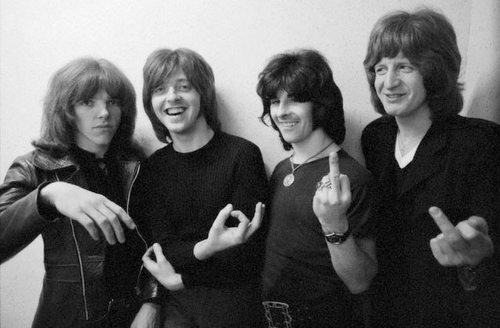
Badfinger was
an Invasion band, basically the same group as the Iveys.
The Iveys had been the first group to
sign up with the
Beatles fledgling Apple record label in
1968. When the Iveys became Badfinger the band
consisted of Mike Gibbins (drums and keyboards), Pete Ham (guitar and
keyboards), Tom Evans (bass and guitar) and Joey Molland (guitar and
keyboards). The name, Badfinger, wasn't precisely what one may think. It was
taken from an earlier title of the
Lennon-McCartney song, 'With a Little
Help From My Friends', namely, 'Bad Finger Boogie', during the composition
of which
Lennon had hurt his index finger at the piano. The band's first
release as Badfinger was the
McCartney composition, 'Come and Get It', in
1970. That made them a sensation right out of the gate in both the United
Kingdom and the States, which equation made them a Top Ten and Twenty band
into 1972, the year they recorded their fourth and last album with Apple,
'Ass'. The band's first release with Warner Brothers was 'Badfinger' in '74.
In December of that year their career was paralyzed for purposes of
litigation when Warner Brothers took their American manager, Stan Polley, to
court for misappropriation of funds. They had just released 'Wish You Were
Here' for Warner Brothers that November, only for it to be pulled off the
market. The group couldn't find any action due legal process and nobody
cared to mess with Warner Brothers. The litigation between Polley and Warner
Brothers would last four years, but when Ham learned there was already no
money for him in April 1975 he became desparate. His last companionship was
the night of that discovery, drinking whiskey with Tom Evans at the White
Hart Pub in Surrey. He hung himself the next morning. Without Ham, Badfinger
dissolved. It was a rude end to a career that was waning but hadn't lost
momentum for the other members as well, they suddenly without coin. Gibbons
managed to stay in the music business, eventually releasing several solo
albums. But both Evans and Molland were working day jobs when they attempted
a comeback in 1979 with 'Airwaves'. 'Say No More' saw release in '81.
Molland then found himself the last party to whom a fellow band member would
speak when on an evening in November '83 he and Evans had an argument over
the phone concerning royalties Evans was receiving apart from others. Evans
hung himself in the garden of his Richmond, England, home the next morning.
Gibbons and Molland took Badfinger into the latter eighties until Gibbons
called it a take in August of '89. Molland wore the Badfinger moniker a bit
longer before turning to a solo career that saw the release of a few solo
albums into the new millennium. Several live performances below. Badfinger 1970 Television performance Badfinger 1971 Music video Badfinger 1972 Television performance Album Badfinger 1973 Television performance Badfinger 1974 In the Meantime Some Other Time Badfinger 1979 Filmed live
|
Badfinger |
|
|
Toe Fat |
Toe Fat is a
continuation of the career of Cliff Bennett in UK Beat. Cliff Bennett, most famous in
association with the
Rebel Rousers,
formed Toe Fat the year following the disbanding of the Cliff Bennett Band in 1968. Toe Fat released only
two albums, 'Toe Fat' (1970) and 'Toe Fat Two' (1970), but the group toured
in America as the opening act for Derek & the Dominoes, formed by
Eric Clapton in 1970. After Toe Fat disbanded (two members of which would move
onward to form
Uriah Heep with a couple members of
the Gods) Bennett released the album, 'Rebellion', in 1971. Albeit a
well-regarded compilation of previously released music, it served as
something of a summary to
Bennett's career. Though he afterward sang with the band, Shanghai, he then
dropped out of the music business, entering the shipping industry to
became a rich man. Bennett would revive the
Rebel Rousers about a decade
later in the eighties. Cliff Bennett & Toe Fat 1970 Album Cliff Bennett 1971
|
|
|
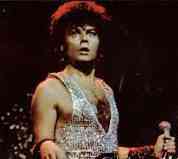
Paul Raven, born Paul Francis Gadd in 1944
in Banbury, Oxfordshire, changed his name to
Gary Glitter in 1971. Such as 'Rock And Roll Part
1 & 2', 'I Didn't Know I Loved You (Till I Saw You Rock And Roll)', and the
album, 'Glitter' were issued in 1972. 1973 saw 'Do You Wanna Touch Me (Oh
Yeah)' along with two titles that reached No. 1 in the UK: 'I’m the Leader
of the Gang (I Am)' and 'I Love You Love Me Love'. Glitter's first tour of
the United States followed that year. Though that tour was to small affect
Glitter was now well on his way to a successful career in glam rock. But by
1980 his popularity began to wane, which he countered with an autobiography
in 1981: 'The Leader'. He then worked in various venues such as the annual
winter Gangshow tour. Such was an oldies circuit, which fate Glitter seemed
to accept as inevitable. But the tours became popular into the nineties,
Glitter eventually able to fill Wembley Stadium in London (capacity 90,000).
He continued recording into the new millennium, his last studio album, 'On',
released in 2001. But his career was sunk by that time. In 1997 Glitter had
been arrested for child pornography after taking his Toshiba laptop to a PC
World computer repair shop in Bristol. He served four months in 1999. His
arrest, however, brought forth allegations of child abuse by other females.
He was arrested and acquitted, then bought a $70,000 yacht and left Great
Britain for Cuba. Next traveling to Cambodia, he lived there until new
allegations of child abuse arose, hence his move to Vietnam in 2004. He was
then arrested for sex with two underage girls and served two years and nine
months of miserable time at the Thu Duc jail. Upon release Glitter was
deported to London. He kept a low profile until his 2012 arrest for sex with
several underage girls between 1975 and 1980 per Operation Yewtree, a
nation-wide hunt after sex offenders largely in the entertainment industry
in the UK. He was sentenced to sixteen years in February 2015. His appeal is
in process as of this writing. His earlier bio as
Paul Raven and Paul Monday is in
UK Beat. Gary Glitter 1972 Album Filmed live Gary Glitter 1973 Filmed live Filmed live Filmed live Gary Glitter 1975 Gary Glitter 1990 Filmed live at Portsmouth Gary Glitter 1991 Filmed concert
|
 Gary Glitter |
|
|
We temporarily suspend this section of the history of early Rock & Roll with Tammi Terrell. We will be making additions as such occur.
|
|
Early Blues 2: Vocal - Other Instruments
Modern Blues 2: Vocal - Other Instruments
Romantic: Composers born 1770 to 1840
Modern: Composers born 1900 to 1950
Early Jazz 1: Ragtime - Bands - Horn
Early Jazz 2: Ragtime - Other Instrumentation
Modern 4: Guitar - Other String
Modern 6: Latin Jazz - Latin Recording
Modern 7: Percussion - Other Orchestration
Modern 8: United States 1960 - 1970
Modern 9: International 1960 - 1970
Early - Boogie Woogie - R&B - Soul
The Big Bang - Fifties American Rock
Total War - Sixties American Rock
Seventies International Rock
Classical - Medieval to Renaissance
Classical - Baroque to Classical
Classical - Romantic to Modern
Jazz Early - Ragtime - Swing Jazz
Jazz Modern - Song - Latin - Percussion - Other
Boogie Woogie - Doo Wop - R&B - Rock & Roll - Soul
Sixties American Rock - Popular
Audio/Video Downloaders/Converters - CD/DVD Burners
Internet Music Poetry Vaping